


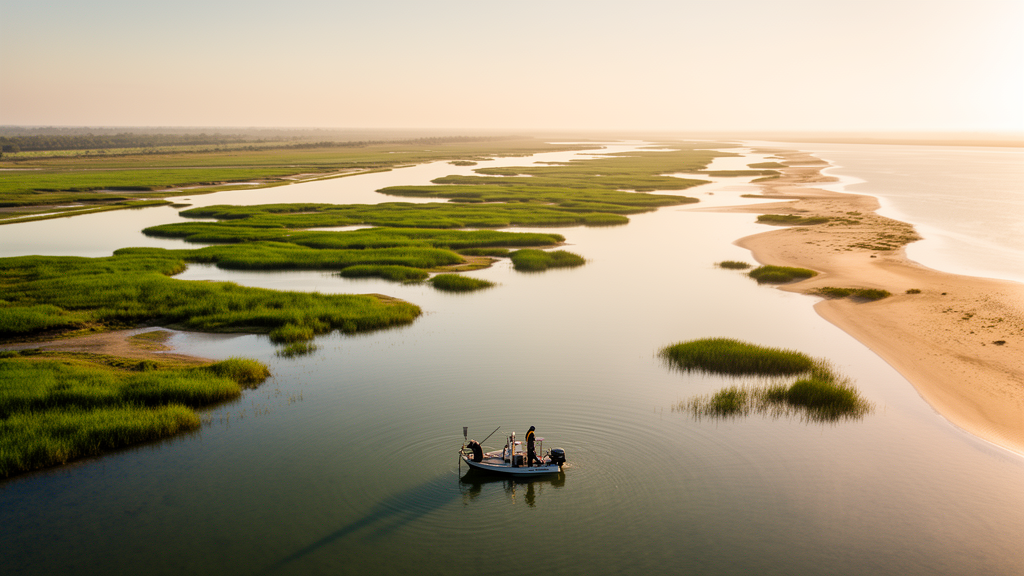
A review and expert workshop conclude that the more than 100 shallow coastal lakes and lagoons of southern Brazil and eastern Uruguay could serve as a globally significant monitoring network for climate variability, land-use change, pollution and eutrophication. The Southern American Coastal Shallow Subtropical Lakes, abbreviated SA-CSSL, extend about 1,000 km along South America’s south-eastern coast but remain underrepresented in international limnological research.
The authors’ perspective synthesizes prior ecological studies and discussions from a workshop held in Porto Alegre from March 31 to April 4, 2025. Twenty participants from universities in Brazil, Uruguay and Germany included nine researchers, eight graduate students and three undergraduate students. The group reviewed past monitoring and ecological assessments, aligned them with ongoing projects, and developed research priorities for microbial ecology, long-term observation and international collaboration. The paper is a review and position article rather than a new field study or an evaluation of a completed monitoring programme.
The Brazilian coastal plain encompassing the SA-CSSL covers approximately 37,000 km², nearly 40% of which consists of lakes and lagoons. The region extends from 30°S to 35°S and includes the Patos-Mirim complex, described as the world’s most extensive coastal lagoon system. Its lakes formed within the passive-margin Pelotas Basin after four major marine transgressions between approximately 400,000 and 5,000 years ago. Their age, shape, isolation and degree of connectivity vary, creating a wide environmental gradient for comparative research.
A defining feature is the presence of large freshwater bodies close to the ocean, an uncommon condition on sedimentary coasts where brackish or saline lagoons are prevalent. Freshwater conditions are associated with high precipitation, aquifers beneath the coastal barrier and substantial river input, including the Guaíba system. Strong winds, mainly aligned northeast to southwest, elongated and segmented the lakes. They are polymictic, with wind continually mixing the water column throughout the year and producing a setting in which atmospheric changes can rapidly affect lake conditions.
Human pressures are already substantial across the region. Lakes range from oligotrophic to hypereutrophic because of urban wastewater and agricultural runoff. Extreme climatic events have also been associated with abrupt changes, including reduced water levels, macrophyte proliferation and eutrophication, especially where marine connectivity is restricted or anthropogenic pressure is high. The authors identify four representative subsystems: the Tramandaí River System, Patos Lagoon System, Mangueira-Mirim System and Uruguayan Lagoon System. Together, these units encompass contrasts in climate, land use, connectivity, population pressure and ecological condition.
The Tramandaí system contains about 40 lakes, most with some connection to one another, and supports more than 265,000 residents, 90% in urban areas. Untreated sewage, agricultural runoff, water withdrawal and invasive species are major pressures. The lakes supply drinking water to at least 17 municipalities while also receiving untreated or partly treated sewage. In Imbé, only 0.5% of domestic effluents were reported as collected and treated, while seasonal tourism can increase the population tenfold. The Patos and Mangueira-Mirim systems add estuarine salinity gradients, extensive agriculture and major urban centres to the range of conditions available for monitoring.
Existing studies illustrate the network’s value for environmental surveillance. Microplastics were measured at 225–240 units per 100 m³ in two larger Tramandaí lakes, with PET, PVC, polypropylene and polyethylene among the polymers analysed. The study did not establish that those four polymers dominated total pollution. Microbial communities associated with the “plastisphere” contained taxa of potential public-health concern, particularly in summer. In the Uruguayan lagoons of Rocha and Castillos, high-throughput sequencing and basin-scale chemical profiling showed that bacterioplankton assemblages were partially structured by gradients of pharmaceuticals, pesticides and endocrine disruptors. Seasonal differences in microbial signatures distinguished contamination levels and included xenobiotic degraders, pathogens and opportunistic pathogens.
Other work has examined fish ecology, macrophyte effects on microbial communities, environmental DNA, cyanobacterial blooms and remote sensing of blooms and water-surface temperature. These studies give the region a substantial interdisciplinary foundation, while the network’s underrepresentation in global datasets remains a limitation. For example, more than 98% of the 8,000 lakes used in one carbon-emissions analysis were outside the tropics. The authors argue that adding SA-CSSL observations could help reduce geographic bias in global carbon budgets and projections, although they did not quantify that effect.
Climate projections cited in the review predict a 15% increase in precipitation in southern Brazil between 2011 and 2040 across all considered human carbon-dioxide-emission scenarios, with similar trends projected for later decades. Greater ENSO variability is presented as a predicted development, not an already established trend. The ecological consequences of the May 2024 Rio Grande do Sul floods, which affected 478 of 497 municipalities and 2.4 million people, remain largely unexplored. The authors also propose a monitoring framework organized around planetary boundaries, together with standardized indicators, GIS-based communication tools and citizen-science approaches.
The review’s central proposal is that the SA-CSSL provide a geographically extensive but not yet fully integrated model for studying how subtropical shallow lakes respond to interacting climatic and anthropogenic pressures. Its value lies in the network’s gradients—from freshwater to intermittently brackish systems and from relatively intact grasslands to urban and agricultural catchments. The proposed framework is not itself evidence that these lakes already function as a continental sentinel system; assessing that role will require coordinated, sustained monitoring and clearer evidence linking observations across the four subsystems.
Subject of Research: Monitoring climate and anthropogenic changes in subtropical coastal shallow lakes across southern Brazil and eastern Uruguay
Article Title: Coastal subtropical Southern American shallow lakes as unique ecosystems for monitoring anthropogenic induced ecosystem changes
Article References: Kluge, M., Shubeita, A., Uchaikina, A., Alonso, C., Herrman, B., Menegotto-Silva, C., Lopes, C., Pagani, D., Marques, D., Moreira-Silva, E., Kristiansson, E., Quintana, I., Cavalcanti, J., Fleck, J., Ribeiro, K., Varghaei, L., Oliveira, L., Rodrigues, L., Ramilo, L., … Medina-Silva, R. (2026). Coastal subtropical Southern American shallow lakes as unique ecosystems for monitoring anthropogenic induced ecosystem changes. One Ecosystem, 11, Article e186107. https://doi.org/10.3897/oneeco.11.e186107
Image Credits: AI Generated
DOI: 10.3897/oneeco.11.e186107
Keywords: shallow lakes, coastal lagoons, Southern Brazil, Uruguay, global change, eutrophication, microbial ecology, ENSO, land-use change, long-term monitoring, Coastal, subtropical
Cite Scienmag News
Morgan Morrow. (October 20, 2026). Review and workshop identify Southern American coastal lakes as a sentinel network for global change. Scienmag. https://scienmag.com/review-and-workshop-identify-southern-american-coastal-lakes-as-a-sentinel-network-for-global-change/
Morgan Morrow. "Review and workshop identify Southern American coastal lakes as a sentinel network for global change." Scienmag, 20 October 2026, https://scienmag.com/review-and-workshop-identify-southern-american-coastal-lakes-as-a-sentinel-network-for-global-change/. Accessed 20 October 2026.
Morgan Morrow. "Review and workshop identify Southern American coastal lakes as a sentinel network for global change." Scienmag. October 20, 2026. https://scienmag.com/review-and-workshop-identify-southern-american-coastal-lakes-as-a-sentinel-network-for-global-change/


