


Global sea level rise is one of the most pressing environmental issues we face today, and new geological research has unveiled critical insights into the historical context of this alarming phenomenon. Recent findings published in the prestigious journal Nature by a collaboration of top researchers in the Netherlands have illuminated the dramatic changes in sea levels following the last ice age, a period approximately 11,700 years ago. This research not only enhances our understanding of past climate events but also provides vital parallels to the climate crisis we face in the present day.
The researchers, from esteemed institutions including Deltares, Utrecht University, and the Netherlands Institute for Sea Research, have meticulously analyzed geological data from the North Sea region. Their focus was on the time frame of the early Holocene, a period marked by rapid climatic transformation and significant sea level fluctuations. By using a unique dataset derived from boreholes in what was once Doggerland—a land bridge that once connected Great Britain to mainland Europe—they were able to reconstruct the historical rates of global sea level rise. This area, now submerged, offers a rare glimpse into the geological past, which is crucial for enhancing our understanding of contemporary changes in sea levels.
The implications of this research are profound. Sea level rose swiftly in the early Holocene due to global warming and the melting of colossal ice sheets that previously covered vast portions of North America and Europe. This event bears a chilling resemblance to the current situation we face today, where rising global temperatures are threatening the stability of ice sheets once again. The accelerating melting process is a stark reminder of how interconnected these systems are, and the need for urgent action to address climate change is more pressing than ever.
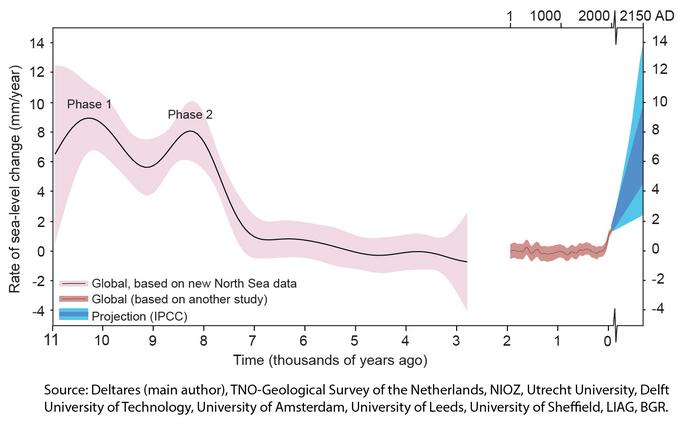
Analyzing the geological evidence allowed researchers to determine that, during two distinct phases in the early Holocene, the rates of sea level rise exceeded one meter per century. These findings are particularly alarming when juxtaposed with current projections from the Intergovernmental Panel on Climate Change (IPCC), which estimates that, if greenhouse gas emissions continue at their current trajectory, sea levels could rise by several meters by the year 2300. While the present average rate of rise is approximately 3 millimeters per year—which translates to about 30 centimeters per century—the expectation of meeting or exceeding the historical rates observed in the early Holocene raises critical concerns for future coastal habitation.
The researchers overcame significant obstacles in obtaining reliable data, given the historical absence of well-preserved geological records from the early Holocene era. The integration of advanced modeling techniques and rigorous dating of submerged peat layers enabled them to clarify long-standing uncertainties about the total sea level rise between 11,000 and 3,000 years ago. Their groundbreaking research revealed a total rise of approximately 38 meters, a figure previously clouded in debate, with earlier estimates ranging from 32 to 55 meters.
As global temperatures continue to increase at an unprecedented rate, this work becomes a foundational benchmark for scientists and policymakers alike. The rapid melting of ice sheets observed today presents a direct threat to millions of people living in low-lying coastal areas. This scenario is markedly different from the past, as the current global landscape is characterized by dense populations, megacities, and critical infrastructure that did not exist earlier in human history.
Consequently, the urgency for enhanced climate adaptation strategies cannot be overstated. The data produced from this research not only contributes to scientific knowledge but also serves as a clarion call for immediate and sustained action towards climate resilience. By understanding the dynamics of past sea level rise, contributions to climate adaptation can be formulated, enabling societies to prepare more effectively for the impactful shifts that lie ahead.
Geologist Marc Hijma, who led the study, states, “With this groundbreaking research, we have taken an important step towards a better understanding of sea level rise after the last ice age.” The study emphasizes how essential careful scientific inquiry is in unraveling the complex interactions between climate, ice sheets, and sea levels. This knowledge equips us with the tools to address the existential threat of climate change head-on, fostering proactive measures that could mitigate the extensive impacts ahead.
The significance of this study extends beyond just historical curiosity. By shedding light on the mechanisms of past climatic phenomena, it establishes a framework for predicting future sea level rise. The urgency for climate-related policies is immense, as the local and global repercussions of inaction could result in dire consequences for contemporary society, particularly for those in vulnerable areas.
The findings underline the need for increased collaborative research efforts across disciplines and geographies. By pooling resources and data, researchers can refine their methodologies and models to ensure accuracy in predictive climate assessments. The historical context of sea level rise is a crucial element of this research landscape, and as our climate continues to change, the fusion of past geological evidence with present-day data will be critical for shaping future responses.
In light of these findings, it is imperative to address the societal implications that accompany rising sea levels. Infrastructure planning and urban development must account for future changes, even as scientists continue to deepen our understanding of the intricate relationships between ice sheets and global climate systems. The integration of scientific insight into public policy frameworks will be essential to navigate the challenges set forth by climate change.
In conclusion, this collaboration illuminates an urgent need for informed debate and action regarding climate adaptation. The staggering rates of sea level rise observed in the early Holocene must serve as a historical lesson, rallying scientists, policymakers, and the public towards a unified goal: to safeguard our planet for future generations while addressing the immediate challenges posed by our changing climate.
Cite Scienmag News
Thomas Green. (March 19, 2025). Understanding Sea Level Rise Following the Last Ice Age: New Insights Unveiled. Scienmag. https://scienmag.com/understanding-sea-level-rise-following-the-last-ice-age-new-insights-unveiled/
Thomas Green. "Understanding Sea Level Rise Following the Last Ice Age: New Insights Unveiled." Scienmag, 19 March 2025, https://scienmag.com/understanding-sea-level-rise-following-the-last-ice-age-new-insights-unveiled/. Accessed 5 September 2026.
Thomas Green. "Understanding Sea Level Rise Following the Last Ice Age: New Insights Unveiled." Scienmag. March 19, 2025. https://scienmag.com/understanding-sea-level-rise-following-the-last-ice-age-new-insights-unveiled/


