


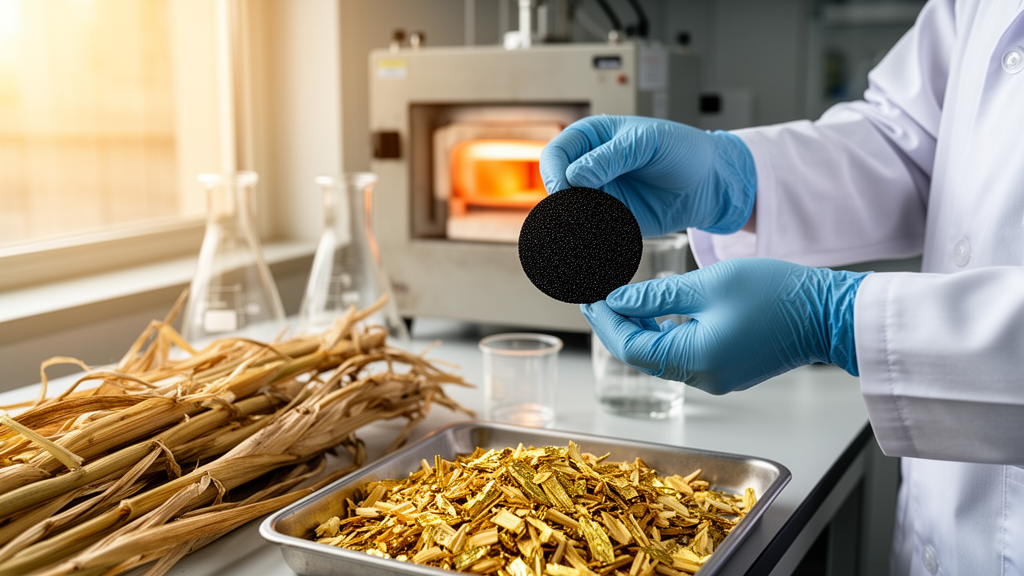
A laboratory materials study reported that a ternary composite made from corn-straw biochar, MXene and manganese dioxide achieved a specific capacitance of 1,049.95 F g−1 per electrode at a scan rate of 5 mV s−1. The findings are summarized in the published abstract of an experimental article in the Journal of Materials Science; the full study was not available for independent assessment.
The researchers constructed the material, designated hCC/Ti3C2Tx@MnO2 (CTM), through sequential hydrothermal compositing of corn-straw biochar, MXene and MnO2. They prepared composites with different amounts of KMnO4 and characterized their phase structure, morphology and electrochemical performance. According to the abstract, the composite contained Ti–O–Mn interfacial bonding, which the authors associated with faster charge transfer and directional electron migration. All of the tested composites reportedly exhibited high specific capacitance and good cycling stability, although the abstract did not provide the number of cycles, retention percentage or other detailed cycling-stability measurements.
Among the tested formulations, CTM-2, produced with a KMnO4 addition of 0.24 g, gave the strongest reported results. Its specific surface area was 1,041.72 m2 g−1, and its surface-capacitive contribution was 0.91. The abstract also reports enhanced conductivity, rate capability and cycling stability, but does not give the numerical values for the latter two properties. These measurements concern laboratory-scale composite electrodes and do not by themselves establish performance in a full commercial supercapacitor or under practical operating conditions.
When CTM-2 was assembled into a symmetric device, the abstract reports a specific capacitance of 192.25 F and a specific capacitance per electrode of 769 F g−1 at a current density of 0.1 A g−1. The authors present the biochar-based composite as a promising electrode material for supercapacitors, but the available abstract does not report energy density, power density, device-level cycling life or comparisons with commercial devices.
Subject of Research: Electrochemical performance of a corn-straw biochar, MXene and MnO2 composite for supercapacitor electrodes
Article Title: Engineering MXene/MnO2 heterojunctions on biomass-derived carbon for enhanced capacitive performance
Article References: Cai, Y., Jin, Y., Zhang, Y., Wei, X., Chen, X., & Xu, Y. (2026). Engineering MXene/MnO2 heterojunctions on biomass-derived carbon for enhanced capacitive performance. Journal of Materials Science, 61(42), 33279-33296. https://doi.org/10.1007/s10853-026-13737-1
Image Credits: AI Generated
DOI: 10.1007/s10853-026-13737-1
Keywords: MXene, MnO2, biochar, supercapacitors, specific capacitance, symmetric devices, electrode materials, hydrothermal synthesis, Engineering, heterojunctions, biomass-derived, carbon
Cite Scienmag News
Denise Maddox. (October 20, 2026). Corn-straw biochar/MXene/MnO2 composite reaches 1,049.95 F g−1 in electrode study. Scienmag. https://scienmag.com/corn-straw-biochar-mxene-mno2-composite-reaches-1049-95-f-g%e2%88%921-in-electrode-study/
Denise Maddox. "Corn-straw biochar/MXene/MnO2 composite reaches 1,049.95 F g−1 in electrode study." Scienmag, 20 October 2026, https://scienmag.com/corn-straw-biochar-mxene-mno2-composite-reaches-1049-95-f-g%e2%88%921-in-electrode-study/. Accessed 20 October 2026.
Denise Maddox. "Corn-straw biochar/MXene/MnO2 composite reaches 1,049.95 F g−1 in electrode study." Scienmag. October 20, 2026. https://scienmag.com/corn-straw-biochar-mxene-mno2-composite-reaches-1049-95-f-g%e2%88%921-in-electrode-study/


