

Tuesday, October 20, 2026
Science
No Result
View All Result
  • Login
  • HOME
  • SCIENCE NEWS
  • CONTACT US
  • HOME
  • SCIENCE NEWS
  • CONTACT US
No Result
View All Result
Scienmag
No Result
View All Result
Home Science News Medicine

Systematic review links robot-assisted gait training to walking gains in children with cerebral palsy

October 20, 2026
in Medicine
Denise Maddox
By Denise Maddox Scienmag Editorial Profile - Mechanical Engineering
Reading Time: 2 mins read
0
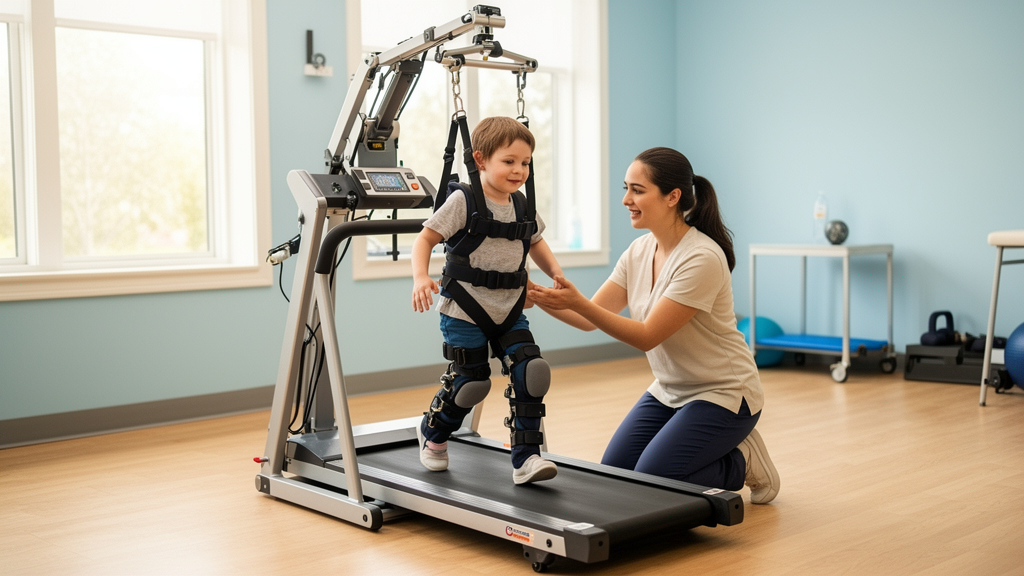
Robot-Assisted Gait Training Helps Children With Cerebral Palsy Walk Faster and Farther

Robot-Assisted Gait Training Helps Children With Cerebral Palsy Walk Faster and Farther

65
SHARES
587
VIEWS
Share on FacebookShare on Twitter
ADVERTISEMENT

A systematic review and meta-analysis reported in the abstract of a BMC Pediatrics article found that robot-assisted gait training was associated with greater improvements in walking speed and 6-minute walk distance than conventional therapy among children with cerebral palsy. The pooled analysis included 22 randomized controlled trials involving 718 children aged 2–18 years. Twenty studies focused on cerebral palsy, two on spinal cord injury, and no studies involving acquired brain injury were identified.

The researchers searched PubMed, Embase, Web of Science, the Cochrane Library, CINAHL and ClinicalTrials.gov from their inception through 1 April 2026. Eligible studies were randomized trials comparing robot-assisted gait training with conventional therapy in children with cerebral palsy or other central nervous system impairments. Risk of bias and methodological quality were assessed with the Cochrane Risk of Bias 2 tool and the PEDro scale. Random-effects meta-analysis calculated mean differences or standardized mean differences, and GRADE was used to assess the certainty of evidence.

For walking speed, the pooled standardized mean difference was 0.58 (95% confidence interval, 0.18 to 0.98; P = 0.005). The 6-minute walk distance improved by a pooled mean difference of 38.68 metres (95% CI, 22.61 to 54.75; P < 0.00001). The abstract rated the evidence for both outcomes as high certainty. An exploratory analysis of two studies also suggested a reduction in the Physiological Cost Index, although the abstract did not report a pooled effect estimate for that measure. No statistically significant between-group differences were found for GMFM-88, balance, spasticity or functional independence.

Exploratory subgroup analyses suggested larger effects on walking speed when interventions lasted at least eight weeks. Robot type was associated with a significant subgroup difference for 6-minute walk distance, but not for walking speed; both subgroup observations were described as preliminary and requiring further validation. The evidence was concentrated overwhelmingly in children with cerebral palsy. The limited spinal cord injury evidence and absence of acquired brain injury studies prevented definitive conclusions for those populations. The abstract stated that additional high-quality trials using uniform outcome measures are needed to assess broader functional endpoints and establish whether the findings extend beyond cerebral palsy.

Subject of Research: Effects of robot-assisted gait training on walking and motor outcomes in children with central nervous system impairments

Article Title: Effects of robot-assisted gait training on walking capacity and gross motor function in children with central nervous system impairments: a systematic review and meta-analysis predominantly based on cerebral palsy studies

Article References: Wu, X., Li, X., Liang, J., Chen, Z., Zhang, J., Yang, X., Fan, Q., Guo, H., Liao, L., & Du, Q. (2026). Effects of robot-assisted gait training on walking capacity and gross motor function in children with central nervous system impairments: a systematic review and meta-analysis predominantly based on cerebral palsy studies. BMC Pediatrics. https://doi.org/10.1186/s12887-026-07359-4

Image Credits: AI Generated

DOI: 10.1186/s12887-026-07359-4

Keywords: robot-assisted gait training, cerebral palsy, pediatric rehabilitation, walking speed, 6-minute walk distance, systematic review, meta-analysis, spinal cord injury, gross motor function, GRADE evidence, Effects, robot-assisted

Cite Scienmag News

Denise Maddox. (October 20, 2026). Systematic review links robot-assisted gait training to walking gains in children with cerebral palsy. Scienmag. https://scienmag.com/systematic-review-links-robot-assisted-gait-training-to-walking-gains-in-children-with-cerebral-palsy/


Denise Maddox. "Systematic review links robot-assisted gait training to walking gains in children with cerebral palsy." Scienmag, 20 October 2026, https://scienmag.com/systematic-review-links-robot-assisted-gait-training-to-walking-gains-in-children-with-cerebral-palsy/. Accessed 20 October 2026.

Denise Maddox. "Systematic review links robot-assisted gait training to walking gains in children with cerebral palsy." Scienmag. October 20, 2026. https://scienmag.com/systematic-review-links-robot-assisted-gait-training-to-walking-gains-in-children-with-cerebral-palsy/

Tags: 6-minute walk distance6-minute walk test outcomes in pediatric neurorehabilitationcentral nervous system impairments and gait rehabilitationcerebral palsyEffectsefficacy of robotic gait training versus conventional therapyevidence certainty in gait training researchGRADE evidencegross motor functionimpactmeta-analysismeta-analysis of walking improvements in cerebral palsymethodological quality assessment in pediatric gait studiespediatric neurorehabilitation techniquespediatric rehabilitationrandomized controlled trials on robot-assisted therapyrobot-assistedrobot-assisted gait trainingrobot-assisted gait training in children with cerebral palsySpinal Cord Injurysystematic reviewsystematic review of gait training interventionswalking speedwalking speed enhancement in children with cerebral palsy
Share26Tweet16
Previous Post

Greenhouse study links 5-minute cold argon plasma-activated water treatment with reduced ToBRFV symptoms and improved tomato growth measures

Next Post

Teacher age associated with leadership-style perceptions in two Ghanaian public senior high schools

Related Posts

Adaptive AI Mobile Simulation Sharpens Nurses’ Drug Calculation Skills in Randomized Trial
Medicine

AI mobile simulation improves nurses’ drug-calculation scores in small Egyptian randomized trial

October 20, 2026
When Ringing Ears Signal Something Far More Sinister
Medicine

Persistent tinnitus preceded diagnosis of multifocal tuberculosis in a 32-year-old patient: case report

October 20, 2026
Village Health Committees Revived in Tribal Maharashtra Deliver Dramatic Rise in Blood Pressure and Diabetes Care
Medicine

Mixed-methods study of 97 village health committees reports improved non-communicable disease screening in tribal Maharashtra

October 20, 2026
Why Media Advocacy Struggles to Take Root in Farm Safety Programs
Medicine

Longitudinal qualitative study reports limited media-advocacy engagement in agricultural safety program

October 20, 2026
The Autonomy Trap: How Deferring to Patient Choice Lets Doctors Off the Hook
Medicine

Viewpoint argues that respecting autonomy requires retaining clinical responsibility

October 20, 2026
Ancient Medicine Meets Modern Aging: Who Actually Uses Community TCM Care in China?
Medicine

Community-based traditional Chinese medicine health service use among older adults and provider-reported delivery barriers in Wuhan, China: an explanatory sequential mixed-methods study

October 20, 2026
Next Post
Age Shapes How Ghanaian Teachers Judge Their Headteachers’ Leadership, Study Finds

Teacher age associated with leadership-style perceptions in two Ghanaian public senior high schools

  • Mothers who receive childcare support from maternal grandparents show more optimized

    Mothers who receive childcare support from maternal grandparents show more parental warmth, finds NTU Singapore study

    27656 shares
    Share 11059 Tweet 6912
  • University of Seville Breaks 120-Year-Old Mystery, Revises a Key Einstein Concept

    1061 shares
    Share 424 Tweet 265
  • Bee body mass, pathogens and local climate influence heat tolerance

    682 shares
    Share 273 Tweet 171
  • Researchers record first-ever images and data of a shark experiencing a boat strike

    546 shares
    Share 218 Tweet 137
  • Groundbreaking Clinical Trial Reveals Lubiprostone Enhances Kidney Function

    531 shares
    Share 212 Tweet 133
Science

Embark on a thrilling journey of discovery with Scienmag.com—your ultimate source for cutting-edge breakthroughs. Immerse yourself in a world where curiosity knows no limits and tomorrow’s possibilities become today’s reality!

RECENT NEWS

  • Simulation study links hybrid machine learning to ring-foundation capacity in variable soils
  • AI mobile simulation improves nurses’ drug-calculation scores in small Egyptian randomized trial
  • Teacher age associated with leadership-style perceptions in two Ghanaian public senior high schools
  • Systematic review links robot-assisted gait training to walking gains in children with cerebral palsy

Categories

  • Agriculture
  • Anthropology
  • Archaeology
  • Athmospheric
  • Biology
  • Biotechnology
  • Blog
  • Bussines
  • Cancer
  • Chemistry
  • Climate
  • Earth Science
  • Editorial Policy
  • Marine
  • Mathematics
  • Medicine
  • Pediatry
  • Policy
  • Psychology & Psychiatry
  • Science Education
  • Science News
  • Social Science
  • Space
  • Technology and Engineering

Subscribe to Blog via Email

Enter your email address to subscribe to this blog and receive notifications of new posts by email.

Join 5,150 other subscribers

© 2025 Scienmag - Science Magazine

Welcome Back!

Login to your account below

Forgotten Password?

Retrieve your password

Please enter your username or email address to reset your password.

Log In
No Result
View All Result
  • HOME
  • SCIENCE NEWS
  • CONTACT US

© 2025 Scienmag - Science Magazine

Discover more from Science

Subscribe now to keep reading and get access to the full archive.

Continue reading