


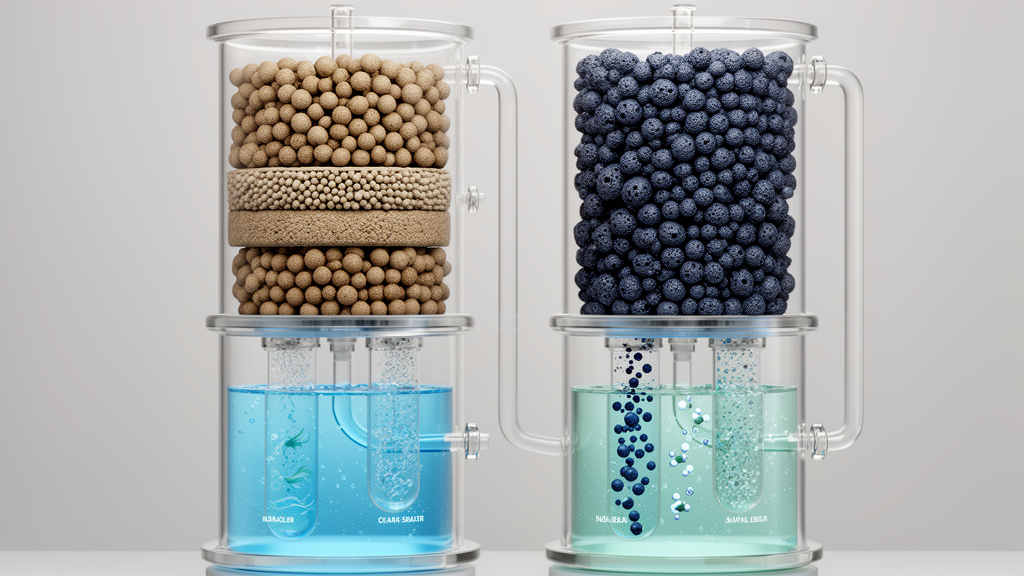
The clearest way to separate today’s radiocesium adsorbents is not by ranking their capacity alone, but by asking where each material must work. A review of cesium-enrichment research concludes that ammonium phosphomolybdate and ferrocyanides have the strongest evidence for measuring trace radiocesium in seawater, while zeolites and crystalline silicotitanates have been used in engineered systems for accident-contaminated water. Layered titanates and metal sulfides offer greater capacity for concentrated or complex wastewaters, whereas metal-organic frameworks and immobilized crown-ether or calixarene adsorbents are better suited to small samples or specialized separation streams. The distinction matters because seawater analysis and large-volume water treatment impose competing demands on selectivity, kinetics, cost, stability and recoverability.
Radiocesium is an especially difficult analytical target because cesium-137 has a half-life of 30.2 years and cesium-134 has a half-life of 2.06 years, yet both can occur at extremely low concentrations in seawater. Major sources include fallout from atmospheric nuclear weapons tests, accidental releases such as Chernobyl and Fukushima, and authorized discharges from nuclear-fuel reprocessing plants. Before Fukushima, the review estimates that global fallout, local fallout and reprocessing discharges contributed approximately 69%, 24% and 7%, respectively, of global cesium-137 inputs. The 2011 Fukushima accident released about 19–25 petabecquerels of cesium-137, with approximately 15–20 petabecquerels entering the ocean. Detection therefore depends on concentrating cesium from tens or even thousands of litres of seawater into a compact medium that can be measured reliably.
Ammonium phosphomolybdate, or AMP, remains one of the two established analytical workhorses. It is a heteropolyacid salt built around a negatively charged Keggin framework, commonly written as (NH4)3PMo12O40·nH2O, whose interstitial ammonium ions can exchange with dissolved Cs+. The large, weakly hydrated Cs+ ion preferentially occupies bridging oxygen sites in the framework, allowing the exchange of Cs+ for NH4+ even in acidic media. A silica-based AMP exchanger has adsorbed cesium across nitric acid concentrations of 0.001–3 mol L−1. Conventional AMP coprecipitation is mature and permits chemical-recovery correction: reported precipitate yields for 20-litre seawater tests exceeded 97%, and radiochemical yields of 96.1–100.1% were obtained in separate 137Cs-spiked 5-litre samples. Its main burdens are transportation of large water volumes, acidification, bulky containers, slow settling, filtration and approximately a week of pretreatment.
Immobilizing AMP in polyacrylonitrile, or PAN, converts the fragile powder into a usable column medium. One Fukushima seawater study used 5 mL of AMP–PAN resin to process 20 litres at 35–40 mL min−1 and reported chemical recovery of 93.5% ± 5% across 55 samples; direct gamma spectrometry then reduced processing from several days to several hours. A 25 mL column processed about 100 litres at 240–320 mL min−1 in roughly six hours, but its six recoveries averaged 88.1% ± 3.3% and fell as flow increased. These results illustrate the central compromise: faster columns increase throughput but reduce contact time and recovery, while specialized resin remains comparatively expensive. Composite AMP systems—including granular and mesoporous forms, magnetic particles and graphene-oxide membranes—are promising, but most have not yet been systematically validated for trace radiocesium in large volumes of low-activity natural seawater.
Ferrocyanides offer the other established route. Copper ferrocyanide and potassium nickel hexacyanoferrate contain negatively charged Prussian-blue-type frameworks whose interstitial sodium or potassium can be replaced by Cs+. The ion sheds part of its hydration shell to enter the structure, where the framework charge, cyanide-bridge environment and exchange sites stabilize it. Copper ferrocyanide cartridges can enrich seawater in the field: a paired system processed 800–5,000 litres at 4–6 L min−1, and the activity ratio in the second cartridge was used to detect breakthrough. The recommended ratio was below roughly 0.2–0.3 for about 1,000 litres and 5 g of adsorbent; ratios reached 0.5–0.8 near 2,000 litres and 0.6–0.9 in five of six samples at 4,000–5,000 litres, making correction increasingly unreliable. Later nonwoven cartridges could be counted directly: 20 litres at 0.5 L min−1 took 40 minutes, with field recovery above 93%, although raising the flow to 2.5 L min−1 lowered recovery to 84–86%.
For accident-contaminated water, zeolites have the advantage of an established engineering role, relatively low raw-material cost and a framework that can exchange Cs+ with sodium, potassium, calcium and other cations. Following Fukushima, herschelite-packed KURION columns provided principal upstream cesium removal, while the parallel SARRY system used IONSIV IE-96 chabazite followed by IE-911 crystalline silicotitanate. Their advantages come with a major constraint: sea salts compete strongly for the same exchange sites. The capacity of KURION herschelite in 3.4 wt% sea-salt solution was approximately one-tenth of its capacity in pure water, and salinity also reduced the effective volume treated by a dynamic bed. Low-silica Na-CHA has separately removed more than 99% of ppt-level cesium-137 in actual nuclear-power-plant wastewater, but such treatment evidence does not establish the material as a principal tracer for quantitative seawater analysis.
Crystalline silicotitanates and layered titanates are tailored more explicitly to high-loading treatment streams. In H-CST, Cs+ enters eight-membered-ring channels and replaces H+, with local oxygen coordination helping stabilize the exchanged structure. Layered titanates instead exchange sodium, potassium or hydrogen from interlayers, while surface hydroxyls and sheet edges may also participate. TAM-5 separated ppm-level Cs+ at pH above 14 and sodium concentrations above 5 mol L−1. H-CTO nanosheets reached a reported maximum capacity of 329 mg g−1 and could be regenerated with 0.2 mol L−1 HCl, while a hydrophilic HTO-3 material reached 360 mg g−1 and equilibrium in about two hours. Titanium-based ion sieves and electrically controlled titanosilicate electrodes offer still more specialized routes, including preselected binding sites and potential-controlled intercalation and release, but many nanstructured forms remain difficult to shape and recover.
Metal sulfides and ion-imprinted materials provide another route to selective capture in hostile matrices. Layered sulfides combine exchange of interlayer cations with strong Cs···S interactions at polarizable sulfur sites. The layered Ti/Sn material KTSS reached equilibrium in about one minute and had a maximum capacity of 450.12 mg g−1. FJSM-KCGTS was built with Cs+ as a template, activated with K+ after template removal, and retained more than 99% removal in actual industrial wastewater containing 137Cs; its capacity in spiked seawater was 206.44 mg g−1. It also retained more than 99.5% removal after 100 or 200 kGy gamma irradiation and more than 98.97% after three regenerations with 1 mol L−1 ammonium chloride. These are encouraging treatment results, but most seawater experiments used elevated stable-Cs spikes and therefore do not demonstrate quantitative recovery of trace 137Cs from natural seawater.
The frontier in analytical enrichment is increasingly molecular. Metal-organic frameworks can bind Cs+ through framework counterions, sulfonic or carboxylic groups, and crown-ether cavities that mimic the ion’s preferred coordination environment. ZJU-X102 incorporates a 24-crown-8 unit and has a reported maximum capacity of 121 mg g−1, while an anionic indium-based layered framework reached 297.67 mg g−1 and a cesium/strontium separation factor of about 320. An NH2-MIL-125(Ti)@ZIF-8 heterostructure reported 392.62 mg g−1 capacity by adding interfacial sites. Immobilized macrocycles are more selective still: a calixarene resin had a Cs+ selectivity coefficient above 300 in nitric-acid feed and retained performance after 500 kGy irradiation. Their narrow recognition cavities suit small-volume enrichment or fine separation, but costly synthesis, ligand loss, salt tolerance and competition from potassium limit seawater use.
The review’s practical conclusion is that no material yet wins every category. AMP and ferrocyanide systems have the clearest foundation for quantitative seawater analysis, yet acidification, column breakthrough, flow sensitivity and cost remain important limitations. Zeolites and crystalline silicotitanates have demonstrated fixed-bed treatment of accident-contaminated water, but seawater salts reduce uptake and effective bed volume. Emerging materials should therefore be judged by the application they are intended to serve. Analytical candidates need validation in low-activity natural seawater for overall recovery, blanks, usable flow rates and maximum treatable volume. Treatment candidates require dynamic breakthrough, service life, radiation stability, leaching and safe immobilization data. Cold-sintered Cs-AMP and thermally converted Cs-zeolite also show how adsorption can be linked to waste-volume reduction and final disposal, but no laboratory capacity result or stable-Cs spike substitutes for sustained, trace-level field validation.
Subject of Research: Materials for enriching radioactive cesium isotopes from seawater and treating nuclear-polluted water
Article Title: Materials used for enriching radioactive cesium isotopes from seawater
Article References: Ling, C., Qian, S., Zhang, K., Zhu, S., Gu, Y., Ma, Z., & Ren, Y. (2026). Materials used for enriching radioactive cesium isotopes from seawater. Frontiers in Marine Science, 13, Article 1996662. https://doi.org/10.3389/fmars.2026.1996662
Image Credits: AI Generated
DOI: 10.3389/fmars.2026.1996662
Keywords: radiocesium, cesium enrichment, seawater analysis, nuclear wastewater, adsorption materials, ammonium phosphomolybdate, ferrocyanides, zeolites, metal-organic frameworks, water treatment, Materials, used
Cite Scienmag News
Violet Maxwell. (October 20, 2026). Radiocesium purification materials compared for seawater and nuclear wastewater. Scienmag. https://scienmag.com/radiocesium-purification-materials-compared-for-seawater-and-nuclear-wastewater/
Violet Maxwell. "Radiocesium purification materials compared for seawater and nuclear wastewater." Scienmag, 20 October 2026, https://scienmag.com/radiocesium-purification-materials-compared-for-seawater-and-nuclear-wastewater/. Accessed 20 October 2026.
Violet Maxwell. "Radiocesium purification materials compared for seawater and nuclear wastewater." Scienmag. October 20, 2026. https://scienmag.com/radiocesium-purification-materials-compared-for-seawater-and-nuclear-wastewater/


