


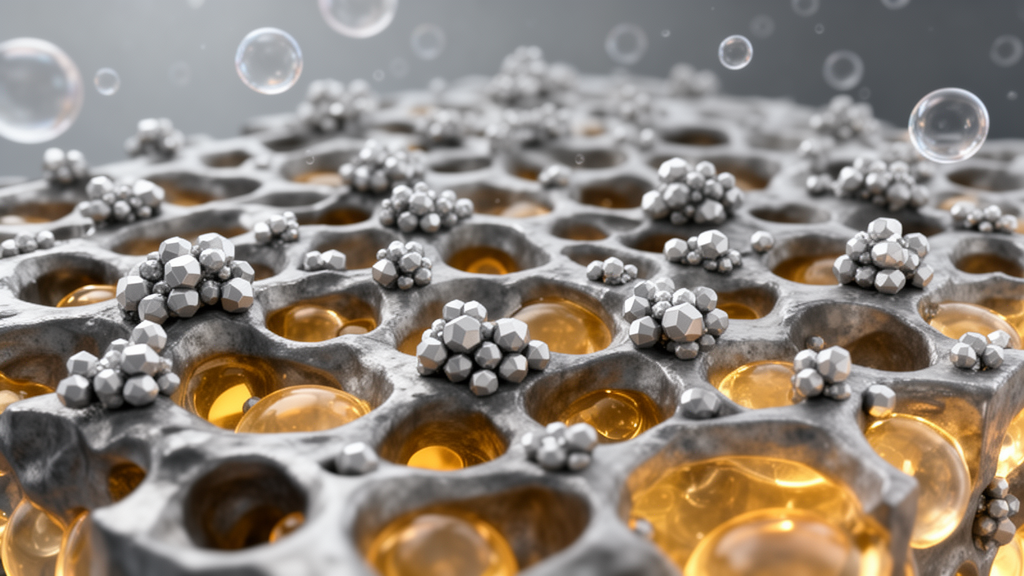
A surfactant-free precipitation process produced phase-pure silver oxide nanoparticles when the precursor ratio was selected through a face-centered central composite design, according to the laboratory materials study. The best-performing formulation used an AgNO₃/K₂S₂O₈ molar ratio of 2/3 and generated predominantly spherical particles below 100 nm, with a calculated crystallite size of about 18.7 nm. When incorporated into an alkaline cathode, the optimized powder delivered a specific discharge capacity of 400 mAh g⁻¹, equivalent to 92.6% of AgO’s theoretical capacity of 432 mAh g⁻¹. The findings connect a readily adjustable chemical ratio with control over AgO nucleation, size and morphology while avoiding surfactants or stabilizing agents.
The study focused on silver(II) oxide, a compound described as containing silver ions in the +1 and +3 oxidation states within a stable crystal lattice. That structure gives AgO unusual electrical conductivity and has supported its use as a cathode material in silver-based batteries, a strong oxidizing agent in chemical processes and an antibacterial material in biomedical settings. Its theoretical specific capacity of 432 mAh g⁻¹, high operating voltage and oxidizing power motivate efforts to improve the practical performance of AgO electrodes. A central obstacle is particle size and morphology, both of which can affect electrochemical behavior and remain difficult to control precisely without surface-active additives. The reported work therefore concentrated on a materials-synthesis parameter rather than on a new battery architecture or a clinical application.
Several routes have been used to prepare AgO, including ozonation of Ag₂O suspensions, anodic oxidation of silver or Ag₂O in alkaline media, and chemical oxidation with strong oxidants such as potassium persulfate. The researchers selected chemical precipitation because it is comparatively simple, uses readily available reagents, produces few by-products and offers controllable conditions. Previous surfactant-free work had produced strongly agglomerated, micron-scale AgO particles exceeding 1 μm, whereas the new experiments sought nanoscale material by systematically changing precursor stoichiometry rather than by testing one factor at a time. The investigators used a seven-run face-centered central composite design, or FCC-CCD, to examine the effects of the silver nitrate and potassium persulfate concentrations on the resulting particle characteristics. This approach was selected because response-surface methods can assess linear, interaction and quadratic effects with fewer experiments than a conventional one-factor-at-a-time sequence.
For the synthesis, 0.0114 mol of AgNO₃ was dissolved in deionized water to form solution A. A separate solution contained 0.01145 mol of K₂S₂O₈, into which KOH was added slowly under magnetic stirring to form solution B. Solution B was then added dropwise to solution A at elevated temperature. The reaction proceeded under strongly alkaline conditions at pH 13, with stirring at 700 rpm for 30 minutes. The black precipitate was filtered, washed with deionized water and dried in an oven at 90 °C for five hours. Seven experimental runs covered silver nitrate amounts from 0.0059 to 0.0170 mol and potassium persulfate amounts from 0.0039 to 0.0114 mol. The samples were labeled according to the AgNO₃/K₂S₂O₈ ratio, allowing the structural and morphological results to be compared across the designed conditions.
Statistical analysis supported the overall usefulness of the two-factor model, while also showing an important distinction between the two measured responses. For crystallite size determined by X-ray diffraction, the model was significant at p = 0.0013; both AgNO₃ concentration and K₂S₂O₈ concentration had conventionally significant effects, with p-values of 0.0016 and 0.0078, respectively. For the scanning electron microscopy particle-size response, the overall model was significant at p = 0.0096, and the K₂S₂O₈ term was significant at p = 0.0079. The AgNO₃ term in that SEM model had p = 0.0865, which is not conventionally significant at the 0.05 level. Linear models adequately described the responses within the investigated design space, with coefficients of determination of 0.96 for the XRD response and 0.90 for the SEM response. Predicted and observed values lay close to the 45-degree reference line used in the model diagnostics.
X-ray diffraction confirmed that the products were monoclinic AgO, with principal peaks at 2θ values of 32.4°, 34.2°, 37.4° and 39.8°. These peaks corresponded to the (220), (002), (111) and (202) planes and were consistent with reference card JCPDS 96-150-9489. Samples made at the optimized ratio and at several other tested ratios showed no detectable secondary phases such as Ag₂O or Ag₂SO₄. By contrast, the samples labeled A/K 3 and A/K 4/5 contained additional Ag₂SO₄ peaks, which the authors attributed to incomplete oxidation caused by insufficient oxidant concentration. Debye–Scherrer calculations gave crystallite sizes ranging from 18.7 to 42.1 nm, with the minimum at the selected A/K 2/3 condition. The diffraction result therefore supplied both phase identification and a nanoscale estimate for the selected material.
Scanning electron microscopy showed that morphology changed markedly across the seven precursor formulations. Low AgNO₃/K₂S₂O₈ ratios predominantly produced flake-like particles, whereas the optimized A/K 2/3 sample contained mostly spherical particles with smooth surfaces and a comparatively uniform distribution. ImageJ estimates of average particle size ranged from 62.45 nm for the optimized sample to 332.84 nm for the A/K 0.80 sample. The optimized powder also had the lowest reported standard deviation, indicating the greatest homogeneity among the tested materials. The difference between XRD crystallite size and SEM particle size was attributed to the agglomeration of multiple crystallites within observed particles rather than to an inconsistency in the measurements. The authors thus considered both scale measurements when selecting the optimum, combining size, distribution, morphology and phase information rather than relying on one measurement alone.
Transmission electron microscopy supplied a closer view of the optimized material. Most A/K 2/3 particles were spherical and measured about 15–25 nm in diameter, broadly agreeing with the crystallite-size estimate from XRD. Non-optimal formulations instead showed irregular, aggregated or flake-like structures. UV–visible spectroscopy of the optimized dispersion displayed a distinct absorption maximum near 307 nm in the ultraviolet region. The authors regarded that optical feature as consistent with nanoscale silver oxide, while noting that reported absorption positions can vary with particle size, shape, crystallinity and synthesis conditions. Together, the diffraction, microscopy and optical measurements supported the conclusion that the selected ratio produced nanoscale AgO without detectable secondary crystalline phases. The evidence concerns laboratory-made powders and does not establish how the particles behave after processing in a full commercial electrode or under long-term cycling.
The researchers interpreted the size trend through the classical LaMer model of nanoparticle formation, in which precursor-derived species accumulate until critical supersaturation is reached, nuclei form and the nuclei subsequently grow. At relatively high AgNO₃/K₂S₂O₈ ratios, faster development of supersaturation was associated with a larger number of nuclei and less material available for the growth of each particle. This favors smaller, more uniform and more spherical particles. At lower ratios, fewer nuclei were expected, leaving more precursor material for continued growth and allowing anisotropic growth in different crystallographic directions to become more pronounced. That interpretation is consistent with the observed plate-like and flake-like forms at lower ratios, although it is a mechanistic explanation of the experimental trend rather than direct measurement of nucleation kinetics. The study therefore links precursor composition to observed structure and shape, but does not quantify individual nucleation rates or growth mechanisms.
To test whether the optimized morphology translated into electrode performance, the researchers mixed 5.5 g of AgO nanopowder with conductive additive and binder and pressed the mixture into a 90 × 46 mm cathode plate. Electrochemical testing used KOH electrolyte with a density of 1.3 g mL⁻¹ under a constant discharge current of 2 A and a 1.3 V cut-off voltage. The electrode maintained a relatively stable plateau of approximately 1.49–1.46 V during the first 50 minutes, followed by a gradual decrease from about 1.48 to 1.45 V and a sharp voltage drop near the end. The authors associated the plateau with comparatively uniform electrochemical reactions and low internal resistance, while describing the final drop as evidence that nearly all active material had been utilized. This was a constant-current discharge assessment of a fabricated cathode plate, not a complete-cell performance test.
Discharge continued for 66 minutes, or 1.100 hours, before reaching the cut-off. Applying the standard relation in which specific capacity equals current multiplied by discharge time and divided by active-material mass, the authors calculated 400 mAh g⁻¹. This was 92.6% of the 432 mAh g⁻¹ theoretical capacity of AgO and was reported as comparable to, and slightly above, earlier values of 360 mAh g⁻¹ for nanostructured AgO and 394.7 mAh g⁻¹ for high-purity AgO. The study was conducted as a controlled laboratory synthesis and single cathode discharge test, so its results do not by themselves establish performance in a complete battery, across multiple commercial devices or during repeated cycling. Within that scope, the combined structural, microscopic, statistical and electrochemical data support precursor-ratio control as a practical route to small, phase-pure AgO nanoparticles for alkaline cathodes and other material-development applications.
Subject of Research: Statistical optimization of surfactant-free AgO nanoparticle synthesis and alkaline cathode performance
Article Title: Design and optimization of molar ratios for controlled synthesis of AgO nanoparticles using face-centered central composite design (FCC-CCD)
Article References: Sajjadi, Z. S., Mashhadi, M., & Naderi Samani, H. (2026). Design and optimization of molar ratios for controlled synthesis of AgO nanoparticles using face-centered central composite design (FCC-CCD). Results in Chemistry, 31, Article 103870. https://doi.org/10.1016/j.rechem.2026.103870
Image Credits: AI Generated
DOI: 10.1016/j.rechem.2026.103870
Keywords: silver oxide nanoparticles, AgO, face-centered central composite design, response surface methodology, chemical precipitation, nanoparticle morphology, alkaline batteries, cathode materials, X-ray diffraction, electrochemical capacity, Design, optimization
Cite Scienmag News
Faith Mcneil. (October 20, 2026). Statistical optimization yields nanoscale silver oxide for alkaline cathodes. Scienmag. https://scienmag.com/statistical-optimization-yields-nanoscale-silver-oxide-for-alkaline-cathodes/
Faith Mcneil. "Statistical optimization yields nanoscale silver oxide for alkaline cathodes." Scienmag, 20 October 2026, https://scienmag.com/statistical-optimization-yields-nanoscale-silver-oxide-for-alkaline-cathodes/. Accessed 20 October 2026.
Faith Mcneil. "Statistical optimization yields nanoscale silver oxide for alkaline cathodes." Scienmag. October 20, 2026. https://scienmag.com/statistical-optimization-yields-nanoscale-silver-oxide-for-alkaline-cathodes/


