


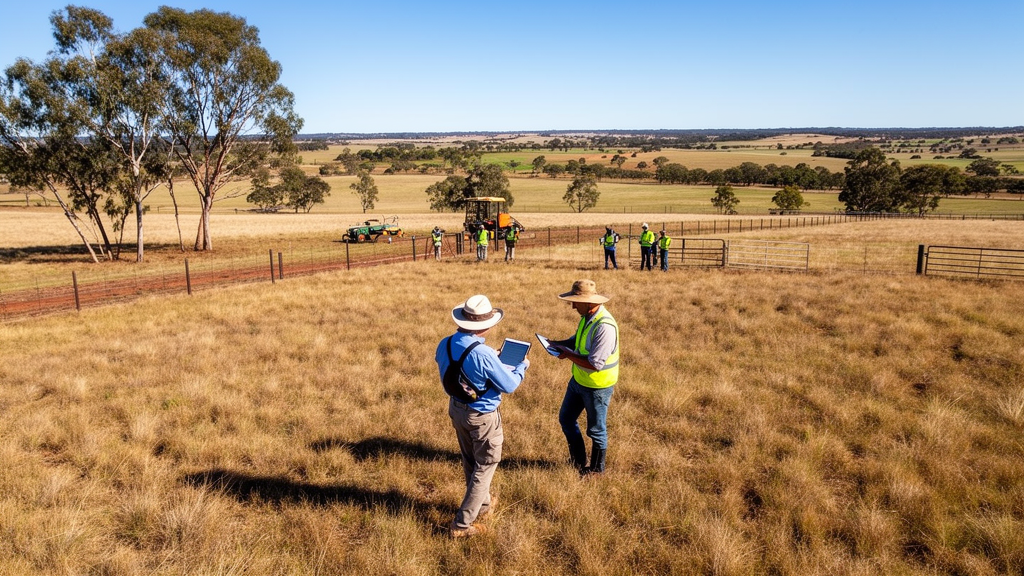
A five-year program of regional surveys across six Australian farming regions found that adoption of agricultural practices was associated with interacting values, knowledge, confidence, financial capacity, trusted information networks and farm context rather than a single decision rule. Researchers developed a Social Benchmarking Method and Framework that combine repeated questionnaires, local partnerships, probability sampling, mixed paper-and-online delivery and statistical modelling to track these factors over time. Surveys conducted from 2019 to 2023 returned response rates of 24% to 36%.
This is a methods study based on the authors’ reflective analysis of six large landholder surveys commissioned by the Cooperative Research Centre for High Performance Soils, also known as the Soil CRC. It draws on three decades of social benchmarking in Australia and combines survey instruments and drafts, internal notes, audits, regional reports and feedback from partner organisations. The surveyed areas were North Central and Wimmera in Victoria, the Eyre Peninsula of South Australia, Central West New South Wales, mainland Tasmania and the Wheatbelt of Western Australia.
The authors describe the approach as a way to produce comparable evidence about landholders’ values, beliefs, norms and management practices while retaining sensitivity to local conditions. It was not a controlled trial of any farming practice, and the reported relationships do not demonstrate that changing an attitude, value or information source would cause adoption. At the centre of the method is a questionnaire structured around 12 areas of inquiry: occupational identity, enterprise and land-use mix, salient issues, general value orientations, place-based values, knowledge, confidence and capacity to act, trusted information networks, attitudes to risk, trust and climate, on-farm management actions, demographic and farm context, and long-term intentions.
The design integrates several behavioural theories. Ajzen’s Theory of Planned Behaviour links intention to behaviour through attitudes, perceived social norms and perceived behavioural control. Value-Belief-Norm theory connects environmental behaviour to values, beliefs and personal responsibility, while the Assigned Values Model examines the relationship between a landholder and the particular place being managed.
The researchers distinguish broadly held principles, such as creating wealth or living in harmony with nature, from assigned values attached to features such as soil, identity, family, community or the future condition of a property. Rather than using an identical questionnaire everywhere, the method retains stable “sister questions” for longitudinal and cross-regional comparison while adding locally selected practices and issues. Regional partners map priorities in workshops, after which the instrument is tailored, pre-tested with local landholders and revised for clarity and relevance.
Most questions use five-point Likert scales, multiple-choice options or categorical responses, while open questions allow respondents to raise issues not anticipated by researchers. A “Do not know/Not applicable” option helps distinguish uncertainty or inapplicability from disagreement. Open responses in one regional instrument identified mobile connectivity, long-range weather forecasting and soil-management knowledge as practical needs that linked several otherwise separate parts of the survey.
Sampling is designed to support broad inference. Researchers obtained spatially referenced lists of properties larger than 10 hectares, then surveyed all eligible landholders in sparsely populated regions or randomly selected the required number in larger ones. The preferred mail-out sample was 2,000, with approximately 250 usable responses treated as generally sufficient for descriptive summaries, exploratory pairwise analyses and follow-up modelling.
Under common survey assumptions, this size can produce margins of error of about 5% to 7%, although actual precision depends on the sampling design and population characteristics, for which formal probability-based calculations are required. The team also compared average land size among respondents with broader regional landholder data as a practical check for skew toward large or small properties, although this check cannot identify every form of non-response bias. Delivery followed the systematic approach associated with Dillman’s Tailored Design Method.
An advance notice informed recipients that the survey was coming, offered an opt-out and provided a QR code for online completion. Those who did not opt out received a printed questionnaire and cover letter, followed by two mailed reminders, another survey and a final reminder. From the second survey onward, a regional online version linked responses to mailed serial numbers.
Local promotion through radio, farming events, media releases and partner networks was treated as essential. Reasons for non-participation included the belief that the survey did not apply to the respondent, lack of time, poor health or age, and a general dislike of surveys. Response rates ranged from 24% in the Western Australian Wheatbelt to 36% in North Central Victoria.
In the Wheatbelt, a state closure prevented the project lead from promoting the survey in person. A less intensive 2023 Wimmera trial that sent flyers with QR codes to 2,000 landholders in two local government areas produced an extremely low response and disproportionately greater participation by women and non-farmers. The analysis proceeded from description to targeted modelling.
Researchers calculated frequencies, means and medians using the available responses for each question, so denominators varied and “Do not know/Not applicable” answers and missing values were excluded from item-level summaries. For reporting, responses of 1–2 and 4–5 on Likert scales were grouped as negative and positive categories, while the original scale values were retained for pairwise comparisons and modelling. Linear regression was used for continuous outcomes, logistic regression for binary outcomes and appropriate categorical models for outcomes with more than two classes.
In each region, as many as 20–40 prioritised associations from pairwise screening were advanced to regression. A p-value below 0.05 was used as the screening threshold, but significance was evaluated alongside sample availability, missing data, practical relevance, local knowledge and consistency with the framework. Spatially referenced landholder data also made it possible to map patterns against features such as soil type.
Illustrative results from a 2025 report for North Central Victoria showed that relationships differed across practices. Whole-farm planning was most strongly associated with knowledge of allocating land use according to land class, together with knowledge and implementation of soil-health, biodiversity and grazing approaches. A multivariable model linked whole-farm planning with business-planning knowledge, use of time-controlled, holistic or cell grazing, management of a larger area, succession planning and longer decision horizons.
The model reported Cox’s Snell R² of 0.40, Nagelkerke R² of 0.54, 85 degrees of freedom and p = 2.03 × 10⁻⁶. Time-controlled grazing was associated with knowledge and confidence in the practice, reduced synthetic use per hectare, succession planning and an assigned value of contributing to positive agricultural change. That model reported Cox’s Snell R² of 0.43, Nagelkerke R² of 0.58, 97 degrees of freedom and p = 5.54 × 10⁻¹⁰.
These are observational associations, not estimates of intervention effects. Values also organized distinct sets of priorities. “Creating wealth” was associated with 24 salient issues, mostly concerning soil but also water security, social licence and missing services. It was positively linked with knowledge of farming and soil health, trusted advisers and several farm practices, but negatively associated with using environmental organisations for information and with understanding of climate change. “Living in harmony with nature” was linked with 23 issues including soil health, biodiversity, water and climate change, as well as belief in science, data-driven decisions and confidence in regenerative agriculture.
Its model included a desire to leave the property in better condition, concern about changing weather and a normative view concerning First Nations access to cultural sites on private land, with R² of 0.35, 263 degrees of freedom and p = 4.85 × 10⁻²³. Overall, the authors reject a deterministic sequence in which values simply produce beliefs, norms and then behaviour: values can shape which organisations landholders trust, trusted networks can reinforce or weaken openness to new information, and one practice may increase the likelihood of adopting another. The method’s central practical lesson is that representativeness depends on sustained local collaboration as much as on technical sampling.
Partners help define meaningful regional boundaries, identify priorities, supply contact information, promote the survey and connect findings to planning cycles. Repeated application can provide evidence about locally associated factors such as knowledge, capacity constraints, trusted sources and assigned values while retaining a comparable core for wider analysis. The authors caution that the framework is not yet a deterministic predictive tool and that further research is required to determine its full applications.
The datasets are also not openly available because of ethics requirements. Even with those limitations, implementation across six regions shows how a stable theoretical core can be adapted locally without sacrificing longitudinal comparability, offering a practical model for tracking social change in land management from local programs through to national policy.
Subject of Research: A repeated social survey method for examining factors associated with rural landholder decisions and farming-practice adoption in Australia
Article Title: A Social Benchmarking Method for surveying rural landholders
Article References: Luke, H., Allan, C., Alexanderson, M., & McDonald, S. (2026). A Social Benchmarking Method for surveying rural landholders. Frontiers in Sustainable Food Systems, 10, Article 1746415. https://doi.org/10.3389/fsufs.2026.1746415
Image Credits: AI Generated
DOI: 10.3389/fsufs.2026.1746415
Keywords: social benchmarking, rural landholders, agricultural surveys, practice adoption, behavioural research, land management, survey methodology, Australia, soil health, trusted networks, Social, Benchmarking
Cite Scienmag News
Alan Morgan. (October 20, 2026). Australian regional surveys map factors associated with landholder practice adoption. Scienmag. https://scienmag.com/australian-regional-surveys-map-factors-associated-with-landholder-practice-adoption/
Alan Morgan. "Australian regional surveys map factors associated with landholder practice adoption." Scienmag, 20 October 2026, https://scienmag.com/australian-regional-surveys-map-factors-associated-with-landholder-practice-adoption/. Accessed 20 October 2026.
Alan Morgan. "Australian regional surveys map factors associated with landholder practice adoption." Scienmag. October 20, 2026. https://scienmag.com/australian-regional-surveys-map-factors-associated-with-landholder-practice-adoption/


