


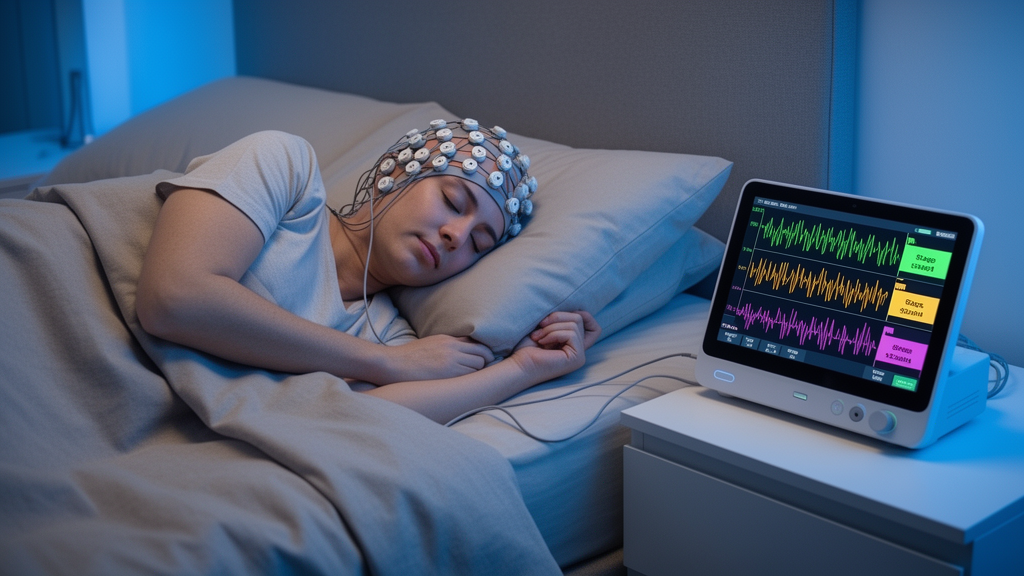
A deep-learning framework designed to classify sleep stages from a single electroencephalogram channel achieved overall accuracies of 87.0%, 83.4% and 84.5% on the SleepEDF-20, SleepEDF-78 and SHHS public datasets, according to a study published in Frontiers in Neuroscience. The model was particularly designed to improve the difficult-to-identify N1 stage, for which it reported accuracies of 57.5%, 52.5% and 49.3%, respectively. These results come from retrospective analyses of archived recordings rather than a prospective clinical trial, and the researchers noted that validation on external clinical datasets remains necessary.
Sleep staging normally requires specialists to examine 30-second polysomnography epochs and assign one of five stages: wakefulness, non-rapid eye movement stages N1, N2 and N3, and rapid eye movement sleep. Although polysomnography provides multiple physiological signals, automated systems based on a single EEG channel could reduce the cost and complexity of monitoring at home or through wearable devices. The researchers focused on central channels because sleep spindles occur predominantly in the central region of the brain. Their model used either the Fpz-Cz channel in SleepEDF or C4-A1 in the Sleep Cardiovascular Health Study, both sampled at 100 or 125 Hz in the original data.
The network’s first component, a multi-scale frequency anti-correlation convolutional network, extracts EEG features with three parallel convolutional branches. Each branch has a different temporal receptive field: 0.25 seconds for the slow-wave branch, 0.5 seconds for the two-peak branch and four seconds for the rhythm-coupling branch. These windows target different spectral scales, allowing the network to represent slow-wave activity, faster rhythms and cross-band patterns associated with changes in sleep state. The authors hypothesized that complementary responses are more useful during transitions, when the relationship between EEG frequency bands changes. An analysis supported that premise: the Pearson correlation between delta and beta power fell from 0.54 during wakefulness to about -0.12 during N3 sleep, while delta-gamma correlation declined from 0.60 to -0.02.
That anti-correlation analysis was based on band powers across sleep stages. Among subjects with at least 30 wake and N3 epochs, paired Wilcoxon tests with Benjamini-Hochberg false-discovery-rate correction found significant differences between the two stages for nine of ten frequency pairs; only the theta-alpha pair did not differ significantly. The findings are consistent with delta dominance and suppression of alpha, beta and gamma activity in deep sleep. They provide physiological support for the architecture, but the study does not show that the observed relationships are unique to the proposed model or establish that they cause better classification in individual patients.
The extracted features are combined by a dual-granularity residual attention module. Its temporal component derives average and maximum statistics across feature channels, then uses causal convolution and fully connected layers to assign normalized weights along the time dimension. A second component calculates the mean and standard deviation of each feature channel, uses a convolution to compress those statistics and applies a sigmoid function to produce channel weights. Residual connections preserve the original representation and help gradients flow through the network. The use of both temporal and channel weighting is intended to retain fine-scale transient patterns while also representing dependencies among the differently filtered signals.
After fusion, a causal transition-aware network models relationships among neighboring epochs. Its multi-head attention mechanism generates queries, keys and values through causal convolutions, so a prediction at one time step can depend only on that step and earlier ones rather than on future EEG. The researchers say this design prevents the leakage of future information during learning and helps the system infer plausible transition rules. Context was supplied by combining the previous, current and following 30-second EEG windows, while the model predicted the label of the middle window. In an ablation experiment on SleepEDF-20, replacing causal convolution with standard one-dimensional convolution reduced overall accuracy from 87.0% to 86.2%, macro F1 from 80.7 to 80.3 and kappa from 0.82 to 0.81, providing limited evidence for the causal design’s added value.
Class imbalance was addressed with focal loss, which reduces the influence of easy examples and gives greater weight to difficult samples. The imbalance was substantial. After preprocessing, N1 accounted for only 3.2% of the SHHS context inputs, compared with 6.6% in SleepEDF-20 and 11.0% in SleepEDF-78. The model’s N1 results were nevertheless mixed: its 57.5% accuracy on SleepEDF-20 exceeded the reported values for the other deep-learning methods in the comparison, but on SHHS its 49.3% was below the 51.4% reported for Zhao and colleagues. On the larger SHHS dataset, the proposed model also did not lead every metric: its 84.5% accuracy was lower than the 86.2% reported for Huang and colleagues, and its 0.78 kappa was below that study’s 0.81.
Ablation tests and feature visualizations indicated that each major component contributed to performance, though the evidence came from SleepEDF-20. The complete model performed better than versions containing only the frequency feature extractor, that extractor plus the causal network, or the extractor plus dual-granularity attention. A two-dimensional t-SNE visualization also showed tighter grouping and clearer stage boundaries for the complete architecture, although the authors cautioned that t-SNE outcomes are sensitive to hyperparameters. Frequency-response analysis indicated that the slow-wave branch concentrated more strongly on low-frequency delta, theta and alpha activity, the two-peak branch responded to delta, theta and beta, and the longer-window branch integrated responses across a wider range.
The model also retained useful performance under changes in sampling rate and added noise. On SleepEDF-20, resampling to 50 Hz produced 86.6% overall accuracy, only 0.4 percentage points below the result at 100 Hz, but N1 accuracy fell by 5.4 points to 52.1%. Upsampling to 200 Hz reduced overall accuracy to 86.0%, N1 accuracy to 54.5% and REM accuracy to 80.9%. Gaussian white-noise tests showed little degradation above a 20-decibel signal-to-noise ratio, with 82.9% accuracy at 20 dB, but performance fell sharply at 10 dB to 67.4% and at 0 dB to 20.0%. These tests represent laboratory noise only; motion artifacts and other real-world interference were not evaluated systematically.
Computational tests showed an inference time of 1.997 ± 0.363 milliseconds per sample on an NVIDIA RTX 3090 graphics processor, with 1.43 million parameters, 0.65 billion floating-point operations and 11.73 megabytes of per-sample memory. Relative to the selected baseline, this represented about 62.9% fewer floating-point operations and 77.4% lower memory use, although inference was slower than the baseline’s reported 1.119 milliseconds. The authors consider the millisecond-scale result compatible with real-time or near-real-time staging after preprocessing, but actual on-device power consumption, long-term stability, quantization and pruning were not tested. Overall, the study presents a computationally promising research model for single-channel sleep staging, not yet a clinically validated replacement for polysomnography or expert interpretation.
Subject of Research: Single-channel EEG deep learning for five-stage sleep classification
Article Title: Anti-correlation time-frequency synergy and dual-granularity fusion for sleep stage classification
Article References: Pan, J., Zhao, X., Zou, X., Zhao, P., Wang, L., & Li, C. (2026). Anti-correlation time-frequency synergy and dual-granularity fusion for sleep stage classification. Frontiers in Neuroscience, 20, Article 1944816. https://doi.org/10.3389/fnins.2026.1944816
Image Credits: AI Generated
DOI: 10.3389/fnins.2026.1944816
Keywords: sleep staging, single-channel EEG, deep learning, multi-head attention, time-frequency features, causal convolution, class imbalance, N1 sleep, focal loss, polysomnography, Anti-correlation, time-frequency
Cite Scienmag News
Blake Davidson. (October 20, 2026). Single-Channel EEG Model Improves Automatic Sleep Stage Classification. Scienmag. https://scienmag.com/single-channel-eeg-model-improves-automatic-sleep-stage-classification/
Blake Davidson. "Single-Channel EEG Model Improves Automatic Sleep Stage Classification." Scienmag, 20 October 2026, https://scienmag.com/single-channel-eeg-model-improves-automatic-sleep-stage-classification/. Accessed 20 October 2026.
Blake Davidson. "Single-Channel EEG Model Improves Automatic Sleep Stage Classification." Scienmag. October 20, 2026. https://scienmag.com/single-channel-eeg-model-improves-automatic-sleep-stage-classification/


