

Tuesday, October 20, 2026
Science
No Result
View All Result
  • Login
  • HOME
  • SCIENCE NEWS
  • CONTACT US
  • HOME
  • SCIENCE NEWS
  • CONTACT US
No Result
View All Result
Scienmag
No Result
View All Result
Home Science News Agriculture

Lysine and cadaverine differentially regulate huperzine biosynthesis

October 20, 2026
in Agriculture
Alan Morgan
By Alan Morgan Scienmag Editorial Profile - Precision Agriculture
Reading Time: 3 mins read
0
Lysine and cadaverine differentially regulate huperzine biosynthesis

Lysine and cadaverine differentially regulate huperzine biosynthesis

65
SHARES
587
VIEWS
Share on FacebookShare on Twitter
ADVERTISEMENT

Supplementing axenic gametophyte cultures of the club moss Huperzia selago with lysine and cadaverine produced distinct, time-dependent changes in the accumulation of huperzine A and huperzine B, according to a controlled plant-culture study. Huperzine A reached its highest overall measured concentration at week 24 in cultures supplied with cadaverine alone, attaining 6.79 ± 0.10 mg g⁻¹ dry weight. Huperzine B accumulated more slowly and peaked at 0.97 ± 0.05 mg g⁻¹ dry weight at week 24 under combined supplementation with 5 + 5 mg L⁻¹ lysine and cadaverine. The results show that the two precursors did not exert a uniform effect across the huperzine pathway and that the strongest responses depended on both the compound measured and the stage of culture.

The researchers maintained H. selago gametophytes for 24 weeks on Whittier–Storchová medium. The treatments included L-lysine, cadaverine, or combined lysine-plus-cadaverine supplements at 5 + 5, 10 + 10, or 20 + 20 mg L⁻¹. Cultures were maintained either without plant growth regulators or in the presence of indole-3-butyric acid and kinetin. A two-way analysis of variance detected significant effects of culture time, medium composition, and their interaction on both huperzine alkaloids. Thus, the measured output depended not merely on whether a precursor was present, but also on when the culture was sampled and which supplementation combination was used.

Huperzine A showed its strongest response during the early-to-intermediate phase of the experiment. Its maximum in that period occurred at week 12 under the 10 + 10 mg L⁻¹ lysine-plus-cadaverine treatment, where it reached 5.70 ± 0.01 mg g⁻¹ dry weight. The overall maximum for this compound, however, was measured later, at week 24 under cadaverine-only supplementation. These observations separate the condition associated with the strongest early-to-intermediate response from the condition that produced the highest late-stage concentration. Huperzine B displayed a different pattern, with delayed accumulation and a peak at week 24 in the combined 5 + 5 mg L⁻¹ treatment. Plant growth regulators likewise modified the feeding response in a time- and variant-dependent manner rather than acting as a uniform stimulator across all conditions.

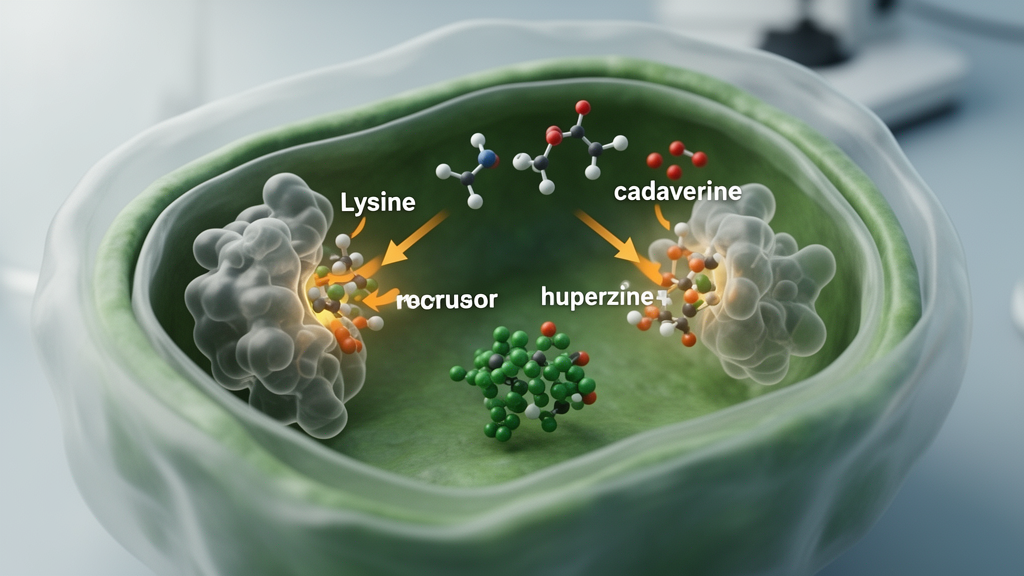
To examine the wider metabolic response, the researchers used LC–MS/IT–TOF profiling, which detected 27 signals corresponding to Lycopodiaceae alkaloids. Huperzine A and huperzine B were confirmed by comparison with authentic standards. The experiments centered on the gametophyte generation of H. selago, a member of the early-diverging vascular-plant lineage Lycopodiaceae. The study investigated a specialized metabolic network in which lysine and cadaverine serve as key entry metabolites. Because those compounds enter the Lycopodiaceae alkaloid network, adding them to the culture medium provided a controlled way to probe regulatory points in huperzine biosynthesis. The reported results support the view that the lysine-derived entry node is an important point of regulation, while also showing that the effects are compound-specific and time-dependent.

The findings establish precursor supplementation as an effective means of modulating huperzine biosynthesis in axenic H. selago gametophytes, rather than identifying one supplementation recipe as universally optimal. Huperzine A and huperzine B exhibited distinct temporal profiles under different treatments, and the response to plant growth regulators also varied with culture time and treatment variant. The authors conclude that axenic gametophyte cultures provide a tractable experimental system for studying specialized metabolism in early-diverging vascular plants and for refining strategies for the controlled production of pharmaceutically relevant alkaloids. Huperzine A and HupB are described in the study as potent acetylcholinesterase inhibitors, but the reported work concerns plant metabolism in culture and does not evaluate clinical effects or human exposure.

Subject of Research: Precursor regulation of huperzine A and B biosynthesis in axenic Huperzia selago gametophyte cultures

Article Title: Lysine and cadaverine differentially regulate huperzine biosynthesis in axenic gametophyte cultures of Huperzia selago (L.) Bernh. ex Schrank et Mart.

Article References: Szypuła, W. J., Markowski, M., & Wileńska, B. (2026). Lysine and cadaverine differentially regulate huperzine biosynthesis in axenic gametophyte cultures of Huperzia selago (L.) Bernh. ex Schrank et Mart.. BMC Plant Biology, 26(1), Article 1672. https://doi.org/10.1186/s12870-026-09868-x

Image Credits: AI Generated

DOI: 10.1186/s12870-026-09868-x

Keywords: Huperzia selago, huperzine A, huperzine B, lysine, cadaverine, axenic gametophytes, plant specialized metabolism, Lycopodiaceae alkaloids, precursor supplementation, plant growth regulators, differentially, regulate

Cite Scienmag News

Alan Morgan. (October 20, 2026). Lysine and cadaverine differentially regulate huperzine biosynthesis. Scienmag. https://scienmag.com/lysine-and-cadaverine-differentially-regulate-huperzine-biosynthesis/

Alan Morgan. "Lysine and cadaverine differentially regulate huperzine biosynthesis." Scienmag, 20 October 2026, https://scienmag.com/lysine-and-cadaverine-differentially-regulate-huperzine-biosynthesis/. Accessed 20 October 2026.

Alan Morgan. "Lysine and cadaverine differentially regulate huperzine biosynthesis." Scienmag. October 20, 2026. https://scienmag.com/lysine-and-cadaverine-differentially-regulate-huperzine-biosynthesis/


Tags: axenic gametophytescadaverinecontrolled plant culture study of club mossdifferentiallyeffects of amino acid supplementation on alkaloid productioneffects of lysine and cadaverineHuperzia selagohuperzine Ahuperzine A and B accumulation in Huperzia selagohuperzine Bhuperzine biosynthesis regulationinfluence of culture conditions on huperzine biosynthesisLycopodiaceae alkaloidslysinelysine and cadaverine plant precursorsplant growth regulatorsplant growth regulators impact on alkaloid levelsplant specialized metabolismprecursor supplementationprecursor-specific regulation of huperzine pathwayregulatetime-dependent changes in plant secondary metabolites
Share26Tweet16
Previous Post

Stakeholders outline ideal mobile health system for congenital heart disease home care

Next Post

Research report: Genetic Variability and Interrelationships of Methionine, Lysine, and Tryptophan in Indian Maize Inbred Lines

Related Posts

Research report: Genetic Variability and Interrelationships of Methionine, Lysine, and Tryptophan in Indian Maize Inbred Lines
Agriculture

Research report: Genetic Variability and Interrelationships of Methionine, Lysine, and Tryptophan in Indian Maize Inbred Lines

October 20, 2026
Fifty fundamental questions to unlock the grapevine microbiome for sustainable viticulture
Agriculture

Fifty fundamental questions to unlock the grapevine microbiome for sustainable viticulture

October 20, 2026
Research report: Synergistic effect of biostimulants and nitrogen fertilization on crop performance of barley (Hordeum vulgare L.) under rainfed conditions
Agriculture

Research report: Synergistic effect of biostimulants and nitrogen fertilization on crop performance of barley (Hordeum vulgare L.) under rainfed conditions

October 20, 2026
Research report: Optimization of nitrogen source ratios for somatic embryo maturation in Pinus elliottii
Agriculture

Research report: Optimization of nitrogen source ratios for somatic embryo maturation in Pinus elliottii

October 20, 2026
Research report: Quantification of soil loss by using RUSLE model under different land use and land cover conditions in AKANYARU catchment in Rwanda
Agriculture

Research report: Quantification of soil loss by using RUSLE model under different land use and land cover conditions in AKANYARU catchment in Rwanda

October 20, 2026
Research report: Nano-encapsulation of peppermint essential oil in chitosan nanoparticles improves salinity tolerance in lettuce
Agriculture

Research report: Nano-encapsulation of peppermint essential oil in chitosan nanoparticles improves salinity tolerance in lettuce

October 20, 2026
Next Post
Research report: Genetic Variability and Interrelationships of Methionine, Lysine, and Tryptophan in Indian Maize Inbred Lines

Research report: Genetic Variability and Interrelationships of Methionine, Lysine, and Tryptophan in Indian Maize Inbred Lines

  • Mothers who receive childcare support from maternal grandparents show more optimized

    Mothers who receive childcare support from maternal grandparents show more parental warmth, finds NTU Singapore study

    27656 shares
    Share 11059 Tweet 6912
  • University of Seville Breaks 120-Year-Old Mystery, Revises a Key Einstein Concept

    1061 shares
    Share 424 Tweet 265
  • Bee body mass, pathogens and local climate influence heat tolerance

    682 shares
    Share 273 Tweet 171
  • Researchers record first-ever images and data of a shark experiencing a boat strike

    546 shares
    Share 218 Tweet 137
  • Groundbreaking Clinical Trial Reveals Lubiprostone Enhances Kidney Function

    531 shares
    Share 212 Tweet 133
Science

Embark on a thrilling journey of discovery with Scienmag.com—your ultimate source for cutting-edge breakthroughs. Immerse yourself in a world where curiosity knows no limits and tomorrow’s possibilities become today’s reality!

RECENT NEWS

  • Principal reports flag serious student absenteeism in 43% of Moroccan schools
  • Better Marital Relationships Linked to Lower Maternal Suicidal Ideation
  • Research report: Genetic Variability and Interrelationships of Methionine, Lysine, and Tryptophan in Indian Maize Inbred Lines
  • Lysine and cadaverine differentially regulate huperzine biosynthesis

Categories

  • Agriculture
  • Anthropology
  • Archaeology
  • Athmospheric
  • Biology
  • Biotechnology
  • Blog
  • Bussines
  • Cancer
  • Chemistry
  • Climate
  • Earth Science
  • Editorial Policy
  • Marine
  • Mathematics
  • Medicine
  • Pediatry
  • Policy
  • Psychology & Psychiatry
  • Science Education
  • Science News
  • Social Science
  • Space
  • Technology and Engineering

Subscribe to Blog via Email

Enter your email address to subscribe to this blog and receive notifications of new posts by email.

Join 5,150 other subscribers

© 2025 Scienmag - Science Magazine

Welcome Back!

Login to your account below

Forgotten Password?

Retrieve your password

Please enter your username or email address to reset your password.

Log In
No Result
View All Result
  • HOME
  • SCIENCE NEWS
  • CONTACT US

© 2025 Scienmag - Science Magazine

Discover more from Science

Subscribe now to keep reading and get access to the full archive.

Continue reading