


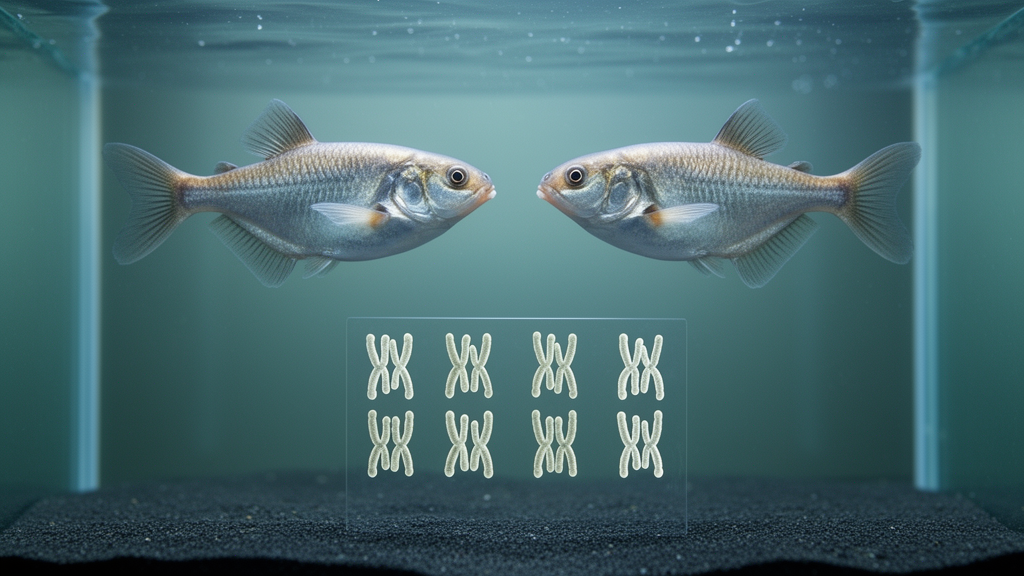
Two African weakly electric elephantfish species, Hyperopisus bebe and Pollimyrus isidori, each carried 40 chromosomes in their somatic cells, the lowest diploid number recorded in the family Mormyridae at the time of the study. Although the species shared the same chromosome count, their chromosome sets had markedly different structures. The observations provide the first cytogenetic data for Hyperopisus and show that the unusually low count of 40 can coexist with substantially different arrangements of metacentric, submetacentric and acrocentric chromosomes.
The investigation was a comparative cytogenetic study conducted during the Joint Ethiopian-Russian Biological Expedition. Researchers karyotyped three individuals of each species: two females and one male for both H. bebe and P. isidori. H. bebe specimens, with standard lengths of 131–356 mm, came from the Alvero River downstream of the Abobo Dam in Ethiopia’s Gambela Peoples’ Region.
P. isidori specimens, measuring 54–60 mm in standard length, were collected from the Baro River downstream of Itang. Both rivers belong to the Sobat River drainage, which discharges into the White Nile in South Sudan. The study examined 30 complete metaphase plates for H. bebe and 33 for P. isidori.
Chromosome preparations were obtained from anterior kidney tissue. The fish received an intraperitoneal 0.1% colchicine treatment for three to four hours before being euthanized with an overdose of tricaine methanesulfonate. Following morphological identification, measurements to the nearest millimetre and examination of the gonads, tissue samples were preserved in 10% formaldehyde and voucher specimens were deposited at the Severtsov Institute of Ecology and Evolution in Moscow under provisional Joint Ethiopian-Russian Biological Expedition labels.
Giemsa-stained chromosome spreads were examined with a Carl Zeiss Axioplan 2 microscope, and chromosomes were classified by centromere position and ordered by decreasing size. Under the study’s classification, metacentric and submetacentric chromosomes were treated as bi-armed, while acrocentric chromosomes, including subtelocentric and telocentric forms, were treated as uni-armed. H. bebe had a diploid complement of 2n = 40, consisting of 24 metacentric, two submetacentric and 14 acrocentric chromosomes.
Its reported fundamental number was FN = 66. P. isidori likewise had 2n = 40, but its complement comprised 26 metacentric, six submetacentric and eight acrocentric chromosomes. No distinguishable sex chromosomes were observed in either species, in keeping with the lack of sex-chromosome reports for other mormyrids considered in the comparison.
The source article contains an internal discrepancy in the fundamental number assigned to P. isidori. Its results text reports FN = 72, while the comparative table lists FN = 74. The discrepancy requires clarification from the original data and does not change the directly reported result that P. isidori possessed 40 chromosomes in the stated morphologies.
It also does not change H. bebe’s reported FN of 66, which is consistent with its formula. Mormyridae comprises 22 genera and almost 230 species of African weakly electric fishes, but representatives of only 14 genera had been examined cytogenetically before this study. Among the species for which chromosome numbers were available, diploid counts usually ranged from 48 to 52, with 50 as the mode.
Krysanov and Golubtsov had previously reported a Pollimyrus taxon identified as P. prope nigricans with 2n = 40, but its complement consisted of two small metacentric and 38 acrocentric chromosomes, giving a reported FN = 42. The new H. bebe and P. isidori results therefore extend the known low numerical extreme of the family while revealing that three taxa with 2n = 40 have substantially different chromosome architectures. Hyperopisus and the two studied Pollimyrus species differ not only in the distribution of chromosome types but also in the relative proportions of uni-armed and bi-armed elements.
The previously described Pollimyrus taxon has 38 acrocentric chromosomes and only two metacentrics. H. bebe has 14 acrocentrics and 26 bi-armed chromosomes, whereas P. isidori has eight acrocentrics and 32 bi-armed chromosomes. The two Pollimyrus species differ chiefly in their number of uni-armed elements, making their chromosome structures more divergent than either is from H. bebe.
Pollimyrus thus becomes the third mormyrid genus for which interspecific variation in karyotype structure has been documented, adding to earlier differences reported between two Marcusenius species and the absence of detected differences among three Mormyrus species. The new observations indicate that chromosome fusions probably played a substantial role in mormyrid karyotype evolution, in addition to the pericentric inversions previously considered the main type of rearrangement. Pericentric inversions had been proposed to account for the conversion of ancestral uni-armed chromosomes into bi-armed forms while preserving chromosome number, and the existing 2n = 50 karyotypes can be explained in the authors’ parsimony scenarios through inversions ranging from one rearranged chromosome pair in Petrocephalus and Stomatorhinus to 17 pairs in Mormyrus.
By contrast, the occurrence of three taxa with only 40 chromosomes cannot be explained by such rearrangements alone. The authors suggest that tandem fusions may have been especially important in the reduction to 2n = 40 in the earlier Pollimyrus taxon, whose low FN and strong predominance of acrocentric chromosomes provide the basis for that interpretation. These results were interpreted within competing reconstructions of the ancestral mormyrid karyotype.
Earlier work had proposed an ancestral haploid number of either 24 or 25. A later analysis instead favoured a hypothetical ancestor with 2n = 50–52 and a predominance of uni-armed chromosomes. That reconstruction drew on Mormyridae’s place within the osteoglossomorph fishes, genomic evidence for a 50-chromosome ancestral euteleostome karyotype dominated by acrocentric elements, a proposed ancestral 2n = 50 complement composed exclusively of uni-armed chromosomes in the related notopterid family, and comparable chromosome structures in some mormyrid genera occupying relatively basal positions in molecular phylogenies.
Against this background, the researchers regarded karyotypes with the fewest uni-armed elements as the most derived condition within Mormyridae. Within that framework, Mormyrus was treated as the most derived among mormyrids retaining chromosome counts of 48–52, while P. isidori was considered the most derived among those with 2n = 40. The comparison spans markedly different arrangements despite similar totals: Petrocephalus microphthalmus and Stomatorhinus walkeri each have 50 chromosomes arranged as two submetacentric and 48 acrocentric elements, while Mormyrus caschive, M. hasselquistii and M. kannume each have 20 metacentric, 14 submetacentric and 16 acrocentric chromosomes.
The authors emphasize that advanced cytogenetic techniques could test their suggestions about the evolution of chromosome arrangements and numbers within Mormyridae. The results therefore define candidate pathways for mormyrid karyotype evolution while leaving the exact P. isidori fundamental number and the broader evolutionary history of these unusual low-count karyotypes unresolved.
Subject of Research: Comparative cytogenetics and karyotype evolution in African weakly electric elephantfishes
Article Title: Derived karyotypes in two elephantfish genera ( Hyperopisus and Pollimyrus ): lowest chromosome number in the family Mormyridae ( Osteoglossiformes )
Article References: Simanovsky, S., Medvedev, D., Tefera, F., & Golubtsov, A. (2021). Derived karyotypes in two elephantfish genera (Hyperopisus and Pollimyrus): lowest chromosome number in the family Mormyridae (Osteoglossiformes). Comparative Cytogenetics, 15(4), 345-354. https://doi.org/10.3897/compcytogen.v15.i4.67681
Image Credits: AI Generated
DOI: 10.3897/compcytogen.v15.i4.67681
Keywords: Mormyridae, elephantfish, karyotype evolution, chromosome number, Hyperopisus bebe, Pollimyrus isidori, cytogenetics, chromosome fusion, African fishes, Ethiopian rivers, Derived, karyotypes
Cite Scienmag News
Drew Townsend. (October 20, 2026). Two elephantfish genera reveal the lowest mormyrid chromosome count. Scienmag. https://scienmag.com/two-elephantfish-genera-reveal-the-lowest-mormyrid-chromosome-count/
Drew Townsend. "Two elephantfish genera reveal the lowest mormyrid chromosome count." Scienmag, 20 October 2026, https://scienmag.com/two-elephantfish-genera-reveal-the-lowest-mormyrid-chromosome-count/. Accessed 20 October 2026.
Drew Townsend. "Two elephantfish genera reveal the lowest mormyrid chromosome count." Scienmag. October 20, 2026. https://scienmag.com/two-elephantfish-genera-reveal-the-lowest-mormyrid-chromosome-count/


