


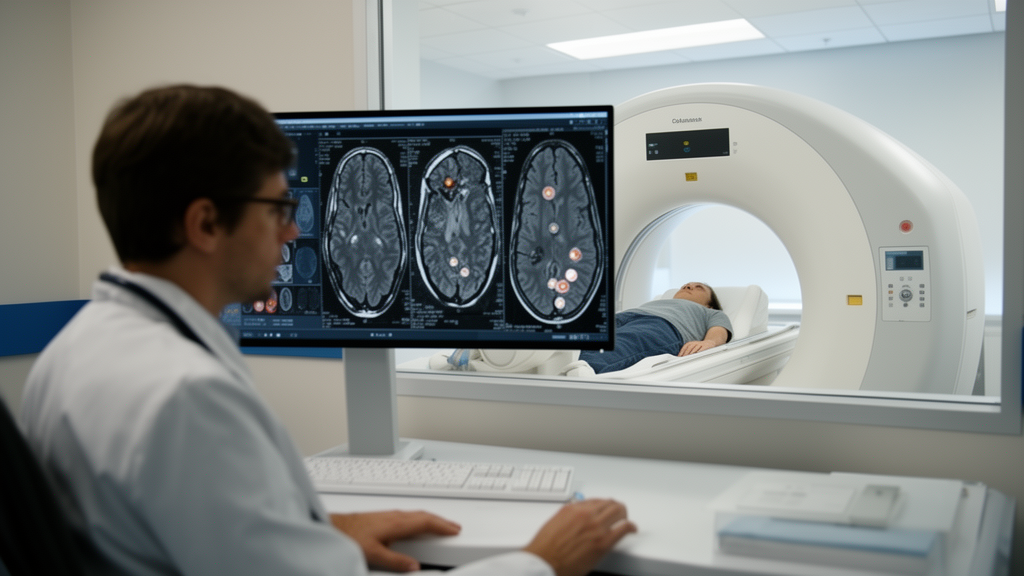
MRI-confirmed brain metastases were diagnosed at roughly twice the early-period rate among residents of North Savo, Finland, according to a population-based retrospective study covering 2004–2023. Across the full period, the age-standardized incidence was 9.20 brain metastases per 100,000 person-years, with the rate rising from 5.8 in 2004–2008 to 11.8 in 2019–2023. An age-adjusted Poisson regression estimated a 24% increase for each successive five-year period, suggesting that population aging alone was unlikely to explain the upward trend.
The findings concern MRI-detected cases in one Finnish region and do not by themselves establish the cause of the increase. The researchers identified 516 North Savo residents whose first MRI diagnosis of brain metastases occurred between 1 January 2004 and 31 December 2023, irrespective of when their primary cancer was diagnosed. Their median age at diagnosis was 66 years, with an interquartile range of 58–73 years and an overall range of 22–94.
The cohort was 47.9% male and 52.1% female. Cases were found by searching the local radiology information system for Finnish-language variants of the term “metastasis,” then checking medical and histopathological records to confirm the diagnosis, identify a primary tumor where possible and exclude primary brain tumors, non-solid malignancies and benign or inflammatory conditions. Histopathological verification was available for 474 of the 516 patients, either through examination of the metastatic lesion or the primary tumor.
Another 23 cases were supported by earlier medical records or supplementary imaging, including computed tomography. The primary cancer remained unidentified in 19 patients, nine of whom had histopathological samples that were inconclusive. Multiple brain metastases in the same patient were counted as one case.
Because patients entered the cohort at their first MRI diagnosis regardless of the date of their primary-cancer diagnosis, the analysis included both synchronous metastases present at cancer diagnosis and metachronous metastases that developed later. That approach differs from registry studies focused only on brain tumors recorded when a primary cancer was initially diagnosed. Lung cancer was the source of the largest share of cases, accounting for 32.0%, or 165 of 516 brain metastases, followed by breast cancer at 24.8%, or 128 cases.
Together, lung and breast cancers accounted for 56.8% of all identified cases. Genitourinary primaries represented 13.6%, gastrointestinal cancers 10.1% and melanoma 9.5%. Lung-cancer brain metastases had an age-standardized incidence of 2.89 per 100,000 person-years, while the corresponding rate for breast-cancer metastases was 2.35.
Patients with breast cancer had a younger median age at brain-metastasis diagnosis than those with lung, gastrointestinal, genitourinary or melanoma primaries, whereas patients whose primary tumor was unknown had the oldest median age, at 81 years. Adenocarcinoma was the predominant histological subtype among lung-cancer cases, responsible for 53% of lung-associated brain metastases. Small-cell carcinoma accounted for 19% and squamous-cell carcinoma for 14%.
Among breast-cancer cases, hormone-receptor-positive, HER2-negative tumors formed the largest group at 47%, followed by hormone-receptor-positive, HER2-positive tumors at 22%. Hormone-receptor-negative, HER2-positive cancers accounted for 14%, and triple-negative disease for 13%. These percentages describe the composition of brain-metastasis cases rather than the probability of developing brain metastases within each breast-cancer subtype, an important distinction because the prevalence of breast-cancer subtypes and differences in disease duration can affect the observed distribution.
Age-specific incidence remained low among people younger than 40 and rose substantially thereafter. It reached 13.4 per 100,000 person-years at ages 50–54 and peaked at 33.1 per 100,000 among residents aged 70–74. The rate at the peak was about six times that recorded at ages 45–49.
Incidence declined after age 74 but remained above 20 per 100,000 person-years in both the 75–79 and 80–84 age groups before falling further among those aged 85 or older. The researchers noted possible explanations for the later decline, including competing mortality and less frequent imaging when results were considered unlikely to change prognosis or treatment, but these explanations were not directly tested in the analysis. The temporal pattern was strongest between the first two five-year periods, followed by a more gradual increase to 11.8 per 100,000 person-years in 2019–2023.
Compared with 2004–2008, the age-adjusted incidence-rate ratios were 1.46 for 2009–2013, 1.64 for 2014–2018 and 2.02 for 2019–2023. Annual crude incidence ranged from 3.9 per 100,000 person-years in 2004 to 17.3 in 2023. A linear model estimated a 31% crude increase per five-year period, compared with 24% after age adjustment, indicating that changing population age contributed to part, but not all, of the observed rise.
The study therefore found a statistically significant temporal increase even after adjusting the case counts for age-specific population denominators. The age-adjusted upward trend remained statistically significant in a sensitivity analysis that excluded 2004–2008: the incidence-rate ratio was 1.17 per five-year period, with a 95% confidence interval of 1.04–1.32 and a P value of 0.007. Treating calendar period as a categorical rather than linear variable did not significantly improve model fit.
The study’s overall crude rate of 10.22 per 100,000 person-years was within the range of approximately 8.3–24 reported by previous population-based studies. Its age-standardized rate of 9.20 was higher than estimates for synchronous brain metastases derived from the United States SEER program, which were about 7 per 100,000 in 2010–2015 and 7.1 in 2015–2019. The researchers said differences in case ascertainment may partly explain the comparison.
Several factors could plausibly contribute to the trend, although the analysis did not establish causation. Expanded access to MRI and a lower threshold for neuroimaging may have improved detection of small or asymptomatic metastases compared with computed tomography. Greater clinical awareness, clearer referral pathways and improved registry completeness could also have raised the number of cases identified.
Advances in systemic cancer treatment may have extended survival and therefore the time during which patients with cancer remain at risk of brain metastasis. The researchers could not directly evaluate MRI availability or use, survival after primary cancer, or the interval between primary-cancer diagnosis and the first MRI showing brain metastases, leaving the contribution of these factors uncertain. The study has a population-based design, a 20-year observation period and virtually complete follow-up through Finland’s organized healthcare system.
General-population denominators came from Statistics Finland, while age-standardized rates were calculated using the 2013 European Standard Population. Its limitations include the retrospective design, possible missing data and the inability to assess whether every brain-metastasis case was captured. Only MRI-detected cases were included, and findings from one Finnish region may not generalize fully to other populations.
The results therefore provide a regional measure of MRI-confirmed brain-metastasis incidence, rather than a complete census of all intracranial metastatic disease or proof that changes in imaging and treatment produced the observed increase.
Subject of Research: Population-based trends in MRI-confirmed brain metastases in North Savo, Finland, from 2004 to 2023
Article Title: Incidence of intra-axial brain metastases in Eastern Finland
Article References: Moniruzzaman, S., Rantala, S., Hakumäki, J., & Rauramaa, T. (2026). Incidence of intra-axial brain metastases in Eastern Finland. Journal of Neuro-Oncology, 180(2), Article 24. https://doi.org/10.1007/s11060-026-05842-7
Image Credits: AI Generated
DOI: 10.1007/s11060-026-05842-7
Keywords: brain metastases, North Savo, Finland, MRI, cancer epidemiology, age-standardized incidence, lung cancer, breast cancer, population-based study, Incidence, intra-axial, brain
Cite Scienmag News
Nathaniel Bowman. (October 20, 2026). Research report: Incidence of intra-axial brain metastases in Eastern Finland. Scienmag. https://scienmag.com/research-report-incidence-of-intra-axial-brain-metastases-in-eastern-finland/
Nathaniel Bowman. "Research report: Incidence of intra-axial brain metastases in Eastern Finland." Scienmag, 20 October 2026, https://scienmag.com/research-report-incidence-of-intra-axial-brain-metastases-in-eastern-finland/. Accessed 20 October 2026.
Nathaniel Bowman. "Research report: Incidence of intra-axial brain metastases in Eastern Finland." Scienmag. October 20, 2026. https://scienmag.com/research-report-incidence-of-intra-axial-brain-metastases-in-eastern-finland/


