


A forearm plank lasting at least 227 seconds—about 3 minutes 47 seconds—placed a 16-year-old boy in the “Excellent” category, corresponding to the top 10% of South Punjab adolescents of the same age and sex. By comparison, a 16-year-old girl needed at least 126 seconds, or 2 minutes 6 seconds, to reach the same percentile-based category. These thresholds came from the first age- and sex-specific plank-test reference values for Pakistani adolescents, developed in a cross-sectional study of 2,970 pupils aged 12–16 across 60 higher secondary schools in South Punjab. The fitted median hold time rose from 50 to 61 seconds between ages 12 and 16 in boys and from 44 to 66 seconds in girls.
The research converted raw plank-hold times into five performance zones based on percentile boundaries adapted from the Chinese National Physical Fitness Evaluation Standard. “Very Poor” was defined as performance at or below the 10th percentile, “Poor” as the 10th to 35th percentiles, “Medium” as the 35th to 65th, “Good” as the 65th to 90th and “Excellent” as the 90th percentile or higher. Cut-points were calculated separately for each age and sex. Of the 2,970 participants, 32.7% were classified as Medium and 24.4% as Good, together accounting for 57.1%. Another 20.6% were placed in Poor, 12.4% in Very Poor and 9.9% in Excellent. These are population-relative classifications for the studied region, not diagnoses, health-risk categories or universal standards of fitness.
Students were recruited in 2020 using stratified random sampling across the Multan, Bahawalpur and D.G. Khan administrative divisions of South Punjab. The investigators randomly selected 20 schools from each division and then selected 50 students from every school, producing a final cohort of 1,477 boys and 1,493 girls, or 49.73% and 50.27% of the sample, respectively. Each whole-year age group from 12 through 16 contained approximately 590 participants. The sampling frame represented about 16.67% of the 360 eligible higher secondary schools in the region. Data were collected before nationwide COVID-19 school closures, so the findings provide a pre-pandemic baseline for this cohort rather than a current or post-pandemic description of adolescents in Pakistan.
To construct smooth percentile curves, the researchers used the Lambda-Mu-Sigma, or LMS, method within the GAMLSS framework in R. Lambda models skewness, Mu represents the median and Sigma captures the coefficient of variation, allowing the reference distribution to depart from a simple normal curve. The fits used the Box-Cox Cole-Green distribution, with each of the three parameters modelled as a quadratic function of age. Because participants’ ages were recorded in completed years rather than months, the curves were supported by only five discrete age points for each sex. Model adequacy was assessed using worm plots, quantile-quantile plots and normalized quantile residuals, which were reported to conform closely to a standard normal distribution. Within each sex, the researchers also performed 1,000 non-parametric bootstrap resamples, refitted the model and recomputed the percentiles to obtain 95% confidence intervals.
Boys recorded a higher average plank time than girls: 80.72 ± 73.48 seconds versus 69.07 ± 58.16 seconds. The overall difference was statistically detectable after correction for multiple comparisons, but its magnitude was small, with a rank-biserial correlation of 0.06. Age-specific analyses told a less uniform story. After false-discovery-rate adjustment, statistically significant differences remained at ages 13 and 15, with effect sizes of 0.14 and 0.12, respectively. No detectable difference was found at ages 12, 14 or 16, although the unadjusted result at age 12 had a p-value of 0.045 before correction. Boys also had higher mean height, weight and body mass index, but the study did not measure biological maturation and did not adjust plank performance for body size or composition, so the relative contributions of maturation, adiposity, muscle mass and other factors could not be separated.
The clearest age pattern occurred near the upper end of the boys’ fitted distribution. Their 90th-percentile hold time increased from 132 seconds at age 12 to 226 seconds at age 16, whereas their median rose by only 11 seconds, from 50 to 61 seconds. The increasingly right-skewed distribution therefore separated a subset of long-lasting performers from the typical boy at older ages. Girls showed a steadier increase through the middle of the distribution: their median climbed from 44 seconds at age 12 to 66 seconds at age 16, and their fitted median was higher than that of boys at the oldest age. The girls’ 90th percentile followed a curved path, rising from 126 seconds at age 12 to 145 seconds at age 14 and then falling to 125 seconds at age 16. Because these are cross-sectional fitted curves, neither pattern demonstrates how an individual adolescent’s performance developed over time.
Uncertainty was greatest at the age boundaries, especially among the upper percentiles. The girls’ age-16 90th percentile of 125 seconds had a bootstrap 95% confidence interval of 118–133 seconds, while the boys’ corresponding estimate of 226 seconds had a much broader interval of 200–252 seconds. The apparent downturn in the girls’ upper percentile should therefore be treated as a boundary effect rather than evidence of declining fitness among older girls: the age-16 curves were the least constrained, and the confidence intervals at ages 14 and 16 for the girls’ upper estimates were only marginally separated. The authors also warned against using the girls’ age-16 third-percentile value of 12 seconds for individual classification because its relative bootstrap interval was 92% wide, spanning 4–15 seconds. Age-16 cut-points, particularly those in the tails, consequently require more caution than the estimates for ages 12–15.
Internal consistency was evaluated through a back-substitution procedure. The researchers first fitted the LMS model to the full sample and then compared its median, or P50, estimates with those produced after fitting a random subsample of 295 boys and 299 girls—about 20% of each sex group. Agreement was quantified with mean absolute percentage error. The average error was 6.69% for boys and 6.04% for girls. All age-specific values were below 10% except the estimate for 16-year-old boys, which reached 10.21%. The subsample produced lower estimates than the full reference in nine of the ten age-by-sex cells and did not reproduce the full model’s shape of change across ages. The procedure therefore supports the internal stability of the central estimates within the sampled population, but it is not external validation: the comparison data came from the same cohort used to construct the references, and the check evaluated only the median rather than the entire distribution or health-related outcomes.
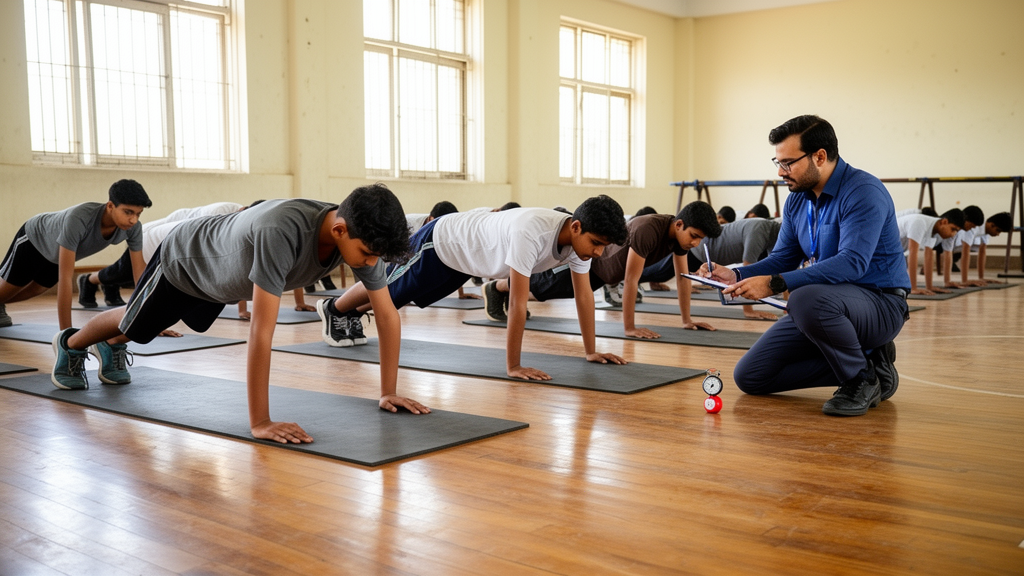
Field testing followed a standardized protocol designed for school environments. Before measurement, each participant received verbal instruction, a visual demonstration and a familiarization attempt, followed by a warm-up lasting about two and a half minutes. The warm-up included 30 seconds each of jogging in place, leg swings, arm circles, walking lunges and hip rotations. Participants then assumed a forearm plank on a mat, with elbows directly beneath the shoulders, feet hip-width apart and the body aligned from head to heels. The timer continued until volitional fatigue or a third form error, with no artificial maximum time imposed, so exceptionally long holds could be observed. Twelve research assistants completed a training workshop, repeated practice trials and supervised pilot sessions before data collection. The researchers did not directly measure test-retest or inter-rater reliability in this sample, although standardized training and clear termination rules were intended to reduce procedural variation.
Several limitations prevent the references from being treated as national or international standards. The study covered only South Punjab, school-level clustering was not modelled in the statistical analyses, and the bootstrap intervals were described as lower bounds on the true sampling uncertainty. Biological maturation was not measured, and whole-year age recording limited the resolution of the reference curves. The plank test evaluates isometric endurance of the anterior core, not lateral or posterior muscular endurance or dynamic core stability, while absolute hold times were not adjusted for body mass or body composition. Direct reliability testing was also absent. The cross-sectional design precludes causal conclusions and observations of individual trajectories. Validation in independently collected samples, replication in other regions of Pakistan, finer age measurement, maturity assessment, body-composition-adjusted references and longitudinal research are needed before these South Punjab benchmarks can be applied more broadly or linked to health outcomes.
Subject of Research: Age- and sex-specific plank-test reference values for core muscular endurance among South Punjab adolescents aged 12–16
Article Title: Age- and sex-specific normative references and performance zones for core muscular endurance in adolescents aged 12–16 years: a cross-sectional study
Article References: Yanlan, G., Liu, Y., Hadier, S. G., Hamdani, S. D., Wu, J., & Hamdani, S. M. Z. H. (2026). Age- and sex-specific normative references and performance zones for core muscular endurance in adolescents aged 12–16 years: a cross-sectional study. Frontiers in Physiology, 17, Article 1802720. https://doi.org/10.3389/fphys.2026.1802720
Image Credits: AI Generated
DOI: 10.3389/fphys.2026.1802720
Keywords: core muscular endurance, plank test, Pakistani adolescents, normative references, percentile curves, performance zones, South Punjab, school fitness, LMS method, cross-sectional study, Age-, sex-specific
Cite Scienmag News
Beatrice Stafford. (October 20, 2026). Cross-sectional study sets South Punjab plank endurance benchmarks for adolescents. Scienmag. https://scienmag.com/cross-sectional-study-sets-south-punjab-plank-endurance-benchmarks-for-adolescents/
Beatrice Stafford. "Cross-sectional study sets South Punjab plank endurance benchmarks for adolescents." Scienmag, 20 October 2026, https://scienmag.com/cross-sectional-study-sets-south-punjab-plank-endurance-benchmarks-for-adolescents/. Accessed 20 October 2026.
Beatrice Stafford. "Cross-sectional study sets South Punjab plank endurance benchmarks for adolescents." Scienmag. October 20, 2026. https://scienmag.com/cross-sectional-study-sets-south-punjab-plank-endurance-benchmarks-for-adolescents/


