


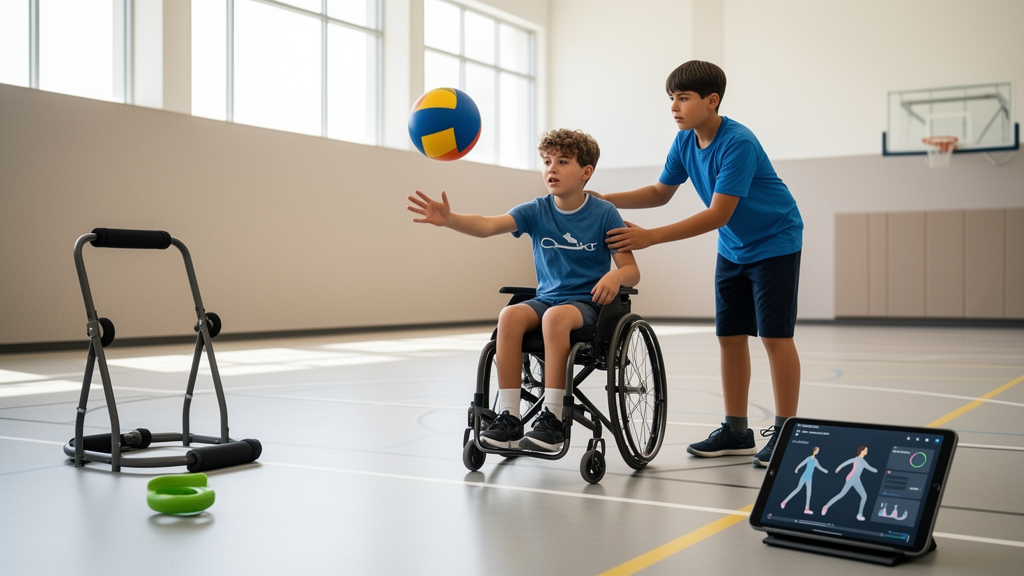
A conceptual analysis proposes that physical education can fail twice-exceptional students with physical disabilities in two opposite ways: making movement accessible while leaving advanced thinking underchallenged, or recognizing advanced contributions while restricting meaningful movement. The authors introduce “strength-referenced competence support,” an instructional principle designed to align evidence of a learner’s advanced physical-education capacity with appropriate challenge, accessible assessment, substantive recognition and continued motor learning. The framework is not a tested intervention, and its seven propositions remain to be evaluated empirically.
The central problem is a mismatch between what a lesson counts as evidence of learning and what a student is capable of learning. A learner with a physical disability might use adapted equipment and participate successfully in a movement task yet receive no opportunity to extend advanced tactical or analytical understanding. Another might demonstrate sophisticated game analysis but spend much of the lesson outside movement activities. Accessible participation alone therefore does not show that competence needs are being supported, and recognition of advanced ability alone does not establish inclusion.
The proposal draws on Self-Determination Theory and its Basic Psychological Need Theory. In this framework, autonomy is the experience of volition, competence is the experience of effectiveness, and relatedness is the experience of connection and acceptance. These needs are universal, although the conditions that support them can vary by learner and setting. A twice-exceptional learner’s advanced capacity does not create a stronger or separate need; instead, it changes the level and form of challenge that may be appropriate. The authors also distinguish insufficient need satisfaction from active frustration, which is associated with experiences such as feeling inadequate, controlled or rejected.
Strength-referenced competence support has four coordinated elements. First, evidence must identify an advanced or emerging capacity relevant to the intended physical-education goal. Second, the task must provide meaningful challenge for that capacity rather than treating the learner’s disability-related adaptations as sufficient evidence of learning. Third, students need an accessible response mode, such as a diagram, spoken explanation or assisted enactment, through which advanced reasoning can be assessed. Fourth, that evidence must have consequences in feedback, assessment or shared activity. The approach also requires meaningful adapted motor learning, making movement access an ongoing educational goal rather than an obstacle to be eliminated.
For example, a student with cerebral palsy who demonstrates advanced tactical understanding of invasion games could be assessed through an accessible explanation of a tactical decision rather than through rapid movement alone. A separate criterion-based motor task could evaluate progress in adapted movement. Merely allowing the student to explain tactics would not complete the model, however, if the reasoning never informs feedback, assessment or play. Likewise, appointing the student as a team analyst would be insufficient if that role permanently replaces physical participation. In this account, generic praise and a designated specialist role do not necessarily amount to substantive recognition; the learning evidence must guide further learning or shared activity.
The framework sets out seven conditional predictions. Accessible assessment of advanced reasoning is expected to predict less competence frustration than an assessment that accepts only disability-constrained motor performance. When evidence of advanced learning informs feedback, assessment or shared activity, competence satisfaction is expected to improve beyond the effect of an equally accessible and challenging task whose evidence is inconsequential. Visible use and acknowledgment of advanced contributions may also moderate the association between publicly visible motor difficulty and feelings of competence or relatedness. Selection and scoring rules that admit both advanced contributions and accessible movement are predicted to reduce structural exclusion compared with rules based only on unadapted motor output.
Other predictions distinguish the likely effects of different kinds of support. For a student constrained in both movement and advanced learning, an improvement confined to motor access should primarily enhance effectiveness in movement, whereas better advanced challenge and recognition should produce the opposite pattern; provision addressing both domains should support effectiveness across them without assuming an extra benefit beyond the sum of the two. Comparable access and challenge paired with greater student influence over adaptations are expected to support more autonomy satisfaction than imposed allocation to the same activities. A tentative final proposition predicts that repeated access to appropriately challenging strength expression and meaningful motor learning may support sustained physical activity through more favorable need experiences and autonomous motivation, although causal evidence would be required.
The authors position the principle within established educational approaches rather than presenting it as an entirely new teaching method. Mastery-oriented assessment, strengths-based education, differentiated instruction and Universal Design for Learning can all implement the same conditions. Universal Design for Learning, in particular, can offer options for engagement, representation, action and expression while retaining demanding tactical problems. Its contribution is not the label attached to it but whether the options actually align the learner’s relevant capacity, challenge, evidence and recognition. If an established approach meets all four conditions, the authors expect it to be functionally equivalent to strength-referenced competence support, with no additional effect from the specific label.
Testing the framework requires unusually careful measurement. Advanced capacity should be established independently of gifted identification, motivational reports and the outcomes being predicted, using accessible tasks, developmentally appropriate standards and information about prior learning opportunities. Researchers should distinguish domain-specific sport knowledge, motor competence, perceived capability and experienced competence. Instructional conditions should also be observed independently: whether the task provided appropriate challenge, whether the response mode was valid, where recognition occurred and whether movement opportunities remained meaningful. Need satisfaction and active frustration should be assessed separately, and measurement equivalence should be checked before group comparisons. The recruitment criteria, prior experience, disability-related variation, cultural context and student preferences all require explicit attention.
The research agenda calls for comparisons that isolate each proposed mechanism rather than treating success in a combined program as proof of the new principle. Assessment studies could compare two ways of evaluating the same goal while holding instructional exposure constant. Recognition studies could match teacher contact, workload and movement opportunities, then specify whether recognition occurred through feedback, assessment or peer uptake. Participation studies could examine how grouping, scoring and selection rules operate rather than relying only on general perceptions of climate. Longitudinal work would need to establish temporal ordering and account for baseline activity, motor competence, health, fatigue and continuing access before attributing later participation to the proposed pathway. The authors caution that the target population is heterogeneous, evidence is currently limited and the framework may be useful even for students who show similar advanced capacity without formal twice-exceptional identification. Its value, they argue, will ultimately depend on whether its conditional predictions improve explanation and instructional decisions beyond less differentiated accounts.
Subject of Research: Conceptual framework for supporting advanced ability and motor access in physical education for twice-exceptional students with physical disabilities
Article Title: Strength-referenced competence support in physical education for twice-exceptional students with physical disabilities
Article References: Alsamiri, Y. A., Alsamani, O. A., Alsharidah, M. A., & Alfaidi, S. D. (2026). Strength-referenced competence support in physical education for twice-exceptional students with physical disabilities. Frontiers in Psychology, 17, Article 1980868. https://doi.org/10.3389/fpsyg.2026.1980868
Image Credits: AI Generated
DOI: 10.3389/fpsyg.2026.1980868
Keywords: physical education, twice-exceptional students, physical disability, competence support, accessible assessment, Self-Determination Theory, Basic Psychological Need Theory, motor learning, strength-based education, Strength-referenced, competence, support
Cite Scienmag News
Courtney Benton. (October 20, 2026). Conceptual framework links adapted PE access with advanced ability support. Scienmag. https://scienmag.com/conceptual-framework-links-adapted-pe-access-with-advanced-ability-support/
Courtney Benton. "Conceptual framework links adapted PE access with advanced ability support." Scienmag, 20 October 2026, https://scienmag.com/conceptual-framework-links-adapted-pe-access-with-advanced-ability-support/. Accessed 20 October 2026.
Courtney Benton. "Conceptual framework links adapted PE access with advanced ability support." Scienmag. October 20, 2026. https://scienmag.com/conceptual-framework-links-adapted-pe-access-with-advanced-ability-support/


