


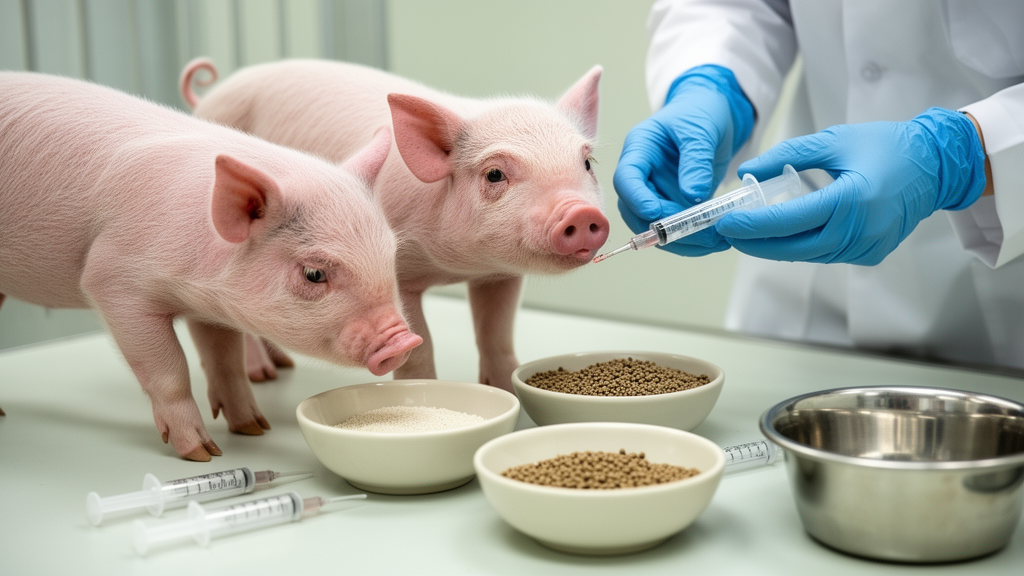
Dietary L-glutamate or L-aspartate altered selected blood, immune and metabolic responses in weaned piglets experimentally challenged with enterotoxigenic Escherichia coli (ETEC), according to a controlled animal study at the University of California, Davis. The experiment found favorable responses for several outcomes with either amino acid, including some responses comparable to those seen in pigs receiving the antibiotic growth promoter carbadox. Supplying both amino acids together did not consistently produce greater effects than supplying either one alone, and the results do not establish that the supplements could replace antibiotics under farm conditions.
The researchers randomly assigned 65 piglets, 28 days old and weighing 7.59 ± 1.11 kilograms, to five treatments with 13 animals per group. The groups received a basal control diet, a diet supplemented with 1% L-glutamate, a diet supplemented with 1% L-aspartate, a diet containing 1% of each amino acid, or basal diet supplemented with 50 mg/kg carbadox. All pigs were orally inoculated with F18 ETEC for three consecutive days, beginning on day 7.
Blood was collected before inoculation and on days 9, 11, 21 and 28. The small intestine was sampled on day 12, near peak infection, and day 28, during recovery. The protocol was reviewed and approved by the UC Davis Institutional Animal Care and Use Committee under protocol 23529.
The challenge was followed by changes in blood-cell profiles and circulating markers of inflammation, although the response to dietary treatment was selective rather than uniform. White blood cell, neutrophil, lymphocyte, monocyte, eosinophil and basophil counts increased after inoculation and peaked on day 21, with no treatment differences in these populations at the individual sampling points. Red blood cell count, mean corpuscular hemoglobin, mean corpuscular hemoglobin concentration, platelet count and total protein concentration also increased on days 9 and 11 relative to pre-inoculation values, while hematocrit, mean corpuscular volume, red cell distribution width and mean platelet volume decreased.
Serum tumor necrosis factor-alpha rose on days 11, 21 and 28, serum interleukin-8 increased on day 11, and C-reactive protein and haptoglobin rose during the early post-challenge period. These infection-associated shifts occurred across the experiment, whereas the amino-acid groups differed from controls or the carbadox group in selected outcomes at particular times. Differences in red blood cell indices were most evident during recovery.
On day 21, piglets receiving L-glutamate or L-aspartate had higher hemoglobin concentration, hematocrit and mean corpuscular hemoglobin than controls. Mean corpuscular volume was also greater in the L-glutamate, L-aspartate and combined-supplement groups than in controls. At that point, L-glutamate and the combination had higher red cell distribution width than controls, while L-aspartate did not show the same elevation.
By day 28, L-glutamate and L-aspartate had lower red cell distribution width than controls, and L-aspartate also showed a tendency toward a greater mean corpuscular volume. These measurements document differences in red blood cell size, hemoglobin content and population uniformity. Systemic inflammatory markers showed a similarly time-dependent pattern.
On day 9, L-aspartate and the combined treatment had lower serum interleukin-8 concentrations than controls, while L-glutamate and L-aspartate had lower C-reactive protein than pigs receiving carbadox. On day 11, all three amino-acid treatments had lower C-reactive protein than controls and the antibiotic group, although pigs receiving the combined supplement had the highest serum tumor necrosis factor-alpha among the groups. By days 21 and 28, haptoglobin was substantially higher in controls than in each amino-acid group and in the carbadox group.
No treatment differences were detected for tumor necrosis factor-alpha, interleukin-8 or C-reactive protein on those later dates. The results therefore show modulation of selected inflammatory markers rather than broad or consistent suppression of every inflammatory signal. Mucosal gene-expression measurements revealed additional differences by intestinal segment and stage of infection.
On day 12, L-aspartate reduced ileal interleukin-8 expression compared with controls, the combined treatment and carbadox. In contrast, pigs receiving both amino acids had higher ileal interleukin-1 beta and interleukin-17A expression than pigs receiving L-aspartate or carbadox, as well as higher jejunal interleukin-1 beta expression. L-glutamate tended to have lower jejunal Toll-like receptor 4 expression, and the combination tended to have lower ileal tumor necrosis factor-alpha expression.
These results came from messenger RNA analysis of intestinal tissue. They establish differences in transcriptional responses, not direct evidence of altered cytokine protein abundance, bioactivity, epithelial integrity or clinical disease severity. By day 28, the intestinal expression profile included several genes associated with immune regulation and tissue repair.
In the jejunum, L-glutamate, L-aspartate and the combination tended to increase interleukin-4 expression relative to controls, while L-glutamate, L-aspartate and carbadox significantly increased interleukin-13 expression. In the ileum, the combined treatment had the greatest interleukin-4 expression, and L-glutamate had greater transforming growth factor beta 1 expression than the other treatments. Untargeted metabolomics offered an exploratory view of biochemical differences among the groups.
The researchers detected 414 features in day-12 jejunal mucosa, including 170 identified metabolites, and 393 features, including 161 identified metabolites, in day-12 ileal mucosa. Day-11 serum contained 402 detected features, of which 142 were identified. Higher jejunal aspartate abundance in pigs receiving L-glutamate or the combination met the predefined exploratory criteria, as did higher ileal glutaric acid in the combined group.
Large fold changes included increased serum palmitoleic and oleic acids with all three amino-acid treatments, increased jejunal maltose, lactose and sucrose, and increased ileal sucrose and cellobiose in L-glutamate-fed pigs. These are treatment-associated differences, not direct evidence that the metabolic changes were beneficial. Pathway enrichment identified recurring associations with alanine, aspartate and glutamate metabolism, the citrate cycle, arginine biosynthesis and carbohydrate-related pathways across serum and intestinal samples.
Glutathione metabolism and taurine and hypotaurine metabolism also appeared in intestinal comparisons, while metabolites including glucose-6-phosphate and fructose-6-phosphate were associated with pentose-phosphate-related changes. The analysis used an exploratory false-discovery-rate threshold below 0.2, together with nominal significance, pathway impact above 0.1 and, for selected metabolites, a variable-importance score above 1. The findings are therefore hypothesis-generating: they cannot identify which metabolic route produced an immune difference or show that greater abundance of a metabolite represented improved health.
Several limitations constrain how the results can be interpreted. L-glutamate and L-aspartate were added as crystalline ingredients in place of corn, so the diets differed not only in the presence of these amino acids but also in total amino acid and nitrogen supply. The combined group received twice the supplemental amino-acid amount of either single-ingredient group, making additive, synergistic and greater-substrate effects impossible to separate.
Only six or seven pigs per group were assessed at the terminal tissue-sampling points, limiting precision for segment-specific immune results. The artificial challenge also does not reproduce the full conditions of commercial production. Taken together, the experiment shows that L-glutamate and L-aspartate can modulate selected hematological, inflammatory and metabolic responses during experimental ETEC challenge in weaned piglets, but it does not demonstrate reduced antibiotic need, improved growth or superiority of the combined treatment.
Subject of Research: Effects of L-glutamate and L-aspartate supplementation on hematological, immune and metabolic responses in ETEC-challenged weaned piglets
Article Title: Dietary L-glutamate, L-aspartate, and their combination supplementation modulated hematological, immune, and metabolic responses in weaned piglets challenged with enterotoxigenic Escherichia coli
Article References: Wongchanla, S., Park, Y., Park, S., Sun, S., & Liu, Y. (2026). Dietary L-glutamate, L-aspartate, and their combination supplementation modulated hematological, immune, and metabolic responses in weaned piglets challenged with enterotoxigenic Escherichia coli. Frontiers in Veterinary Science, 13, 1938098. https://doi.org/10.3389/fvets.2026.1938098
Image Credits: AI Generated
DOI: 10.3389/fvets.2026.1938098
Keywords: ETEC, weaned piglets, L-glutamate, L-aspartate, amino acid nutrition, intestinal immunity, hematology, inflammation, metabolomics, piglet nutrition, Dietary, combination
Cite Scienmag News
Kristina Jarvis. (October 20, 2026). Amino acid supplements alter responses in ETEC-challenged weaned piglets. Scienmag. https://scienmag.com/amino-acid-supplements-alter-responses-in-etec-challenged-weaned-piglets/
Kristina Jarvis. "Amino acid supplements alter responses in ETEC-challenged weaned piglets." Scienmag, 20 October 2026, https://scienmag.com/amino-acid-supplements-alter-responses-in-etec-challenged-weaned-piglets/. Accessed 20 October 2026.
Kristina Jarvis. "Amino acid supplements alter responses in ETEC-challenged weaned piglets." Scienmag. October 20, 2026. https://scienmag.com/amino-acid-supplements-alter-responses-in-etec-challenged-weaned-piglets/


