


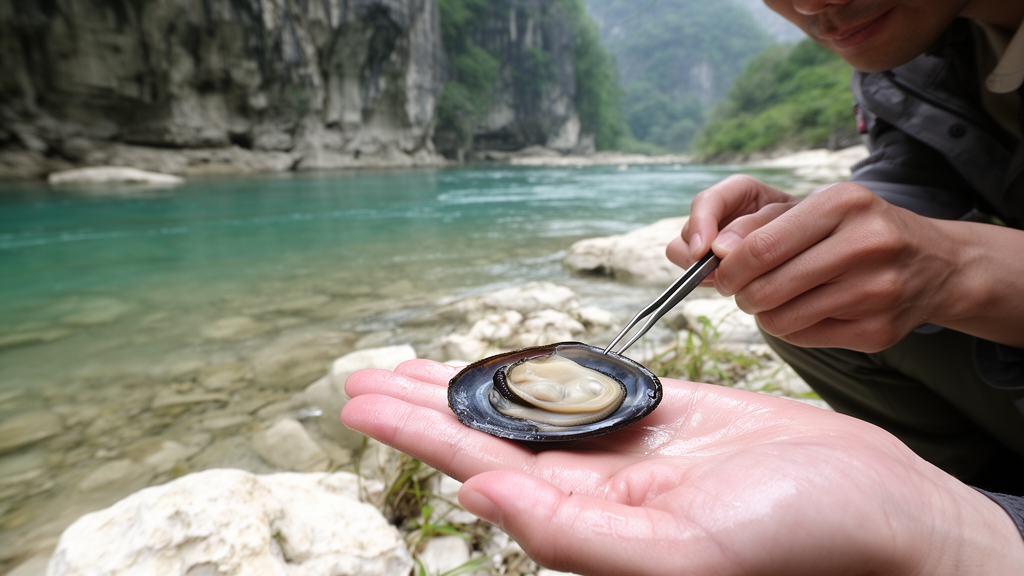
A new species of freshwater mussel, Pseudocuneopsis heqing, has been identified from the Heiwan River in Guizhou Province, China, using shell morphology, mitochondrial DNA barcoding and complete mitochondrial-genome analysis. The integrative taxonomic study describes the animal as a distinct member of the unionid genus Pseudocuneopsis and places it in a transitional zone between the Yangtze and Pearl River basins. It is the first known record of the genus from this zone, expanding the documented geographic distribution of a group whose recognized species are otherwise confined to those two major drainage systems.
Researchers collected eight specimens from the Heiwan River at 27.8839° N, 108.7329° E in Jiangkou County, Tongren City, in July 2025. They examined shell shape, umbo position, surface sculpture, hinge structure and muscle attachment, and measured shell length, width and height with a Vernier caliper having an accuracy of 0.02 millimetres. The series comprises one holotype and seven paratypes, all deposited in the Museum of Zoology at Shanxi Normal University.
The type locality provides the species’ only documented distribution in the study, making the new record locally specific rather than a range-wide assessment of its occurrence. P. heqing has a medium-sized, solid and regularly elliptical shell. Its periostracum ranges from reddish brown to dark brown and bears fine concentric growth lines.
The anterior and posterior margins are bluntly rounded, the dorsal margin extends obliquely from the umbo and gradually arches, and the ventral margin is nearly straight or slightly concave in some individuals. The umbo is positioned about one-third of the way along the shell length. The hinge structure provides some of the most conspicuous diagnostic features.
The left valve bears two pseudocardinal teeth: a low, lamellar anterior tooth and a taller, robust, columnar posterior tooth with a serrated summit. The right valve has a single erect, triangular-pyramidal pseudocardinal tooth with a V-shaped depression in its center. The shell’s nacre is light orange.
These features distinguish P. heqing from most congeners. Its shell is considerably smaller than the long, triangular-wedge shell of P. capitata and larger than that of P. wuana, while its orange nacre differs from the milky-white or white nacre of P. capitata and P. sichuanensis. It shares some measurements and coloration with P. yangshuoensis and P. perflora but differs in surface sculpture, nacre color and hinge anatomy.
Molecular data independently supported recognition of the new species. The researchers amplified the mitochondrial cytochrome c oxidase subunit I gene, or COI, with an approximately 680-base-pair PCR product and then trimmed the alignment to a 573-base-pair barcode fragment. In the COI dataset, variation within P. heqing was 0.2% using uncorrected p-distance, whereas distances from the new species to the six other sampled Pseudocuneopsis species ranged from 7.6% to 9.4%.
Its closest sampled relative was P. sichuanensis at 7.6%. These interspecific values were substantially above the 3% threshold cited by the study for COI-based species delimitation, providing molecular separation alongside the shell diagnosis. The investigators also generated a complete mitochondrial genome for P. heqing.
At 15,905 base pairs, the genome contains the 37 genes typical of unionid mitogenomes: 13 protein-coding genes, two ribosomal RNA genes and 22 transfer RNA genes. Its gene order is consistent with that reported for the subfamily Unioninae, while its combined adenine-plus-thyrosine content exceeds its guanine-plus-cytosine content. For broader phylogenetic reconstruction, the researchers combined 12 mitochondrial protein-coding genes and two ribosomal genes from 65 taxa, producing a concatenated alignment of 12,049 base pairs.
The analysis therefore placed the new species within a genome-scale context that was considerably broader than the initial eight-specimen collection. Bayesian inference and maximum-likelihood analyses produced identical tree topologies. Nodes within Pseudocuneopsis received 100% maximum-likelihood bootstrap support and Bayesian posterior probabilities of 1.0, and the genus was recovered as a strongly supported group within the tribe Unionini.
P. heqing was positioned as sister to a branch containing P. sichuanensis, P. yemaoi, P. wuana and P. yangshuoensis. P. perflora branched next, with P. capitata at the base of the genus in the inferred topology. The agreement among diagnostic shell characters, barcode distances and mitogenomic relationships supplied three lines of evidence for recognizing the specimens as a species separate from the previously described members of the genus.
The Heiwan River lies in the Wuling Mountain area of northeastern Guizhou, a karst landscape characterized in the study by caves, underground rivers and fragmented watersheds. The Yangtze River basin has a dense river network and broad drainage area, whereas the Pearl River basin is described as having shorter rivers, steep slopes and well-separated tributaries. The authors note that karst isolation, environmental gradients, crustal uplift and changes in ancient river courses may have contributed to population separation and diversification.
They also identify a potentially important biogeographic signal: before this discovery, P. capitata, P. sichuanensis, P. yemaoi and P. perflora had been reported from the Yangtze basin, while P. wuana and P. yangshuoensis occurred in the Pearl River basin. P. heqing extends the known distribution into the area between them, although the study does not directly reconstruct the historical connections of the two drainage systems. The discovery adds a seventh recognized species to a genus that has expanded rapidly since Pseudocuneopsis was established in 2022.
The authors attribute the increasing number of taxa partly to a clearer taxonomic framework and to the use of multilocus and mitogenomic analyses that can identify lineages whose differences are not readily resolved by shell form alone. The study illustrates the value of combining morphology with molecular data because shell traits in unionids can be plastic or convergent, while DNA barcoding and genome-scale phylogenies provide additional evidence for delimiting and ordering species. Its central result is a formally described, genetically distinct mussel represented by a complete mitochondrial genome and a series of vouchers from a single karst-river locality.
Freshwater mussels are sensitive to environmental disturbance and are therefore used as indicators of ecological health, while karst ecosystems can be fragile and local endemic populations may be vulnerable to habitat alteration. Against that background, the authors consider expanded surveys and monitoring in distinctive habitats such as karst rivers a conservation priority. The present study did not measure population size, abundance trends, reproductive performance or responses to environmental change, and its eight specimens came from one locality.
It therefore documents a taxonomic and biogeographic finding rather than a conservation assessment. Its broader contribution is to show that integrating field morphology with mitochondrial sequencing can reveal additional diversity in China’s river systems and clarify where a rapidly growing genus occurs.
Subject of Research: Integrative taxonomy and mitogenomic phylogeny of a new Pseudocuneopsis freshwater mussel from Guizhou, China.
Article Title: Pseudocuneopsis heqing sp. nov. ( Bivalvia , Unionidae ) from karst rivers of Guizhou, China: integrative species delimitation and mitogenomic phylogeny
Article References: Wang, X., Nan, F., Liu, X., & Wu, R. (2025). Pseudocuneopsis heqing sp. nov. (Bivalvia, Unionidae) from karst rivers of Guizhou, China: integrative species delimitation and mitogenomic phylogeny. Zoosystematics and Evolution, 101(4), 2181-2190. https://doi.org/10.3897/zse.101.172606
Image Credits: AI Generated
Keywords: freshwater mussels, species discovery, Pseudocuneopsis heqing, Guizhou, karst rivers, integrative taxonomy, DNA barcoding, mitogenomics, phylogenetics, Yangtze basin, Pearl River basin, Pseudocuneopsis
Cite Scienmag News
Margaret Porter. (October 20, 2026). New mussel species identified from Guizhou karst river. Scienmag. https://scienmag.com/new-mussel-species-identified-from-guizhou-karst-river/
Margaret Porter. "New mussel species identified from Guizhou karst river." Scienmag, 20 October 2026, https://scienmag.com/new-mussel-species-identified-from-guizhou-karst-river/. Accessed 20 October 2026.
Margaret Porter. "New mussel species identified from Guizhou karst river." Scienmag. October 20, 2026. https://scienmag.com/new-mussel-species-identified-from-guizhou-karst-river/


