


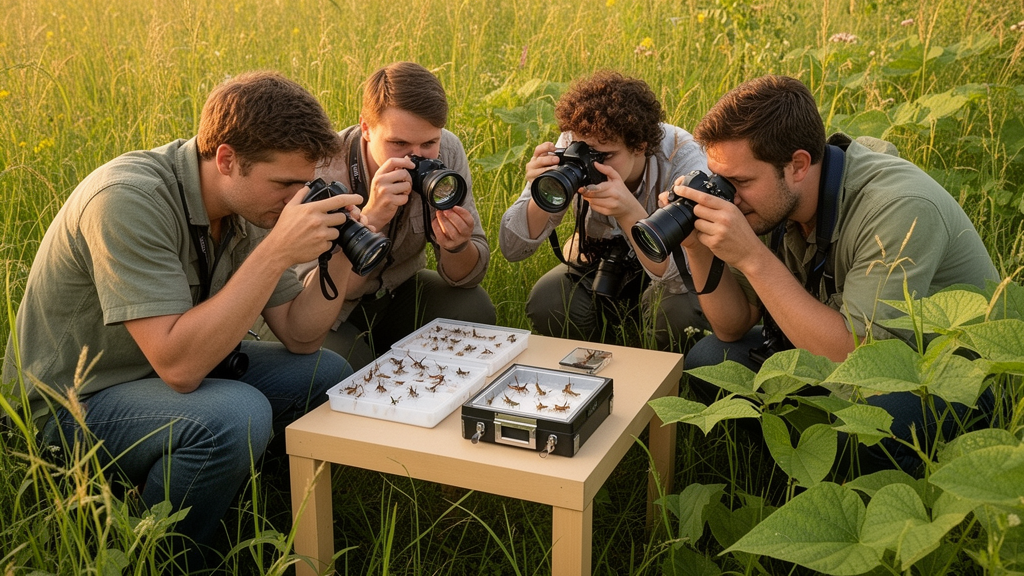
A review of 14 published studies found that community science is being used in orthopteran research, but its potential to expand biodiversity monitoring remains underused. Only four of the reviewed projects used acoustic data collected by community scientists, while the other 10 primarily relied on photographs, social media, field collection or combinations of these methods. The studies addressed species richness, abundance, novel or threatened species, range changes, invasive species and environmental factors, showing the range of questions that participation by nonprofessionals could support.
Community science includes the participation of people who are not professional scientists in the collection, analysis or interpretation of scientific data. Two broad approaches were distinguished in the review. In guided projects, scientists lead data collection through an established protocol and work directly with volunteers or organizations, sometimes through platforms such as Zooniverse. In open projects, individuals work largely independently and share records through social media or apps such as iNaturalist. These approaches can expand the geographic coverage and volume of ecological data available to researchers, particularly when observations are contributed over many locations and across extended periods.
Orthopterans are prominent members of the insect group that represents a large share of Earth’s biodiversity, a group for which reports of severe insect declines have raised concern. They occupy rural and suburban backyards, urban parks and vacant lots, where the calls of many males form an acoustic feature of summer. Their short life cycles and, in some species, specialization in habitat, food and egg-laying make them useful indicators in climate-change research. However, the review notes that there is still too little information about extant insect biodiversity to understand the causes and consequences of population declines, strengthening the potential value of continuous community-science monitoring.
Many male orthopterans call to attract mates, which makes it relatively straightforward to quantify species richness, abundance and emergence times from acoustic surveys. Scientists can identify species from their acoustic profiles, while community scientists can record sounds from trails and roadsides without collecting specimens. Acoustic monitoring can be especially useful in fragile habitats or for threatened species because it may reduce the need for repeated physical disturbance. A single recording can also contain calls from several taxa, potentially allowing existing recordings to be used more extensively, increasing the rate of new data collection, reducing costs and encouraging collaboration.
Smartphones provide many of the tools needed for such work, including audio and video recording, global positioning and internet access. Tools such as TADARIDA, a toolbox for animal detection in acoustic recordings that integrates discriminant analysis, as well as artificial-intelligence methods, can make large collections of acoustic and photographic data more useful. The review describes nationwide community-science acoustic monitoring in some locations and taxa, including FrogID and bird-monitoring programs. These examples show how the same basic technology can support repeated observations, but the reviewed orthopteran literature itself contained only four studies that directly used community-collected acoustic data.
The scale of open participation was illustrated by iNaturalist records available on July 14, 2022. The platform contained 1,128,486 orthopteran records accompanied by photographs and observation localities for 5,732 species. Such records can help researchers identify occurrences, document range expansion and track other distributional patterns. Local participation may also provide valuable knowledge about where singing insects occur, while residents can contribute observations throughout the year, including periods when distant research teams are unlikely to be conducting fieldwork. Community-science initiatives have also been used to monitor conservation efforts, rediscover species thought to be extinct, identify new species and document invasive species or range expansion.
The review characterized 43% of the 14 studies as guided and 50% as open, leaving the type unclear in the remaining 7%. Most major orthopteran groups were represented, including grasshoppers, crickets, katydids and wetas, but taxonomic coverage within each group was limited largely to new, rare or invasive species. Guided studies generally involved groups of fewer than 15 people, whereas open studies typically did not report the number of nonprofessional participants. This omission prevents consistent evaluation of project reach and the amount of volunteer labor contributed, making participant numbers a relevant measure when comparing the scale of different initiatives.
Online analysis provides another route for community scientists to contribute to orthopteran research. The ongoing Cricket Wing project on Zooniverse asks participants to classify microscope images of live and dead cricket sperm cells and immune cells, or hemocytes. The underlying research examines how traffic noise may affect immune and reproductive traits, areas for which relatively little physiological evidence about orthopterans is available. At the time of the source’s July 14, 2022 access, the project had generated 12,304 sperm-cell images and 1,917 hemocyte images. Each image was classified ten times before the final count was recorded, a redundancy measure intended to control classification error and bias.
By July 14, 2022, Cricket Wing had registered 700 participants since its May 10, 2022 launch and recorded 38,497 classifications, comprising 37,356 sperm counts and 1,141 hemocyte counts. Guides, tutorials and an open discussion forum help participants troubleshoot tasks and learn about the broader science. The project is also being used in high-school outreach, while its developers plan to extend it to questions involving rapid adaptation through song analysis and machine learning. These are future directions rather than reported experimental results; the current project’s demonstrated role is the large-scale community analysis of images for the research into cricket immune and reproductive traits.
Effective programs require clear, concise protocols that specify how volunteers access study organisms, where target species can be found, how sounds should be recorded and how observations should be documented. Instructions should cover recording distance and duration, locality, date, time, habitat and general notes, as well as procedures for backing up or sharing files. Workshops, field notes, video demonstrations, online tutorials and example recordings can provide training, while an “unsure” option may reduce forced identifications. Training duration, practice and the mode of instruction can affect data quality, and replication through independent observers or repeated classifications can help reveal error and observer variation.
Projects must also account for spatial and temporal sampling bias, as well as the difficulty of correcting uneven coverage without introducing further problems. The authors therefore recommend matching analytical techniques to the question, planning sampling in advance and determining the appropriate balance between community-generated and professionally collected data. Despite the potential of community scientists to track species abundance, richness, emergence time and distributional change through sound, organized long-term orthopteran programs remain scarce. With training, replication and sampling plans designed to reduce avoidable harm, community science can turn the calls of crickets, grasshoppers and other orthopterans into sustained ecological evidence while engaging the public in the research process.
Subject of Research: Community science for orthopteran ecological monitoring and image-based analysis
Article Title: The role of community science in orthopteran research
Article References: Byerly, A. R., Firneno Jr., T. J., Beard, R., & Larson, E. L. (2023). The role of community science in orthopteran research. Journal of Orthoptera Research, 32(2), 109-114. https://doi.org/10.3897/jor.32.90444
Image Credits: AI Generated
DOI: 10.3897/jor.32.90444
Keywords: community science, orthopterans, acoustic monitoring, biodiversity, grasshoppers, crickets, katydids, smartphone sensors, citizen science, conservation, role, community
Cite Scienmag News
Margaret Porter. (October 20, 2026). The role of community science in orthopteran research. Scienmag. https://scienmag.com/the-role-of-community-science-in-orthopteran-research/
Margaret Porter. "The role of community science in orthopteran research." Scienmag, 20 October 2026, https://scienmag.com/the-role-of-community-science-in-orthopteran-research/. Accessed 20 October 2026.
Margaret Porter. "The role of community science in orthopteran research." Scienmag. October 20, 2026. https://scienmag.com/the-role-of-community-science-in-orthopteran-research/


