


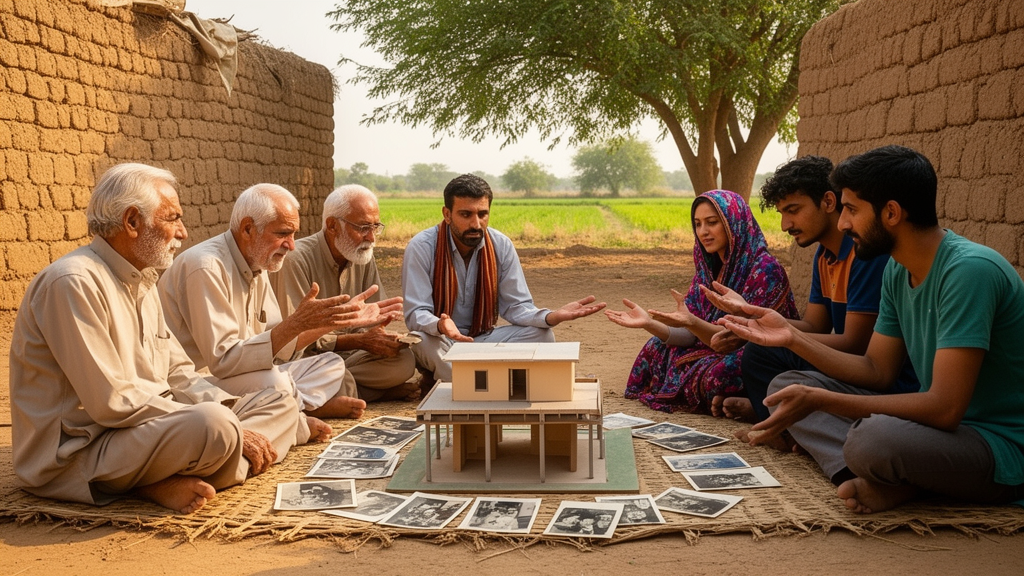
A convergent mixed-methods study of six climate-vulnerable communities in Pakistan found that collective memory was the strongest statistical predictor of adaptive behaviour during recurrent climate extremes. Researchers collected data from 420 household survey respondents, 35 semi-structured interview participants and 100 focus group discussion participants across ten groups in Sindh and Khyber Pakhtunkhwa provinces. The investigation also included 14 months of systematic participant observation and a longitudinal archival review of 40 documents spanning 2000 to 2023.
Structural equation modelling indicated that collective memory had both direct and indirect statistical relationships with adaptive behaviour. Its direct coefficient was β = 0.43, with p < 0.001. Two statistically significant mediation pathways were identified: one through risk perception, with an indirect coefficient of β = 0.11 and p < 0.001, and another through participation in informal governance, with an indirect coefficient of β = 0.105 and p < 0.01. These model estimates associate remembered experience with reported adaptation, but they do not establish that collective memory alone caused behavioural change.
The study examined how repeated climate events can coincide with changes in the informal institutions communities use to make decisions. Drawing on Social-Ecological Systems theory, Social Vulnerability Theory and Collective Memory Theory, the researchers considered the interconnected processes of risk-perception recalibration, collective memory in adaptation decisions, and the evolution of informal governance across gender, generational and socio-economic lines. The qualitative, observational and documentary components provided evidence about these institutional processes, while the survey and modelling components assessed relationships among the study’s main variables.
Gender inequality was pronounced in the governance structures examined. Women represented between 55% and 64% of community operational role-holders but occupied only between 18% and 27% of authoritative governance positions. Both the quantitative and qualitative evidence showed this difference between operational participation and positions of authority. The result applies to the six communities studied and does not by itself establish the pattern in every climate-vulnerable community in Pakistan.
The longitudinal archival analysis identified three phases in the evolution of informal governance: a reactive phase from 2000 to 2010, a consolidating phase from 2010 to 2018, and adaptive institutionalisation from 2018 to 2023. The analysis therefore documents a sequence in the characteristics of informal governance across the reviewed period, rather than proving that recurrent climate extremes alone caused each transition. Taken together, the findings show that adaptation in the studied settings was associated with collective memory, risk perception and participation in informal governance, while also revealing a gap between women’s operational representation and their access to authoritative roles. Because the research was concentrated in six communities and used a convergent mixed-methods design, the generalizability of these relationships beyond the study setting remains limited.
Subject of Research: Collective memory, risk perception and informal governance in community adaptation to recurrent climate extremes in Pakistan
Article Title: Risk perception, collective memory and adaptive behaviour under recurrent climate extremes: a convergent mixed-methods study of informal governance dynamics in climate-vulnerable Pakistan communities
Article References: aslam, S., Sukhrob, P., Roximovna, B. K., Abdullaeva, I., Matchanova, B., & Kadamovich, Y. J. (2026). Risk perception, collective memory and adaptive behaviour under recurrent climate extremes: a convergent mixed-methods study of informal governance dynamics in climate-vulnerable Pakistan communities. Regional Environmental Change, 26(4), Article 218. https://doi.org/10.1007/s10113-026-02682-z
Image Credits: AI Generated
DOI: 10.1007/s10113-026-02682-z
Keywords: collective memory, climate adaptation, recurrent climate extremes, informal governance, risk perception, Pakistan, gender inequality, social vulnerability, mixed methods, community resilience, Risk, perception
Cite Scienmag News
Sloane Callahan. (October 20, 2026). Collective memory linked to adaptation in six climate-vulnerable Pakistan communities. Scienmag. https://scienmag.com/collective-memory-linked-to-adaptation-in-six-climate-vulnerable-pakistan-communities/
Sloane Callahan. "Collective memory linked to adaptation in six climate-vulnerable Pakistan communities." Scienmag, 20 October 2026, https://scienmag.com/collective-memory-linked-to-adaptation-in-six-climate-vulnerable-pakistan-communities/. Accessed 20 October 2026.
Sloane Callahan. "Collective memory linked to adaptation in six climate-vulnerable Pakistan communities." Scienmag. October 20, 2026. https://scienmag.com/collective-memory-linked-to-adaptation-in-six-climate-vulnerable-pakistan-communities/


