


A comparative assessment finds that agricultural trade between Kazakhstan and China has expanded substantially since bilateral exchanges began in 1995, with Chinese imports from Kazakhstan rising from US$34 million in 2010 to US$573 million in 2022 and exports to Kazakhstan increasing from US$142 million to US$352 million over the same period. The analysis, published in Frontiers in Political Science in 2026, combines trade statistics, policy documents, statistical analysis and qualitative comparison to assess the relationship and identify routes to deeper cooperation. It describes the partnership as economically complementary but still constrained by institutional gaps, differing technical standards, sanitary and veterinary requirements, and limitations in Kazakhstan’s transport and processing infrastructure.
Kazakhstan’s comparative advantage lies in its extensive land resources and production of grains, oilseeds, flour-based products and livestock goods. The country has approximately 216.9 million hectares of agricultural land, including 187 million hectares of pasture and 29.4 million hectares of arable land, according to the study. Cereals occupy 15.8 million hectares, or 69.6% of the arable area, and about three-quarters of the cereal area is planted with wheat, chiefly in northern Kazakhstan. The Akmola, Kostanay and North Kazakhstan regions account for 75% of wheat acreage and 85% of output. Southern irrigation supports cotton, sugar beet, tobacco and rice, giving the country a wider production base than grain alone.
Low production costs and available land make Kazakhstan a competitive grain supplier, but the research identifies slow modernization, weak innovation capacity, inadequate investment, obsolete or insufficient technology, and shortages of grain-storage facilities as constraints on higher-value exports. Quality also limits competitiveness: only 70% of total wheat output falls into grades 1–3, creating a shortage of high-quality wheat. The authors therefore present modernization and processing as central to the country’s agricultural strategy, rather than treating expansion of raw grain shipments alone as evidence of a durable partnership. Their assessment also notes that Kazakhstan’s global ranking in agricultural output and livestock production remains below that expected from its land area.
China provides a large market and a complementary industrial base. The study reports that China feeds approximately 22% of the world’s population while possessing about 7% of the world’s arable land, creating sustained pressure to raise productivity and diversify food imports. Rice, corn and wheat account for more than 90% of China’s food production, while rising incomes and urbanization have increased demand for meat, dairy products and feed grains. China also imports a large share of its soybean consumption. A cited forecast projected a 36% increase in grain demand between 2014 and 2030, reaching 776 million tons, underscoring the scale of the market Kazakhstan is seeking to enter.
Comparative analysis of the countries’ agricultural export structures indicates that their principal strengths generally differ. Kazakhstan’s comparative advantages in the 2018 data are concentrated in cereals, animal and vegetable oils, cotton, flour products and livestock-related goods. China is comparatively stronger in edible fruits, wool, vegetables, fruit products, plant-planting materials and several processed products, while exporting smaller quantities of meat, fish, animal products and coffee to Kazakhstan. The resulting complementarity is visible in a trade pattern in which Kazakhstan supplies grain and other commodities while China exports more processed or specialized products, creating opportunities for two-way expansion rather than direct competition across the entire agricultural sector.
Trade has also become more diverse institutionally. By mid-2021, 87 of the 3,834 Kazakh enterprises holding export permits could produce goods for the Chinese market, while protocols for nine additional products were under negotiation. The range of participating businesses expanded from small entrepreneurs to large private and state-owned companies, and exchange methods broadened from border trade to general trade, processing and large official supplies. Yet the study finds no dedicated coordinating institution or long-term strategic program for agricultural trade. Regulatory inconsistencies and informal practices therefore continue to elevate transaction risks. Non-tariff obstacles include import and export controls, complicated customs procedures, divergent technical and conformity-assessment standards, sanitary and quarantine requirements, and environmental quality requirements.
Investment cooperation is accelerating as both sides seek to move beyond commodity exchange. Kazakhstan has attracted more than US$350 billion in foreign direct investment since independence, including approximately US$26 billion from China, with China remaining among the country’s five largest sources of investment. Chinese direct investment in Kazakhstan reached US$1 billion from January through September 2022, according to official figures cited in the paper. By 2023, 1,718 Kazakh enterprises were exporting agricultural products to China, and bilateral agricultural trade had reached US$789 million by August, a 72.7% year-on-year increase. These are reported trade and investment observations rather than evidence that the partnership has eliminated bottlenecks or guaranteed future growth.
Technology transfer may be especially important for closing the gap between Kazakhstan’s resource endowment and its agricultural productivity. Agreements made around the 2023 China–Central Asia Summit cover smart agricultural services, water conservation, green innovation, rehabilitation of desert and saline land, improved irrigation, and scientific exchanges in animal husbandry and veterinary medicine. North-West Agricultural University of China has cooperated with Kostanay State University, while a joint centre for studying new crops was established in 2023. Kazakh researchers are also testing Chinese-linked wheat varieties and exchanging expertise in crop breeding, genetic research and livestock management. These activities connect international cooperation to measurable objectives such as yields, disease resistance, adaptation to arid conditions and product quality, although the study does not report the results of a controlled evaluation of their effects.
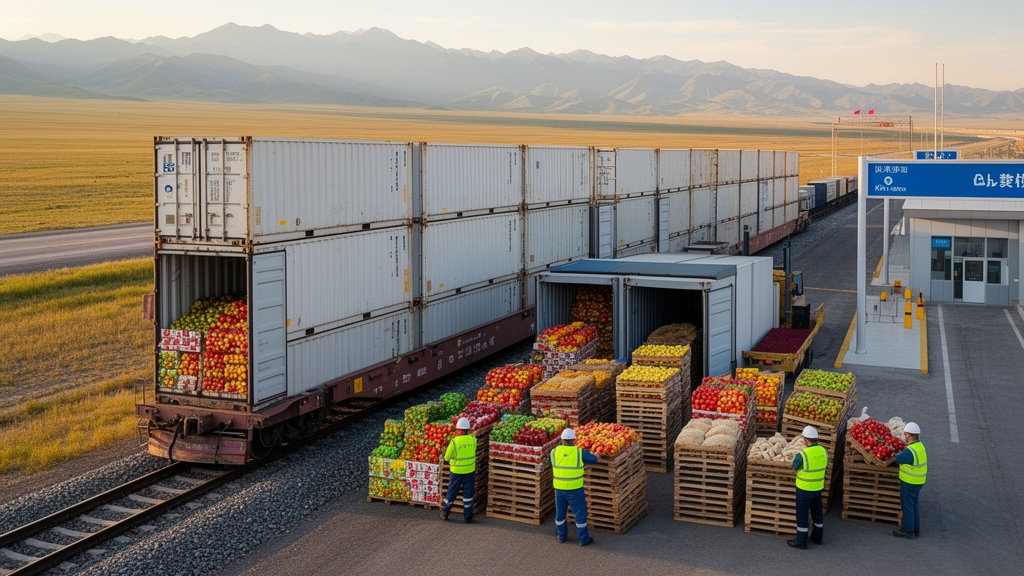
Logistics is the most direct link between production capacity and the Chinese market. Railway exports of Kazakh agricultural products to China increased from 615,000 tons in 2022 to 2 million tons in 2023. A “green channel” introduced for agricultural trade in 2019 streamlined customs clearance, while road movements through Xinjiang exceeded 4 million tons after border crossings reopened and procedures improved. Major developing infrastructure includes railway links such as Bakty–Ayagoz and Darbaza–Makhtaral, the Altynkol–Khorgos food center, the Khorgos dry port, the Lianyungang logistics terminal, and the Xinjiang Free Trade Zone. The food center has a projected export capacity of 5 million tons per year, but such figures describe planned capacity rather than observed trade flows. Five road crossings and two railway corridors currently connect the two countries, and grain is the largest Kazakh cargo category transported east to China.
Digital commerce and certification offer additional pathways, particularly for smaller producers. Kazakhstan’s national pavilions on Alibaba and JD.com introduced 130 companies and 7,500 products to Chinese consumers; the Alibaba pavilion reportedly generated US$3 billion in turnover by 2023, with wheat and camel milk among the popular products, while more than 10,000 orders were processed during the JD.com platform’s first hour. Chinese-invested laboratory capacity launched in Kazakhstan at the end of 2023 to accelerate certification of livestock and meat exports. The study recommends mutually recognized standards, coordinated policy, improved logistics and stronger processing capacity, while warning that foreign agricultural land leases and large-scale investment could create land-governance, environmental, social-equity and dependency concerns unless agreements are transparent, equitable and effectively regulated.
Subject of Research: Comparative assessment of agricultural trade, technology and logistics cooperation between Kazakhstan and China
Article Title: Agricultural trade cooperation between Kazakhstan and China: status assessment and growth pathways
Article References: Sharipkazy, N., Muhametkhanuly, N., Nurzhayeva, A. M., Zhekenov, D., & Feng, W. (2026). Agricultural trade cooperation between Kazakhstan and China: status assessment and growth pathways. Frontiers in Political Science, 8, Article 1847502. https://doi.org/10.3389/fpos.2026.1847502
Image Credits: AI Generated
DOI: 10.3389/fpos.2026.1847502
Keywords: Kazakhstan–China trade, agricultural exports, food security, grain production, agro-industrial development, agricultural technology, cross-border logistics, trade standards, foreign investment, e-commerce agriculture, Agricultural, trade
Cite Scienmag News
Alan Morgan. (October 20, 2026). Kazakhstan–China Agricultural Trade Expands as Cooperation Deepens. Scienmag. https://scienmag.com/kazakhstan-china-agricultural-trade-expands-as-cooperation-deepens/
Alan Morgan. "Kazakhstan–China Agricultural Trade Expands as Cooperation Deepens." Scienmag, 20 October 2026, https://scienmag.com/kazakhstan-china-agricultural-trade-expands-as-cooperation-deepens/. Accessed 20 October 2026.
Alan Morgan. "Kazakhstan–China Agricultural Trade Expands as Cooperation Deepens." Scienmag. October 20, 2026. https://scienmag.com/kazakhstan-china-agricultural-trade-expands-as-cooperation-deepens/


