


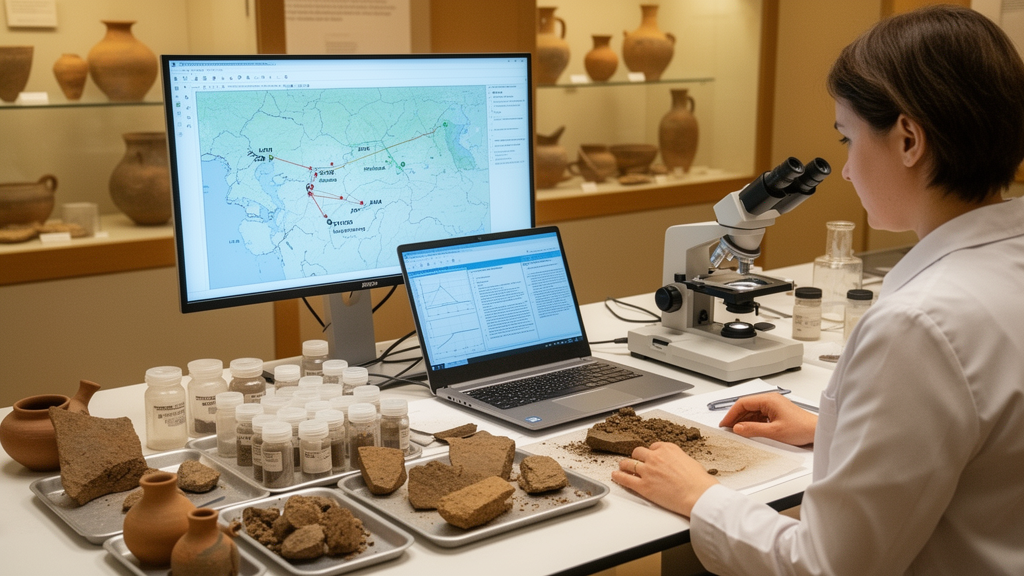
A preprint presents two open datasets that consolidate stable-isotope measurements from 114 papers covering 435 locations across the former Soviet space. The compilation, stored in the IsoArcH database, links archaeological isotope results to site coordinates, available sample information and the source studies in which the measurements were reported. It covers archaeological contexts from the Mesolithic to the Late Modern period and includes data associated with human and animal remains from parts of Asia and the Caucasus.
The project is designed to make a dispersed body of research more accessible to international audiences. The authors searched Google Scholar, Web of Science and Science Direct using English and other relevant languages, including Russian, Ukrainian, Azerbaijani, Georgian and Kazakh. Their summary notes that much of the regional literature was published in Russian and was largely absent from the international literature.
The atlas contains measurements for six stable-isotope systems: carbon, reported as δ13C; nitrogen as δ15N; oxygen as δ18O; sulphur as δ34S; strontium as 87Sr/86Sr; and lead as 206Pb/204Pb. These are the measurement types recorded in the source studies. The compilation does not describe a new laboratory experiment or a single unified analytical campaign.
Instead, it gathers results already obtained and reported by separate research teams, retaining their associated archaeological and source-article information. Each dataset entry records the originating archaeological site, including GPS coordinates, and links the associated isotope data to a relevant source article. Where those details were available, the compilation also includes the source of the analyzed sample, its dating and information about its deposition.
This structure preserves the context supplied by the original studies and allows database users to return from a compiled measurement to the publication in which it was reported. The first accompanying dataset is titled “Compilation of carbon, nitrogen, oxygen, sulphur and strontium stable isotope data from the Mesolithic to the Late Modern period in the Black Sea area.” The second is presented as “A landmark compilation of stable isotope data from archaeological contexts in the post-Soviet space.” Both are associated with the IsoArcH database, and the preprint lists them as accessible data sets connected to the compilation. The stated purpose of the atlas is to serve as a comprehensive source for further research and as a reference set for the geographic and temporal area it covers.
Its scale is substantial: the authors collected results from more than one hundred studies spanning archaeological contexts across the former USSR, with the accessible collection incorporating ancient human and animal remains from Asia and the Caucasus. The resources are intended to support researchers who may not have encountered the region’s studies in international publications. Because the project is a literature compilation, its reach is defined by the papers found through the stated searches and by the information reported within them.
The datasets contain multiple isotope systems and archaeological metadata, but the supplied preprint description does not present a new statistical assessment, population-level estimate or uniform analytical protocol across the 114 papers. The collection is instead an openly connected archive of published measurements, site records and source references, preserving the diversity of the underlying studies rather than replacing their original methodological context. The work is currently a preprint under review for Earth System Science Data, with discussion beginning on 20 October 2026.
Its central contribution is organizational rather than experimental: by bringing 114 papers, 435 locations and six stable-isotope measurement types into two linked datasets, the authors have created an open resource for studying the archaeological record of the post-Soviet space. The authors describe it as a comprehensive source for future research and a geographic and temporal reference set, while the associated source articles remain the foundation for assessing the context of every compiled observation.
Subject of Research: Stable-isotope datasets compiled from archaeological studies across the former Soviet space
Article Title: Stable isotope bioarchaeological atlas from the post-Soviet space
Article References: Hagarová, A., Gorbulina, M., & Salesse, K. (2026). Stable isotope bioarchaeological atlas from the post-Soviet space. https://doi.org/10.5194/essd-2026-619
Image Credits: AI Generated
Keywords: stable isotopes, bioarchaeology, archaeological data, former Soviet space, Black Sea region, Caucasus, open datasets, IsoArcH, archaeological atlas, Stable, isotope, bioarchaeological
Cite Scienmag News
Justin Rhodes. (October 20, 2026). Open isotope atlas consolidates post-Soviet archaeological data. Scienmag. https://scienmag.com/open-isotope-atlas-consolidates-post-soviet-archaeological-data/
Justin Rhodes. "Open isotope atlas consolidates post-Soviet archaeological data." Scienmag, 20 October 2026, https://scienmag.com/open-isotope-atlas-consolidates-post-soviet-archaeological-data/. Accessed 20 October 2026.
Justin Rhodes. "Open isotope atlas consolidates post-Soviet archaeological data." Scienmag. October 20, 2026. https://scienmag.com/open-isotope-atlas-consolidates-post-soviet-archaeological-data/


