


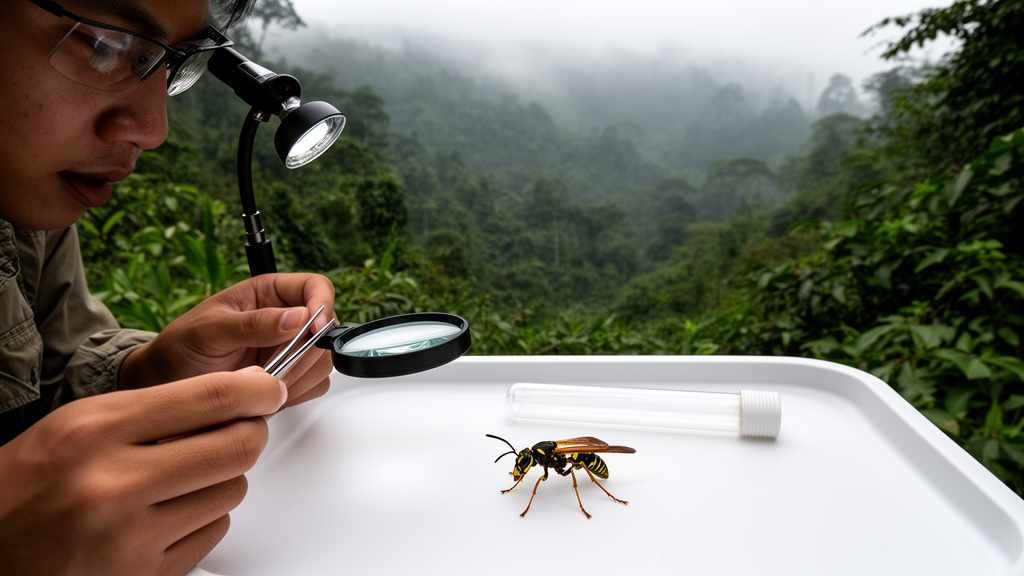
A taxonomic study of scoliid wasps in northern Vietnam has identified a new species, Sericocampsomeris vietnamica, and documented six taxa previously unconfirmed from the country. Researchers examined Campsomerini specimens collected in 10 northern provinces, described and illustrated the new male species from Cat Ba National Park, and produced identification keys for the genera, species and subspecies represented in northern Vietnam. They also compiled a 13-entry checklist of scoliid wasps recorded from Vietnam. The work shows that targeted field sampling and detailed examination of preserved specimens can reveal both undescribed diversity and taxonomic boundaries that may need revision.
Scoliidae is a worldwide family of solitary aculeate wasps within Vespoidea, with about 560 species in 43 genera and two subfamilies, Proscoliinae and Scoliinae. Members of the family are commonly called digger wasps, hairy wasps or scarab-hunter wasps and are parasitoids of scarab larvae. Two primary characters distinguish them from other Hymenoptera: the wing membrane beyond the closed cells is closely striolate, and the mesosternum and metasternum form a flat plate over the bases of the middle and hind coxae. The family also shows substantial sexual dimorphism, commonly expressed in antennal structure, wing venation, body form and coloration. Females are generally easier to identify to genus and species, whereas males can be very similar externally and often require examination of genital structures.
The investigators collected adult wasps with sweep nets and Malaise traps in Ha Noi, Hai Phong, Hoa Binh, Lang Son, Lao Cai, Nam Dinh, Quang Ninh, Thanh Hoa, Thai Binh and Vinh Phuc. Pinned, dried specimens were studied with a stereoscopic microscope, and identifications were compared with the taxonomic works of Betrem, Gupta and Jonathan, and Liu and colleagues. The identification key for Sericocampsomeris was based on Vietnamese material together with original descriptions of S. degaullei, S. stygia and S. punctata. The national checklist was assembled from published records, including those of Betrem, Bradley and Betrem, Gupta and Jonathan, Osten, Danilov and Dubatolov, Liu and colleagues, Taylor and Barthélémy, and Chen and colleagues.
The new species, S. vietnamica, is known from two male specimens: a holotype and a paratype collected on 17 February 2016 in Cat Hai district, Hai Phong Province, at 7 metres above sea level inside Cat Ba National Park. The specimens were deposited in the Institute of Ecology and Biological Resources, part of the Vietnam Academy of Science and Technology in Ha Noi. The holotype measures 22.5 millimetres in body length, while the examined specimens range from 21 to 24.5 millimetres; their forewings measure 20–21 millimetres. The species name refers to Vietnam, and the female remains unknown.
The male of S. vietnamica is predominantly black, with a dark-yellow anterior margin on the clypeus, a testaceous tegula, yellowish-white vestiture and conspicuous blue reflections on the metasoma. Narrow yellow bands occur apically on the first three tergites, with the band on the first very narrow and broadly interrupted along the midline. Narrow, medially interrupted yellow bands are also present on the second and third sternites. The wings are hyaline with a yellowish cast and are slightly infuscated subapically. Diagnostic structures include a densely and distinctly punctate frontal area, a weakly impressed frontal fissure extending to the anterior ocellus, and an anterior ocellus larger than the posterior pair and set in a broad, shallow pit. The scutellum and metanotum lack a median longitudinal carina.
The new species resembles S. flavomaculata and S. stygia in having a medially impunctate clypeus, dense frontal punctation, a frontal fissure extending to the anterior ocellus and apical yellow bands on the first three tergites. It can nevertheless be separated from them by its densely, coarsely and deeply punctate head, scape, mesoscutum, scutellum and metanotum; its entirely black scapulae, scutellum and metanotum; and the absence of an apical yellow band on the fourth tergite. Other distinctions include narrow, broadly interrupted yellow bands on the second and third sternites, yellowish setae on the head and mesosoma, yellowish wings and blue metasomal reflections. Its genitalia provide further diagnostic characters: the paramere is slender, rounded apically and moderately angled along its outer margin, with dense long setae dorsally and sparse short setae ventrally, while the base of the volsella bears moderately dense long setae.
Beyond the new taxon, the study reported six previously unconfirmed taxa for Vietnam: Megacampsomeris shillongensis, Micromeriella marginella marginella, Phalerimeris phalerata phalerata, Sericocampsomeris flavomaculata, Campsomeriella annulata annulata and Campsomeriella collaris collaris. The specimens came from localities including Ha Noi, Hoa Binh, Thai Binh, Thanh Hoa, Nam Dinh, Quang Ninh, Lang Son, Vinh Phuc and Lao Cai. The new records extend the documented Vietnamese distributions of these taxa, although the checklist is not a complete census of the country’s scoliid fauna. It consolidates published records, including some based on older museum material and historical locality names whose precise modern locations remain uncertain.
The examination also raised questions about the separation of several named subspecies. Females of Campsomeriella collaris have traditionally been divided into the nominate subspecies, with white erect setae on the occiput, scapula and anterior mesoscutum, and C. collaris quadrifasciata, with red-brown setae in the same regions. Males differ in the extent and arrangement of yellow markings. However, the researchers found that populations collected at the same localities, including Thai Binh and Thanh Hoa, could be identified as either form under the available key, and some small females had dense greyish setae. The authors therefore considered it likely that C. collaris varies in coloration across India, Nepal, Bangladesh, Vietnam and China and suggested that recognizing both subspecies may not be warranted. They called for future work using a broader geographical sample to evaluate the variation.
A similar issue arose for Phalerimeris phalerata, a species historically divided into three subspecies using the width and continuity of yellow bands on the first two tergites and the color of the apical fringes. Northern Vietnamese females showed variable conditions, including narrow, continuous bands on the first and second tergites, a narrow third-tergite band interrupted medially, and a mixture of median black and lateral yellow setae on the fifth tergite. On this basis, the authors proposed synonymizing P. phalerata turneri with P. phalerata phalerata. They also noted that seven nominal subspecies of Micromeriella marginella have been distinguished largely through differences in yellow body markings, and considered those characters potentially insufficient to retain all the named forms as valid taxa. These conclusions identify taxonomic questions rather than resolve them definitively.
The study’s practical output comprises a key to the genera, species and subspecies of Campsomerini in northern Vietnam and a separate identification key for Sericocampsomeris. The latter includes S. degaullei, S. flavomaculata, S. punctata, S. rubromaculata, S. stygia and the newly described S. vietnamica, although the authors lacked female specimens for three of those species. Northern Vietnam lies within the Indo-Burma biodiversity hotspot, but the authors note that taxonomic investigation of the country’s insects has been limited and fragmentary, partly because of prolonged wars and a shortage of Vietnamese entomologists. The new species, its deposited type material and the revised keys therefore provide a documented baseline for subsequent surveys of Vietnam’s scoliid wasps.
Subject of Research: Taxonomic diversity and distribution of scoliid wasps in northern Vietnam
Article Title: Taxonomic study of the tribe Campsomerini ( Hymenoptera , Scoliidae ) from northern Vietnam, with the description of a new species and a checklist of Vietnamese scoliid wasps
Article References: Pham, P. H., & van Achterberg, C. (2023). Taxonomic study of the tribe Campsomerini (Hymenoptera, Scoliidae) from northern Vietnam, with the description of a new species and a checklist of Vietnamese scoliid wasps. Deutsche Entomologische Zeitschrift, 70(2), 369-385. https://doi.org/10.3897/dez.70.101152
Image Credits: AI Generated
Keywords: Scoliidae, Campsomerini, new species, Vietnam, taxonomy, Hymenoptera, Sericocampsomeris, biodiversity, entomology, identification keys, Taxonomic, tribe
Cite Scienmag News
Drew Townsend. (October 20, 2026). Northern Vietnamese scoliid wasp study describes new species. Scienmag. https://scienmag.com/northern-vietnamese-scoliid-wasp-study-describes-new-species/
Drew Townsend. "Northern Vietnamese scoliid wasp study describes new species." Scienmag, 20 October 2026, https://scienmag.com/northern-vietnamese-scoliid-wasp-study-describes-new-species/. Accessed 20 October 2026.
Drew Townsend. "Northern Vietnamese scoliid wasp study describes new species." Scienmag. October 20, 2026. https://scienmag.com/northern-vietnamese-scoliid-wasp-study-describes-new-species/


