


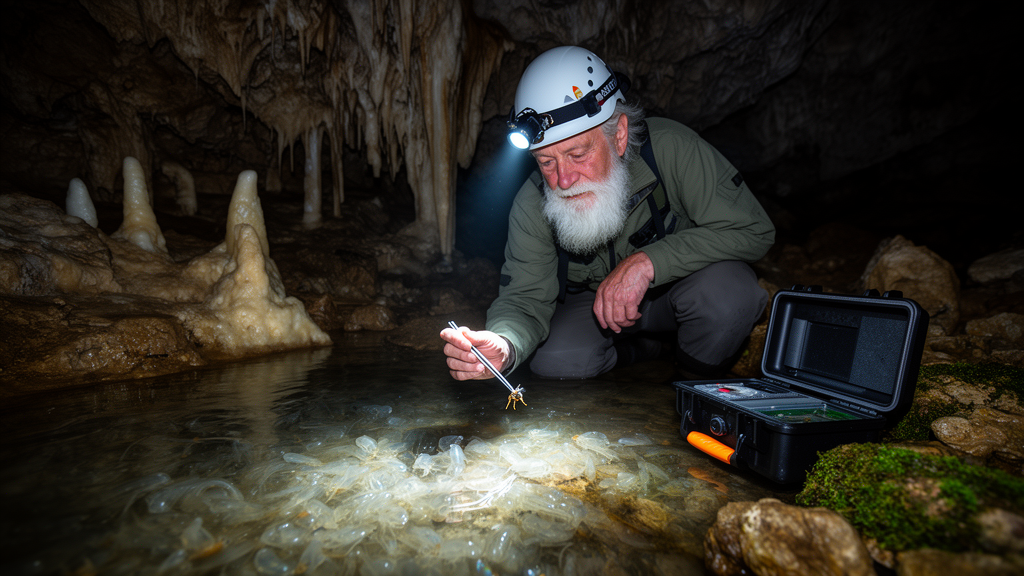
Professor Boris Sket, a Slovenian zoologist whose career centered on subterranean fauna, died in Ljubljana on May 7, 2023, at the age of 86. Over nearly seven decades, he described or contributed to the description of numerous species, genera and families, investigated their evolution and distribution, and helped establish the Dinaric Karst as a global hotspot of subterranean biodiversity. His work extended across cave shrimps, amphipods, isopods, leeches, sponges, the European olm and microorganisms, while his institutional leadership and teaching shaped generations of researchers. Sket’s output included more than 350 articles and over 570 bibliographic units, alongside field observations and reports that entered “grey literature” before becoming internationally accessible.
Sket’s interest in underground life began during and immediately after the Second World War. While Ljubljana was occupied, he visited the National Museum, now the Slovenian Museum of Natural History, where preserved subterranean crustaceans of the genera Niphargus and Troglocaris captured his attention. Soon after the war, he made cycling expeditions with his grandfather to caves near Ljubljana, where pale animals in the water fascinated him. His professional development at the University of Ljubljana included work as teaching assistant to Janez Matjašič, a doctorate completed in 1961 with a thesis on freshwater isopods, and appointments as assistant and full professor of zoology and speleobiology. From 1974 to 2012, he led the university’s invertebrate zoology and speleobiology research group. He also served as dean, vice-dean and rector of the Biotechnical Faculty and the University of Ljubljana.
Fieldwork during Sket’s early career demanded considerable improvisation. Travel often depended on trains and bicycles, while caving equipment was less developed than today’s LED lighting, ropes and scuba apparatus. Carbide lamps, ladders, homemade masks, pipes and air pumps were used in place of more advanced technologies. Sket and his technical assistant, the malacologist France Velkovrh, made nets, sieves and filters for collecting tiny organisms. Sket also designed the “Sket bottle,” a plastic container capable of collecting animals by suction during snorkeling or diving. These methods helped document that subterranean habitats extend beyond accessible caverns to fissures in carbonate rock, cracks in unconsolidated sediments, groundwater, sinking streams, coastal springs and other interstitial environments.
Taxonomy provided the foundation for Sket’s work on Dinaric fauna, even though he regarded taxonomic expertise as a necessary component of broader biological inquiry rather than his primary interest. He adopted a pragmatic interpretation of the biological species concept, treating morphology as evidence that could indicate reproductive isolation while questioning whether apparent “cryptic species” might instead reflect insufficient examination. His taxonomic coverage extended across many animal groups. He described the first troglobitic sponge, Eunapius subterraneus, and contributed to the description of the enigmatic subterranean hydroid Velkovrhia enigmatica, named in recognition of Velkovrh. He also worked extensively on leeches, establishing himself as a global authority on their taxonomy and curating regional and global checklists. Molecular phylogenies later supported several leech lineages, including Erpobdellidae, while showing that some traditional groupings did not reflect evolutionary relationships.
Sket’s collaboration with Jure Jugovic helped clarify the taxonomy of the cave shrimp genus Troglocaris. Molecular phylogenies revealed unexpected relationships among European cave shrimps and surface atyids, identified possible new species and showed that the broadly distributed Troglocaris anophthalmus complex possessed deep genetic structure. Jugovic’s research indicated that some morphological variation used in identification was associated with sex and age rather than taxonomic status, and that adult shrimps were the most taxonomically distinct stage. It also showed that rostrum length, formerly an important diagnostic character, could vary in the presence of predatory olms and was therefore unreliable for species diagnosis. Sket and his coauthors subsequently revised the subgeneric structure of Troglocaris, described additional species and reassessed the structure of the T. anophthalmus complex.
Among Sket’s most influential biogeographical work was his collaboration with David Culver on species-rich caves. Their 2000 analysis used a cave containing at least 20 troglobionts as an operational threshold for “richness,” allowing faunistic lists to be compared at a global scale. The study identified caves with the highest diversity outside the tropics, at mid-latitudes, and later regional analyses supported the concept of a “mid-latitude ridge” of high subterranean species richness. Sket’s mapping of the Western Balkans showed that terrestrial and aquatic species richness followed different geographic patterns. He also classified subterranean taxa into broad biogeographic groups, including forms restricted to parts of the karst and those distributed across it. He argued that geological history and ancient drainage systems were major influences on these distributions, while competition, habitat specialization and other ecological processes operated at smaller scales.
Sket’s evolutionary research addressed how terrestrial and aquatic organisms became subterranean and whether they continued evolving after entering caves. He proposed multiple origins for Dinaric aquatic fauna, involving marine ancestors, freshwater ancestors and marine lineages that passed through surface freshwater before colonizing underground environments. Studies of the water louse Asellus aquaticus, developed with students and close collaborators, subsequently indicated that the Dinaric region served as a refuge during Pleistocene glaciations, that many subterranean populations were genetically isolated from adjacent surface populations despite occasional contact, and that colonization of caves had occurred on several occasions. His work also emphasized convergence, including repeated loss of eyes and pigment, alongside variation among caves that prevented subterranean populations from becoming morphologically uniform. He rejected the proposition that cave animals cease evolving and used Niphargus and organisms inhabiting cave hygropetric environments as evidence for continuing adaptation and diversification.
Sket investigated the ecological structure of caves, particularly sinking streams, anchialine caves, fissure systems, percolation water and cave hygroprotic habitats. Monitoring at 16 sites along the Pivka River in the Postojna-Planina cave system from 1965 to 1976 measured temperature, oxygen, nitrates, bacterial oxygen consumption and community structure. The results showed that surface conditions penetrated deeper during high water levels and strong currents, while flowing water became oxygenated and nitrogen waste remained. In anchialine caves along the Adriatic coast, Sket documented three water layers: marine water at the bottom, fresh water above, and a thin, oxygen-depleted halocline between them. Each layer supported a distinct fauna, and the vertical distribution of species reflected their habitat requirements and interactions with other organisms.
Conservation formed a sustained part of Sket’s work. He regarded subterranean fauna as an important component of natural heritage and warned that many species were vulnerable because of restricted distributions and K-selected life histories. His early observations of organic pollution in the subterranean flow of the Pivka River linked eutrophication with movement of surface organisms into the cave system and the disappearance of specialized subterranean species. With Culver, he recommended standardized monitoring using fixed time-person effort, baited terrestrial and aquatic traps, and potential use of capture-mark-recapture methods. Sket also assessed the conservation status of Slovenian leeches, crustaceans, amphibians and groundwater species, prepared cave checklists, contributed to European conservation projects and developed criteria for identifying caves suitable for protection under the European Habitats Directive. His proposed network of protected, species-rich regions along the Dinaric Karst was not realized, but his public criticism of pollution remained prominent.
Sket also transformed the institutional and public reach of subterranean biology. He introduced Subterranean Biology into the University of Ljubljana curriculum and supervised 10 doctoral students, 5 master’s students and 25 graduate students. Many became respected specialists, including researchers of subterranean sponges, microcrustaceans, cave fauna outside the Dinaric Karst and the physiology of subterranean animals. He contributed to the popular-science magazine Proteus, edited animal identification keys, co-authored a 1990 book on Slovenian fishes, participated in the monumental publication The Fauna of Slovenia and wrote a high-school textbook on evolution. He served as president of the International Society for Subterranean Biology from 2004 to 2008 and remained an active researcher after retirement. The record assembled here presents Sket not only as a prolific taxonomist, but as a field naturalist, evolutionary thinker, ecologist, biogeographer, conservation advocate and teacher whose work helped define the study of life below ground.
Subject of Research: Boris Sket’s contributions to the taxonomy, evolution, ecology, biogeography and conservation of subterranean fauna
Article Title: Professor Boris Sket (1936–2023): the SpeleoBiologist and much more
Article References: Fišer, C., Bračko, G., Delić, T., Fišer, Ž., Jugovic, J., Moškrič, A., Prevorčnik, S., Verovnik, R., Zagmajster, M., Zakšek, V., & Trontelj, P. (2024). Professor Boris Sket (1936–2023): the SpeleoBiologist and much more. Subterranean Biology, 48, 171-201. https://doi.org/10.3897/subtbiol.48.122645
Image Credits: AI Generated
DOI: 10.3897/subtbiol.48.122645
Keywords: Boris Sket, speleobiology, subterranean fauna, Dinaric Karst, cave biodiversity, taxonomy, molecular phylogeny, cave ecology, biogeography, conservation, Professor, Boris
Cite Scienmag News
Gavin Prescott. (October 20, 2026). Professor Boris Sket (1936–2023): the SpeleoBiologist and much more. Scienmag. https://scienmag.com/professor-boris-sket-1936-2023-the-speleobiologist-and-much-more/
Gavin Prescott. "Professor Boris Sket (1936–2023): the SpeleoBiologist and much more." Scienmag, 20 October 2026, https://scienmag.com/professor-boris-sket-1936-2023-the-speleobiologist-and-much-more/. Accessed 20 October 2026.
Gavin Prescott. "Professor Boris Sket (1936–2023): the SpeleoBiologist and much more." Scienmag. October 20, 2026. https://scienmag.com/professor-boris-sket-1936-2023-the-speleobiologist-and-much-more/


