


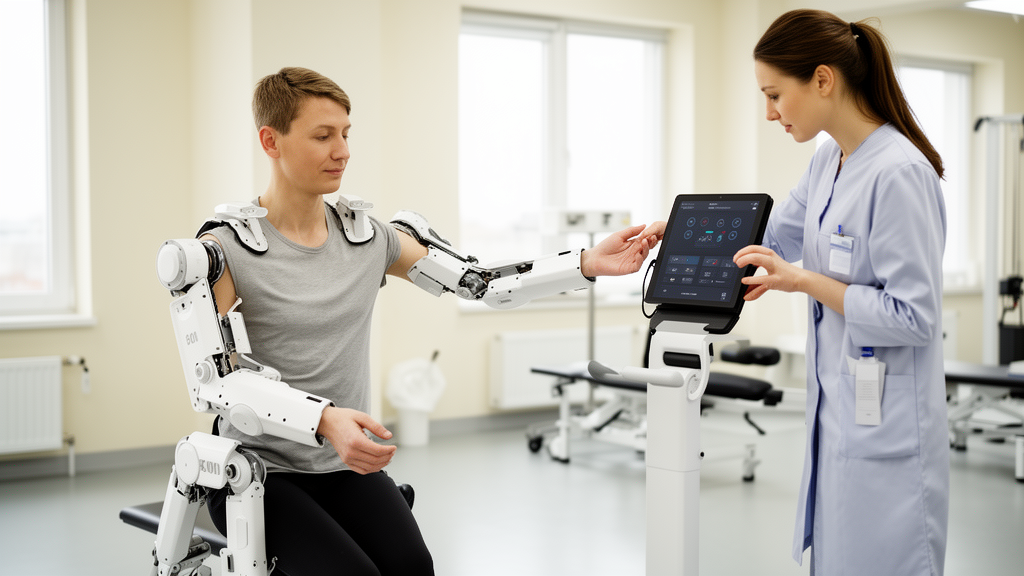
A systematic review and meta-analysis of randomized controlled trials suggests that physical assistance from rehabilitation robots may modestly improve upper-limb sensorimotor recovery after neurological disorders, most often stroke, but the evidence remains fragile. The finding comes from a deliberately narrow comparison: experimental and control groups completed broadly similar tasks, received comparable therapy doses and feedback, and used the same robotic system when applicable, so the main distinction was the presence, amount or mode of robotic assistance. Across nine trials involving 272 stroke survivors, researchers estimated a small positive effect on change in Fugl-Meyer Assessment scores, but the confidence interval included no effect, results varied sharply between studies, and the certainty of evidence was low. The analysis therefore offers encouraging but preliminary evidence rather than proof that a robot’s mechanical help independently improves recovery.
The review team searched PubMed, Scopus and Google Scholar through November 2025, identifying 1,365 database records and two additional records through citation and preprint searches. After removal of 839 duplicates, 528 records underwent title-and-abstract screening and 45 full-text reports were assessed. Thirteen peer-reviewed randomized controlled trials, with sample sizes ranging from 13 to 74 and 369 participants in total, met the criteria for qualitative synthesis. Nine of these studies, all involving stroke survivors, reported data suitable for quantitative analysis. Eleven trials in the qualitative synthesis examined stroke, while two involved other neurological conditions: incomplete spinal cord injury and multiple sclerosis. The review protocol was not prospectively registered in PROSPERO or an equivalent registry, a limitation the authors acknowledged and recommended avoiding in future updates.
Its eligibility rules were designed to isolate robotic assistance from other treatment differences. Trials were excluded if groups received different amounts of therapy, feedback, training contexts or robotic technologies, or if participation, motivation or voluntary effort appeared to differ systematically. Studies comparing active with passive assistance, assistive with resistive exercise, or error-augmenting with error-reducing training were therefore rejected because those contrasts changed task demands or the participant’s role. This left studies addressing a cleaner mechanistic question: what happens when rehabilitation conditions are closely matched except for the robot’s physical influence? The primary outcome was change in the Fugl-Meyer Assessment, an impairment measure for upper-limb motor function. Because one trial used a modified 54-point version rather than the standard 66-point scale, the researchers calculated standardized mean differences rather than raw score differences.
In the main random-effects analysis, robot-assisted training produced a standardized mean difference of 0.425 in favor of the experimental conditions. Its 95% confidence interval ranged from −0.007 to 0.858, meaning the data were compatible with little or no benefit as well as a potentially meaningful advantage, while statistical significance was not reached at the prespecified threshold. Heterogeneity was substantial: 62.62% of the observed variability was attributed to differences among studies rather than sampling error. The fixed-effect model produced a statistically significant estimate of 0.371, but the authors emphasized the random-effects result because between-study variation was high. Individual effects ranged from favoring the comparator to strongly favoring robot-assisted training, revealing that the pooled average did not represent a uniform response across devices, patients or rehabilitation protocols.
Two trials accounted disproportionately for the heterogeneity. Studies by Takahashi and colleagues and Ramos-Murguialday and colleagues reported standardized mean differences of 1.625 and 1.877, respectively, while the other seven studies ranged from −0.333 to 0.756. Both larger-effect trials enrolled people with severe chronic stroke and used intensive assistance linked to the patient’s movement or motor intention. Their findings are consistent with the idea that contingent assistance may be especially useful when voluntary movement is difficult, but the review cannot establish that explanation because participant characteristics and multiple intervention details differed at the same time. The pooled estimate therefore should be treated as a tentative average rather than a predictable treatment effect.
Among chronic-stroke trials, eight studies with 219 participants produced a larger random-effects estimate of 0.53, with a 95% confidence interval of 0.067 to 0.992 and heterogeneity of 60.72%. The subgroup was statistically significant under the model used, but its wide interval, high inconsistency and reliance on small studies made the finding suggestive rather than definitive. Anatomical subgroup estimates were nearly identical but similarly uncertain: shoulder-and-elbow training had a random-effects estimate of 0.223 with a confidence interval of −0.44 to 0.887, based on three trials and 76 participants, while hand-focused training had an estimate of 0.221 with a confidence interval of −0.158 to 0.601, based on five trials and 166 participants. The numerical similarity does not establish equivalence between proximal and distal training, nor does either subgroup show a clear advantage for robotic assistance.
Individual trials further illustrate the mixed record. Assist-as-needed force outperformed constant guidance in one chronic-stroke shoulder-elbow study, while movement-intention-contingent assistance produced greater impairment recovery than non-contingent assistance in a brain–computer-interface trial involving severe chronic stroke. By contrast, active assisted versus unassisted hand training, high versus low assistance, deficit versus null force fields, and intention-contingent versus sham brain–computer-interface control produced no significant between-group differences. Physical assistance also failed to show a clear advantage over virtual assistance in a newer hand-training trial, although virtual assistance achieved greater functional improvement. These contrasts suggest that assistance may be more useful when its timing responds to intent or effort, but the evidence does not directly establish the superiority of any control strategy.
Risk-of-bias analysis found low concerns in four of the 13 trials and some concerns in the other nine, with lack of double-blinding a recurring issue. Using GRADE, the researchers rated certainty in the primary outcome as low, downgrading the randomized evidence for risk of bias, inconsistency and imprecision; no downgrade was applied for indirectness. Funnel-plot analysis found mild visual asymmetry, and smaller, less precise studies tended to report larger positive effects, but Egger’s regression was not statistically significant. With only nine studies, however, publication bias cannot be ruled out reliably. Sensitivity analyses that varied assumed correlations between pre- and post-treatment measurements or added an excluded trial did not change the direction of the pooled estimate, although its magnitude, precision and heterogeneity varied. Exploratory meta-regression found no clear explanation for the variation from disease stage, severity or dosage, and an apparent limb-segment association rested on too few studies to be reliable.
The review offers a plausible technical rationale for why robotic assistance might help, but these mechanisms remain hypotheses. A robot can move a limb that cannot yet be moved voluntarily, permit larger or faster repetitions, and generate contact forces and sensory feedback through the human–machine interface. When that feedback is precisely coupled to motor intent, it could reinforce sensorimotor learning and encourage active participation. Assistance may also tune task challenge by making movement possible while preserving meaningful demands. The trials included contingent, fixed, progressive, intention-linked, brain–computer-interface-controlled and other forms of assistance, but they rarely standardized or fully reported force levels, movement geometry, repetitions, progression rules, feedback schedules and rest periods. Larger, adequately powered randomized trials are needed to manipulate assistance level, timing and sensory coupling while holding other therapy components constant, allowing researchers to determine whether the promising pooled signal reflects a genuine independent contribution from robotic force.
Subject of Research: Effects of robotic assistance on upper-limb sensorimotor recovery after neurological disorders
Article Title: Effect of robotic assistance on upper-limb sensorimotor recovery: a systematic review and meta-analysis
Article References: Choudhuri, R., Solomon, J. M., Nehrujee, A., Sujatha, S., & Balasubramanian, S. (2026). Effect of robotic assistance on upper-limb sensorimotor recovery: a systematic review and meta-analysis. Frontiers in Neurorobotics, 20, Article 1860365. https://doi.org/10.3389/fnbot.2026.1860365
Image Credits: AI Generated
DOI: 10.3389/fnbot.2026.1860365
Keywords: robotic assistance, upper-limb rehabilitation, stroke recovery, sensorimotor recovery, neurorehabilitation, rehabilitation robots, systematic review, meta-analysis, randomized trials, brain-computer interfaces, Effect, robotic
Cite Scienmag News
Denise Maddox. (October 20, 2026). Robot Assistance May Aid Upper-Limb Recovery, but Evidence Remains Fragile. Scienmag. https://scienmag.com/robot-assistance-may-aid-upper-limb-recovery-but-evidence-remains-fragile/
Denise Maddox. "Robot Assistance May Aid Upper-Limb Recovery, but Evidence Remains Fragile." Scienmag, 20 October 2026, https://scienmag.com/robot-assistance-may-aid-upper-limb-recovery-but-evidence-remains-fragile/. Accessed 20 October 2026.
Denise Maddox. "Robot Assistance May Aid Upper-Limb Recovery, but Evidence Remains Fragile." Scienmag. October 20, 2026. https://scienmag.com/robot-assistance-may-aid-upper-limb-recovery-but-evidence-remains-fragile/


