


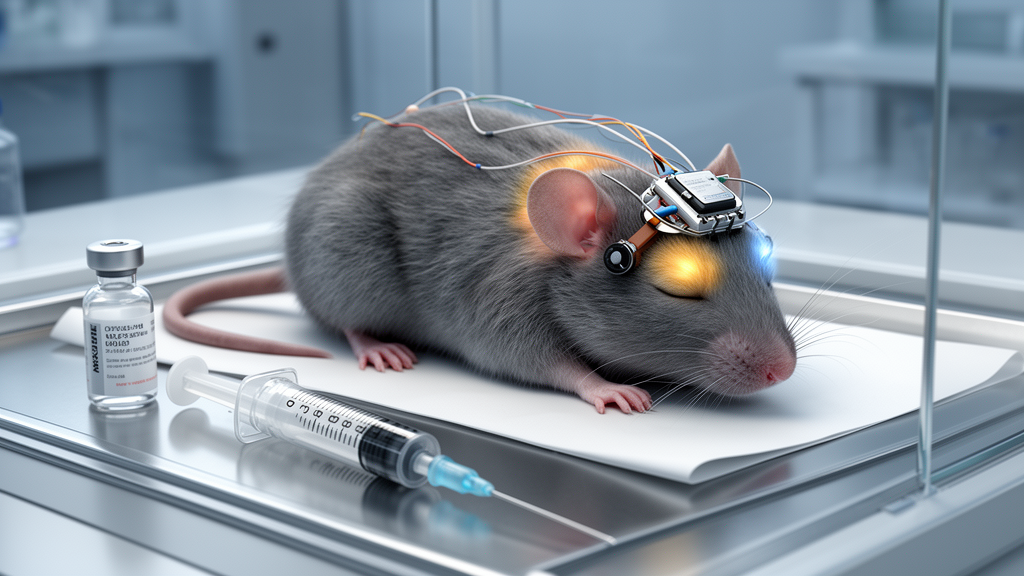
A deep-learning framework that combines local EEG and EMG pattern extraction with a recording-wide memory bank classified rodent sleep stages with 94.4% accuracy in subject-held-out testing, while maintaining nearly the same performance when trained only on vehicle-control recordings and tested under psilocybin, MDL100907 and their combination. The study used more than 1.1 million expert-annotated four-second segments collected from 13 adult male Long-Evans rats under four pharmacological conditions, with and without sleep deprivation. Although the dataset came from one laboratory and the tested drugs share serotonergic mechanisms, the results show that explicitly integrating temporal context can reduce both subject dependence and sensitivity to treatment-induced shifts in brain activity.
The researchers built the system around a modified one-dimensional ResNeXt-29 network that processed four recording channels: three electroencephalography signals from frontal, somatosensory and visual cortex, plus dorsal-neck electromyography. Each four-second window contained 2,000 samples and was converted into a 512-dimensional embedding. Sleep stages were Wake, non-rapid eye movement sleep, REM sleep and Artifact. The dataset was imbalanced, comprising 43.8% Wake, 43.5% NREM, 12.3% REM and 0.3% Artifact windows. Two experienced annotators scored recordings, with Cohen’s kappa reaching 0.84 on a four-stage verification set. The annotators were not blinded to treatment, a limitation acknowledged by the authors because awareness of experimental condition could, in principle, influence labels.
A central architectural element was a 128-dimensional Global Context Vector, or GCV, operating as a learnable memory bank across a sequence of 512 windows, equivalent to about 34 minutes of recording. After each of the three ResNeXt stages, bidirectional cross-attention allowed information to flow both from the convolutional features into the GCV and from the GCV back into the signal representation. Temporal self-attention, position-wise feed-forward networks, residual connections and layer normalization were incorporated at each stage. A four-layer Transformer encoder then classified each window using its full one-minute context, while a lightweight parallel branch classified windows independently and served only as a training regularizer. Only the contextual branch was used for reported test predictions.
The model was trained with label-smoothed cross-entropy and an auxiliary supervised contrastive loss. For contrastive learning, each batch was passed through the network twice with independently sampled physiological augmentations, including mild Gaussian noise, conservative amplitude scaling, circular shifts of up to 40 milliseconds, occasional channel dropout and occasional polarity inversion. Windows with the same sleep-stage label, as well as two augmented versions of the same window, were treated as positive examples. The contrastive objective was intended to group embeddings by stage while reducing sensitivity to nuisance variation. In a separate ablation, gradient-reversal heads attempted to make the embedding uninformative about subject identity and treatment condition, but this adversarial component produced negligible additional benefit and was excluded from the default model.
Across five-fold cross-validation, each fold withheld complete animals from training, allowing the researchers to test whether performance generalized beyond idiosyncratic signal patterns. The full model achieved a macro-averaged F1 score of 0.943, accuracy of 0.944 and ROC-AUC of 0.993, with standard deviations across folds of 0.008, 0.008 and 0.001, respectively. It outperformed SlumberNet, whose F1 was 0.870, and Random Forest, whose F1 was 0.879; the differences were statistically significant under a Nadeau and Bengio corrected resampled t-test, with p values of 0.0001 and 0.0401. AttnSleep achieved 0.801 F1, although its adaptation for four-channel input did not preserve the architecture’s original per-channel attention design. Random Forest also showed a pronounced training-validation gap, reaching 99.9% training F1 but 88.1% validation F1.
Ablation results identified global context as the largest single contributor. Removing the GCV reduced F1 by 2.3 percentage points, equivalent to a 25.3% reduction in classification error relative to the ablated version. Initializing the vector with all zeros performed best, suggesting that a task-specific memory could be learned more effectively than manually supplied spectral summaries or randomly initialized values. Supervised contrastive learning added a more modest 0.6 percentage points in F1 and an 8.2% error reduction. Linear probes offered another view of the representation: sleep stage was decoded from frozen embeddings with balanced accuracy of 0.912, whereas subject identity was decoded at 0.130 against chance of 0.077 and treatment at 0.312 against chance of 0.250. An encoder lacking both the GCV and contrastive loss encoded subject and treatment information more strongly, at 0.214 and 0.421, respectively.
The most demanding evaluation asked whether a model trained without any drug data could classify recordings from unseen animals under pharmacological perturbation. In this saline-only protocol, the same subject-held-out folds were retained, so successful prediction required transfer across both subjects and treatments. Mean F1 was 0.937, less than one percentage point below the 0.943 obtained with the full dataset. Performance was lowest for psilocybin at 0.932, followed by the drug combination at 0.939 and MDL100907 at 0.946. The psilocybin result coincided with pronounced REM suppression and altered theta-band dynamics, while MDL100907 produced the smallest departure from the control distribution. A size-matched random subsample performed comparably to the saline-only model, suggesting that the small residual gap was associated mainly with fewer training examples rather than failure under drug shift.
The system was also relatively economical with expert labels. Training on only one hour of annotated data produced accuracy above 88% and F1 of 0.832. Performance rose substantially by eight hours, reaching F1 of 0.921, and then largely plateaued: F1 was 0.919 with 12 hours and 0.918 with 24 hours, compared with 0.943 for the approximately 1,000-hour dataset. The eight-to-12-hour range represented about 1% of the complete corpus while trailing full-data performance by only 2.4 percentage points in F1. Context-aware Grad-CAM analysis also showed that model saliency tended to concentrate around state transitions and waveform segments that departed from their surrounding baseline. This is consistent with the model using sequence-level information when local four-second evidence is ambiguous, although the maps do not directly reveal the direction of information flow between individual epochs.
Several boundaries limit how broadly the findings can be applied. The experiments involved only 13 adult male rats from a single supplier and laboratory, so performance across other electrode configurations, ages, sexes, species or recording protocols remains unverified. Both psilocybin and MDL100907 act through the serotonergic system; transfer to compounds with fundamentally different GABAergic, dopaminergic or glutamatergic mechanisms is untested. The Transformer also receives at most 34 minutes of context rather than a complete sleep cycle, and the model requires all four input channels at inference despite using channel dropout during training. Per-subject z-scoring may additionally bias predictions when drug treatments substantially change the proportion of time spent in each stage. The method complements established tools such as AccuSleep, SPINDLE, Sleep-deep-learner and Somnivore rather than replacing them, and direct comparison with those pipelines, including any calibration or retraining they require, remains future work. With external validation and broader drug testing, the results nevertheless offer a promising route to reducing manual scoring in drug-discovery sleep studies without treating each new animal or treatment condition as an entirely separate classification problem.
Subject of Research: Deep-learning classification of rodent sleep stages from EEG and EMG under pharmacological conditions
Article Title: Global context integration for pharmacologically robust preclinical sleep stage classification
Article References: Brejtr, V., Aleksić, K., Šíchová, K., Vejmola, Č., Páleníček, T., & Lhotská, L. (2026). Global context integration for pharmacologically robust preclinical sleep stage classification. Scientific Reports, 16(1), Article 33004. https://doi.org/10.1038/s41598-026-57917-0
Image Credits: AI Generated
DOI: 10.1038/s41598-026-57917-0
Keywords: rodent sleep staging, deep learning, electroencephalography, electromyography, pharmacology, domain generalization, psilocybin, MDL100907, Transformer models, preclinical neuroscience, Global, context
Cite Scienmag News
Cassandra Pierce. (October 20, 2026). Global context model sustains rodent sleep staging under drug shifts. Scienmag. https://scienmag.com/global-context-model-sustains-rodent-sleep-staging-under-drug-shifts/
Cassandra Pierce. "Global context model sustains rodent sleep staging under drug shifts." Scienmag, 20 October 2026, https://scienmag.com/global-context-model-sustains-rodent-sleep-staging-under-drug-shifts/. Accessed 20 October 2026.
Cassandra Pierce. "Global context model sustains rodent sleep staging under drug shifts." Scienmag. October 20, 2026. https://scienmag.com/global-context-model-sustains-rodent-sleep-staging-under-drug-shifts/


