


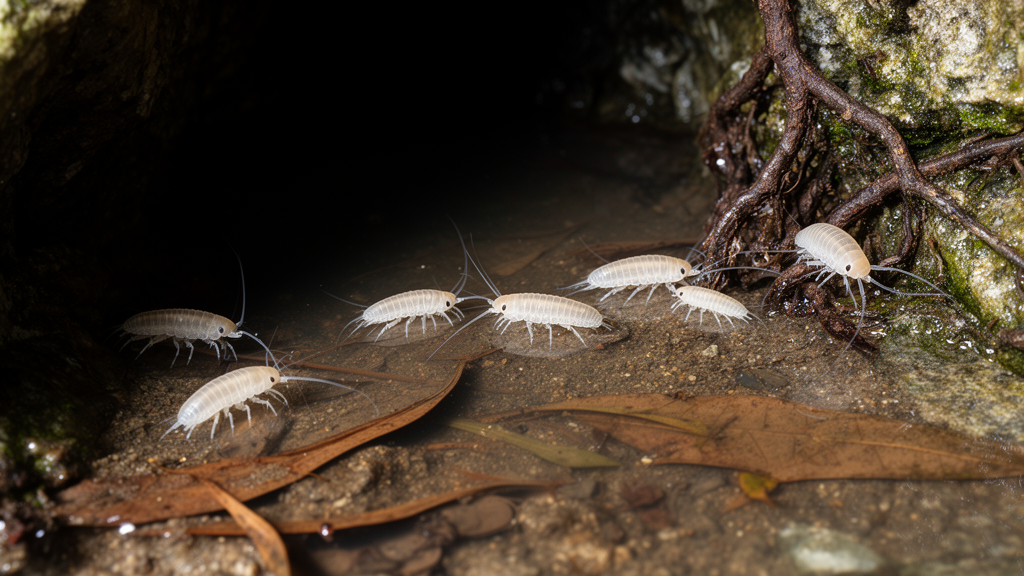
DNA barcoding of groundwater isopods from wells in Benin and Cameroon identified 23 strongly divergent molecular lineages within the genus Metastenasellus, indicating much greater species diversity than the genus’s sparse taxonomic record suggests. The study analyzed mitochondrial cytochrome c oxidase subunit I, or COI, sequences from 89 specimens and applied complementary distance-based and tree-based methods to delimit molecular operational taxonomic units. The authors described the result as a first estimate of diversity rather than a formal species revision: most of the 23 units may correspond to species, but a single mitochondrial marker cannot establish species boundaries by itself.
Metastenasellus belongs to the asellote isopod family Stenasellidae, whose members are adapted to groundwater habitats. Before this study, the genus contained nine formally described species distributed across a trans-Saharan range, including one species from Algeria and eight from West and Central Africa. No species had been described from Benin, while Cameroon had two named species, Metastenasellus camerounensis and M. boutini. Earlier field observations and a small number of COI sequences had nevertheless indicated that the genus was present in both countries and might conceal additional diversity that conventional descriptions had not resolved.
The specimens came from sampling campaigns conducted between 2015 and 2019 in Benin’s Ouémé and Yéwa basin and during 2009 and 2019 in Cameroon. In Benin, researchers visited 169 stations, 98 of which contained isopods; the DNA dataset selected 57 Metastenasellus specimens from 19 of those stations to provide a geographically balanced representation of the basin. In Cameroon, approximately 150 stations were surveyed in the Wouri, Sanaga and Nyong watersheds, and Metastenasellus was found at 44 stations. The combined molecular dataset contained 57 specimens from Benin and 32 from Cameroon, together with the externally described species Stenasellus virei as an outgroup for rooting the phylogenetic tree.
Animals were collected from traditional hand-dug and modern lined wells with a modified phreatobiological net and baited traps. DNA was extracted from small pieces of appendage tissue where possible, while whole individuals were sometimes used for smaller specimens. Researchers amplified the COI marker by polymerase chain reaction, checked the products by electrophoresis and obtained bidirectional Sanger sequences. After sequence assembly and comparison with GenBank records, the analyses included newly generated sequences, two previously available Beninese sequences and four available from Cameroon, plus five sequences of the named species M. boutini.
A maximum-likelihood phylogeny was inferred with IQ-TREE under a TN+F+I+G4 nucleotide substitution model selected by the Bayesian Information Criterion. Branch support was estimated with 1,000 ultrafast bootstrap replicates. The researchers then used ASAP, a distance-based method for assembling species by automatic partitioning; GMYC, a generalized mixed Yule coalescent model applied to an ultrametric tree; and two implementations of Poisson tree processes, one allowing different rates among lineages and one using a single rate. They also calculated uncorrected pairwise distances among specimens and within and between the molecular units. This combination allowed the molecular partitions to be compared with both genetic divergence and the branching structure of the phylogeny.
ASAP consistently recovered the same 23 molecular operational taxonomic units whether it used p-distances, Jukes-Cantor distances or Kimura two-parameter distances. Eleven units were associated with Benin and 12 with Cameroon. GMYC independently identified the same 23 units, each represented by a singleton or a strongly supported clade with bootstrap values of 99–100 percent. Multi-rate Poisson tree processes returned 22 units, merging the units numbered 13 and 14, whereas the Bayesian single-rate implementation proposed 26 units. That method split MOTU 1 into two singletons and divided MOTU 12 into two singletons and a two-specimen group. The authors regarded the 26-unit result as less plausible because some proposed splits occurred between sequences separated by only 2.1–3.5 percent divergence.
Genetic distances showed a pronounced gap between variation within the 23 principal units and divergence among them. Maximum within-unit uncorrected pairwise distances ranged from 0.2 percent in MOTUs 9 and 10 to 3.5 percent in MOTUs 12 and 22. Mean distances between units ranged from 17.1 percent for MOTUs 5 and 7 to 27.5 percent for several pairs, while the largest pairwise distance among all specimens was 28.6 percent. The authors compared these values with a crustacean COI threshold of 0.16 substitutions per site derived from patristic distances, noting that the Metastenasellus values were well above that benchmark. They also cited the 24.5-percent separation between the named species M. boutini and M. camerounensis as a reference point for interspecific divergence within the genus.
Additional observations were consistent with many molecular units representing distinct species. Morphological work in progress found clearly different male second pleopods among specimens assigned to MOTUs 9, 10 and 11, whose pairwise distances ranged from 20.4 to 24.8 percent. Two units also occurred together at each of two Beninese stations, BEN072 and IBT, providing evidence of separately evolving mitochondrial lineages in sympatry. The researchers nevertheless cautioned that divergent mitochondrial genomes can coexist within one species, so neither sympatry nor a large barcode distance conclusively resolves the question. They likewise emphasized that introgression and incomplete lineage sorting can affect species delimitation based on a single locus.
The geographic distributions recorded for the molecular units were narrow. Most appeared associated with individual stations or nearby localities, and no unit detected in the upper Ouémé basin was found farther downstream, even though the river could potentially have connected portions of the basin. These patterns suggested substantial isolation among groundwater populations, although the study’s geographic coverage was too limited to map the full ranges of the organisms. The finding is especially notable because it emerged from the first substantial sampling of Metastenasellus in Benin and Cameroon. The authors compared their result with an analysis of obligate groundwater Aselloidea in Western Europe that identified about 150 species in 12 genera, while noting that African diversity remains largely uncharacterized.
Overall, the study provides a DNA-based assessment of diversity within a poorly documented stygobiont genus rather than a completed taxonomic revision. The 23 molecular units include the two named Cameroonian species and numerous lineages not formally described, including all 11 units associated with Benin. Their separation is supported by agreement among three principal delimitation approaches, large genetic distances and, for some lineages, anatomical or sympatric evidence. Yet formal recognition of species would require integration with morphological examination and additional genetic data, particularly nuclear markers. The research therefore establishes 23 candidate lineages as a concrete measure of the diversity present in the sampled wells, while leaving their status and wider distributions open for subsequent taxonomic examination.
Subject of Research: DNA-based species delimitation of the groundwater isopod genus Metastenasellus in Benin and Cameroon
Article Title: DNA taxonomy reveals high species diversity among the stygobiont genus Metastenasellus ( Crustacea , Isopoda ) in African groundwater
Article References: Lagnika, M., Kayo, R. P. T., Sonet, G., Flot, J.-F., & Martin, P. (2024). DNA taxonomy reveals high species diversity among the stygobiont genus Metastenasellus (Crustacea, Isopoda) in African groundwater. Subterranean Biology, 48, 51-71. https://doi.org/10.3897/subtbiol.48.113022
Image Credits: AI Generated
DOI: 10.3897/subtbiol.48.113022
Keywords: Metastenasellus, groundwater isopods, DNA barcoding, COI gene, species delimitation, cryptic diversity, Benin, Cameroon, stygobionts, Stenasellidae, taxonomy, reveals
Cite Scienmag News
Margaret Porter. (October 20, 2026). DNA taxonomy reveals high species diversity in African Metastenasellus. Scienmag. https://scienmag.com/dna-taxonomy-reveals-high-species-diversity-in-african-metastenasellus/
Margaret Porter. "DNA taxonomy reveals high species diversity in African Metastenasellus." Scienmag, 20 October 2026, https://scienmag.com/dna-taxonomy-reveals-high-species-diversity-in-african-metastenasellus/. Accessed 20 October 2026.
Margaret Porter. "DNA taxonomy reveals high species diversity in African Metastenasellus." Scienmag. October 20, 2026. https://scienmag.com/dna-taxonomy-reveals-high-species-diversity-in-african-metastenasellus/


