


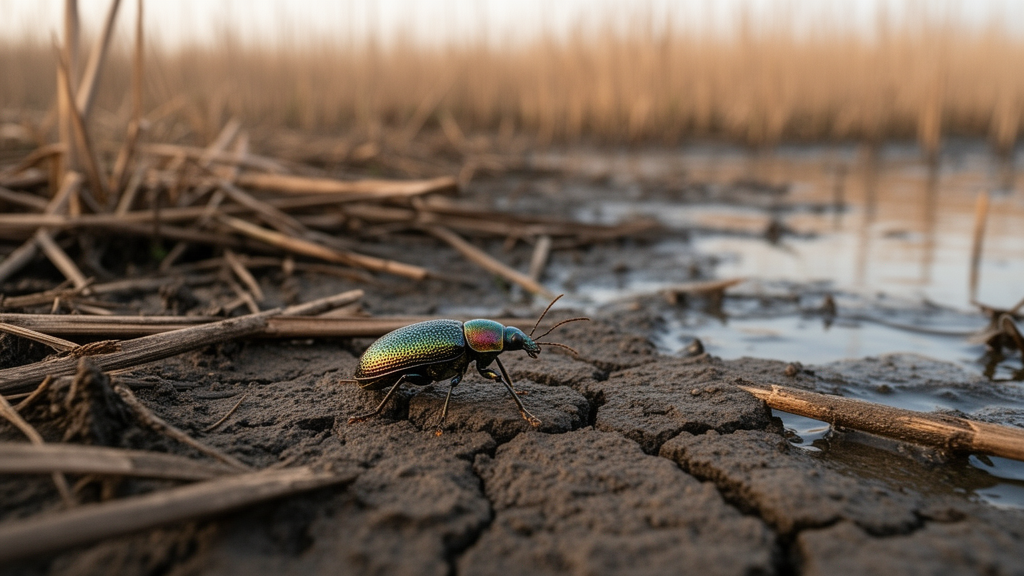
A century-scale reconstruction indicates that the Golden-dimpled Ground Beetle, Carabus clatratus auraniensis, has disappeared from Croatia’s Mediterranean biogeographical region, including its type locality near Vrana Lake, even though protected areas contain 67% of the region’s known records. The study combined museum specimens, literature records, field observations, historical maps, land-cover data and protected-area boundaries to examine the subspecies’ distribution in Croatia and Slovenia. It found a sharp contrast between the apparent persistence of the beetle in Croatia’s Continental region and its sustained absence in the Mediterranean region, where wetlands have been drained and converted to agriculture.
The subspecies was described by Joseph Müller in 1903 from Vrbica by Vransko blato, near Vrana Lake in Mediterranean Croatia. Its type material is held in the Civic Museum of Natural History in Trieste, Italy. For the analysis, researchers assembled 82 records collected across the Western Balkans over roughly 130 years: 81 from Croatia and one from Slovenia. The database combined information from scientific publications, 56 entomological-collection records, 10 literature-derived records and four direct field observations. The Global Biodiversity Information Facility contained no records of the subspecies when accessed on 20 January 2025. Records were organized by decade, collection date and biogeographical region, with pre-1975 observations classified as historical and those from 1975 onward classified as recent.
The researchers used a chronogeonemy analysis, which examines the temporal and spatial dimensions of changes in a species’ occupied area, to reconstruct trends in the subspecies’ Croatian distribution. They also compared land cover at Vrbica and nearby Biljane Donje using the Third Military Survey of the Habsburg Empire from 1869 to 1887, CORINE Land Cover data from 1980 and 2018, and chi-squared tests of changes between broad Level 1 and finer Level 3 land-cover categories. A separate gap analysis intersected known Croatian records with national parks, nature parks and Natura 2000 sites under the Habitats and Birds Directives. The combined approaches were intended to assess both historical change and the coverage provided by the current protected-area network.
Only six Mediterranean records were recovered, all from mainland Croatia rather than the Adriatic islands. Three originated in northern Dalmatia near Zadar, including the type locality at Vrbica and Biljane Donje near Vrana Lake; two came from the Istrian Peninsula; and one came from the Draga Valley near Rijeka. The most recent Mediterranean record dates from 1968, while the type locality has produced no record for more than 120 years. The authors interpret this pattern as local extinction rather than simply an absence of observations. Surveys of carabid beetle assemblages in wetland and riparian habitats have repeatedly covered the region, including work around Vrana Lake and on the Istrian Peninsula. At Vrana Lake, more than 85 pitfall traps and hand sampling during the vegetation season failed to detect the subspecies.
Historical maps show that the landscapes supporting the early records no longer resemble the sites where the beetle was found. The nineteenth-century military survey depicts broad marshes around Vrana Lake, including Vransko blato at the type locality. Comparison with CORINE maps showed that the wetland was fully drained and the remaining marshes near the lake were restricted to a narrow strip along its northwestern edge. At Biljane Donje, the former Terljuge wetlands were also drained. Between 1980 and 2018, broad-leaved forest disappeared within the Biljane Donje study area, transitional woodland and shrub declined, and pasture increased. Statistical comparisons identified significant changes in the broad land-cover categories there, with a chi-squared value of 41.45 and p < 0.001, as well as significant changes within the finer categories, all at p < 0.001.
Some of the habitat transformation at Vrana Lake preceded the formal establishment of protected areas. Work on the Prosika Canal lowered the lake’s water level by approximately three metres and allowed water to drain toward the Adriatic Sea. Further canal deepening and a land-reclamation project completed in 1948 subsequently converted most of the surrounding wetland ecosystem to farmland. An ornithological reserve was established at Vrana Lake in 1983, the Vrana Lake Nature Park followed in 1999, and Natura 2000 sites were designated. The authors conclude that these measures came too late to preserve the beetle’s Mediterranean population because the relevant habitat changes had already occurred. The apparent success of protected-area coverage therefore did not correspond to the subspecies’ continued persistence at the type locality.
The Continental region of Croatia presented a different pattern. The subspecies has been recorded there since the late 19th century, with the earliest precisely localized record dating from March 1896 in Osijek. The number of records fell between the two world wars and during the postwar period, then rose sharply from 2000 onward, especially during 2000 to 2010. The authors note that reduced entomological research may partly account for the earlier scarcity of observations, while the more recent increase may also reflect greater sampling effort. Nevertheless, they interpret the pattern alongside the continuing presence of populations as evidence that the large Continental wetlands support the subspecies. Protected areas covered 14 of 16 known Continental localities, or 88%. Across all precisely georeferenced Croatian records considered in the gap analysis, 18 of 22, or 82%, were inside protected areas.
Most recent Continental records come from wetlands along the Sava, Drava and Danube rivers, particularly the Lonjsko polje and Kopački rit nature parks. Both are Ramsar-listed wetlands and among the largest remaining wetland complexes and best-preserved semi-natural habitats in the Danube Basin. The beetle occurs in open wet grasslands, pastures, reedbeds, shrubby vegetation near water and flooded lowland forest. Its ecological requirements are narrow: it is described as stenotopic and highly hygrophilous, and later larval instars and adults hunt underwater. The first larval instar lives on land. Populations include both fully winged and short-winged individuals, and the species is unusual within the genus because it retains the capacity for flight. A single winged specimen recorded on the Mura River in northeastern Slovenia in 2007 was not followed by other finds during intensive monitoring from 2007 to 2024, so the researchers regard it as accidental rather than evidence of an established Slovenian population.
Some habitat within the Continental wetlands is maintained through existing human land use. Livestock grazing and pigs rooting in wet soils create shallow depressions that hold water and form a mosaic of saturated microhabitats. These conditions are associated with the occurrence of the subspecies in Lonjsko polje. The findings do not imply that all human intervention benefits the beetle; rather, they identify grazing and rooting as specific activities that create habitat features used by the insect. The broader wetlands also support other threatened organisms, including the notostracan crustaceans Triops cancriformis and Lepidurus apus and endangered beetles. The authors therefore describe the Golden-dimpled Ground Beetle as a potential flagship and umbrella species for Continental wetland nature parks. Within Croatia, most records occurred below 200 metres, with no records in the Alpine region and none in surveyed peatlands.
The species already has an alarming conservation history elsewhere in Europe. Carabus clatratus is considered highly threatened and has been reported extinct in Switzerland and Italy. In Italy, the spread of the invasive Red Swamp Crayfish, Procambarus clarkii, is associated with predation on adult beetles and contributed to the species’ extinction. The Mediterranean wetlands examined in Croatia have not recorded that crayfish. Based on the beetle’s high reproductive potential and a successful reintroduction in Italy before crayfish invasion, the authors recommend restoring suitable wetland habitat and reintroducing specimens from Continental Croatia, potentially at Vrana Lake, to improve the subspecies’ prospects. More broadly, they call for revised conservation assessments, continued protection of wetlands against drainage, and use of historical distribution analysis alongside modern spatial tools so that protected-area statistics do not conceal extinctions that have already occurred.
Subject of Research: Conservation status and habitat-driven local extinction of the Golden-dimpled Ground Beetle in Croatia and Slovenia
Article Title: Extinction risk alert: evaluating conservation trends for the Golden-dimpled Ground Beetle ( Carabus clatratus auraniensis J. Müller, 1903) in Western Balkans
Article References: Brigić, A., Ružanović, L., Mlinarić, M. K., Vujčić-Karlo, S., Koren, T., Vrezec, A., & Kapla, A. (2025). Extinction risk alert: evaluating conservation trends for the Golden-dimpled Ground Beetle (Carabus clatratus auraniensis J. Müller, 1903) in Western Balkans. Nature Conservation, 59, 257-277. https://doi.org/10.3897/natureconservation.59.161038
Image Credits: AI Generated
DOI: 10.3897/natureconservation.59.161038
Keywords: Golden-dimpled Ground Beetle, Carabus clatratus auraniensis, local extinction, wetland degradation, land-use change, Croatia, Western Balkans, protected areas, chronogeonemy, Vrana Lake, Extinction, risk
Cite Scienmag News
Margaret Porter. (October 20, 2026). Study links wetland loss to Croatian beetle’s local extinction. Scienmag. https://scienmag.com/study-links-wetland-loss-to-croatian-beetles-local-extinction/
Margaret Porter. "Study links wetland loss to Croatian beetle’s local extinction." Scienmag, 20 October 2026, https://scienmag.com/study-links-wetland-loss-to-croatian-beetles-local-extinction/. Accessed 20 October 2026.
Margaret Porter. "Study links wetland loss to Croatian beetle’s local extinction." Scienmag. October 20, 2026. https://scienmag.com/study-links-wetland-loss-to-croatian-beetles-local-extinction/


