


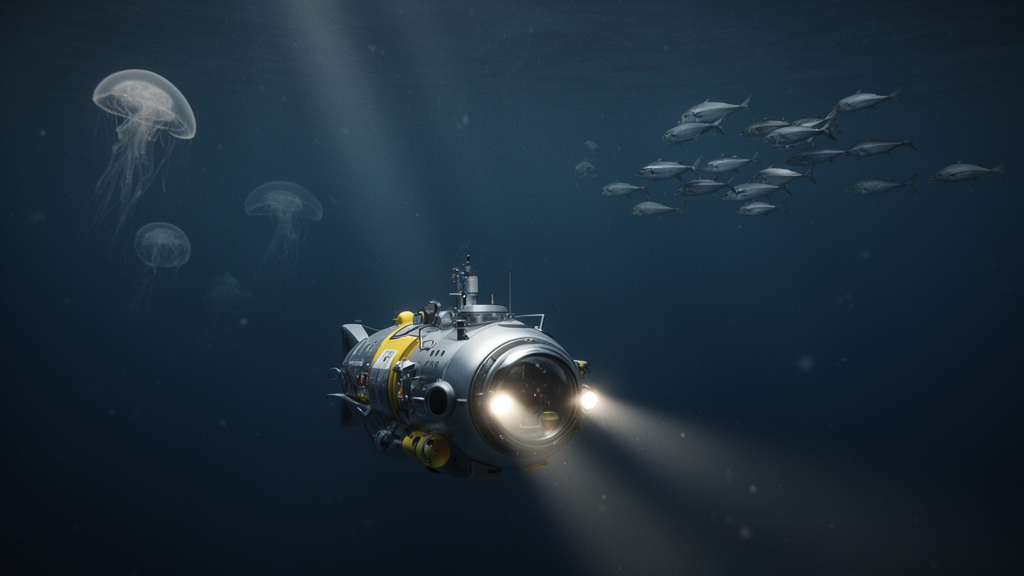
A research expedition has set out to investigate the ecological consequences of experimental mining on the abyssal seafloor of the Clarion-Clipperton Zone, more than 4,000 metres below the Pacific surface. Expedition SO322, led by biogeochemist Matthias Haeckel of the GEOMAR Helmholtz Centre for Ocean Research Kiel, is returning to an area where a remotely controlled collector removed polymetallic nodules in spring 2021. The researchers will examine the seafloor five and a half years after that trial, focusing on changes in animal communities, the extent of disturbance by sediment resettling, and whether artificial hard surfaces can support recolonisation where nodules were removed. The project is a field investigation rather than a new mining test, and its findings will depend on how much can be observed in an ecosystem whose species and ecological relationships remain only partly understood.
The SO322 expedition is part of MiningImpact, a European consortium that has studied the environmental impacts of potential deep-sea mining since 2015. It is scheduled to run from 17 October to 9 December 2026, beginning and ending in San Diego, and will work in the Pacific’s Clarion-Clipperton Zone. Thirty-nine researchers from 17 institutions in seven European countries are taking part. Their disciplines include biology, microbiology, chemistry, oceanography and geology, allowing them to investigate biological and chemical aspects of the seabed as well as sediment and geological conditions. This is a multidisciplinary observational study of the consequences of an earlier disturbance. It is intended to answer specific questions about faunal change, sediment effects and potential recolonisation, but it cannot provide a complete assessment of the abyssal ecosystem or predict every consequence of future mining.
Polymetallic nodules form at an exceptionally slow rate, growing by about one to two millimetres over a million years. In undisturbed abyssal plains, they also supply a hard surface on which animals can settle. Sea anemones, soft corals and giant stalked sponges may live on the nodules, and the sponges can provide habitat for other organisms. Haeckel said researchers typically find two to three small organisms on each nodule. Where nodules have been removed, those organisms and the habitats associated with them are absent. The expedition’s central question is how the communities around the 2021 trial have changed during the five and a half years since the collector operated.
That earlier test was conducted by the Belgian company Global Sea Mineral Resources, which operated a remotely controlled pre-prototype nodule collector for 74 hours in the Clarion-Clipperton Zone. The vehicle travelled about 32 kilometres and harvested polymetallic nodules across 54,000 square metres, an area roughly equivalent to seven soccer fields. Besides removing nodules, the collector removed the biota-rich surface layer of sediment. The experiment therefore created a disturbed track that can now be compared with surrounding seabed. SO322 will examine both the cleared area and its wider sediment-affected zone, offering observations from a real collector trial rather than relying only on short-term responses or predictions.
The trial also produced a plume of sediment suspended in bottom water, with material settling again within several hundred metres of the mining site. Fauna attached to nodules, known as sessile fauna, cannot escape the plume and may be buried by resettling sediment. Haeckel said some organisms can clean themselves while others cannot, and that organisms which filter food from the water are also very likely to be affected. These statements identify mechanisms the researchers will investigate, rather than establishing the extent of impact in every organism. One of SO322’s objectives is to determine how long plume-related effects persist and how far they extend beyond the collector’s route.
To conduct those observations, the research vessel Sonne carries a large suite of equipment. Its remotely operated vehicle, KIEL 6000, is about the size of a small van and, with cables, winches, a control unit and accessories, requires five 20-foot containers. The ship also carries ABYSS, an autonomous underwater vehicle with a launch and recovery system; three benthic landers that can be deployed on the seafloor; and sediment-sampling devices such as multiple and box corers. Scientific equipment aboard the vessel fills 16 containers. Sonne will remain at sea for 54 days, the maximum period for which the ship is designed to stay out without entering a port.
Beyond tracking changes around the collector footprint, the team will test whether artificial hard substrates can promote recolonisation of the seabed. The planned experiment will introduce surfaces where nodules have been extracted, allowing researchers to ask whether animals can begin using a substitute habitat and what kinds of organisms settle on it. The artificial structures will not reproduce the nodules in every respect, and the test will not settle every question about long-term restoration. Nevertheless, placing them in the disturbed landscape can help investigators characterize the arrival of organisms on a new hard surface and compare that process with the condition of the original nodule habitat. The results will inform the project’s broader work on potential environmental consequences.
Major uncertainties surround the biology of the Clarion-Clipperton Zone. Haeckel said about 90 percent of the species sampled so far remain unidentified and have no scientific name, while the total number of species still to be discovered is unknown. The functions of individual species are also poorly understood, leaving researchers without a complete map of their ecological relationships. Species connectivity is another unresolved question. Some species are distributed across the entire Clarion-Clipperton Zone between Mexico and Hawaii, and in some cases across the wider Pacific Ocean. Such a distribution implies that gene exchange must occur, but the intermediate spatial links and temporal scales involved have not been established. These knowledge gaps limit how confidently the lasting effects of disturbance can be characterized.
SO322 is also intended to strengthen the evidence available to the International Seabed Authority and national authorities. MiningImpact translates its scientific findings into recommendations concerning potential deep-sea mining, and the consortium has been assessing environmental consequences since 2015. The five-and-a-half-year interval since the collector trial provides an opportunity to look beyond the immediate period of operation and determine which changes remain detectable in the seabed. Haeckel said the benthic ecosystem is unlikely to recover on human timescales: removal of a specific nodule habitat can be permanent, while alterations to sedimentary processes may persist for thousands of years. He argued that damage on that scale must be prevented because it may become apparent only when it is already too late.
SO322 is therefore a voyage into a habitat defined by very slow formation, uncertain biodiversity and potentially persistent disturbance. The expedition does not initiate commercial extraction and does not, by itself, establish the consequences of mining across the entire Clarion-Clipperton Zone. It instead examines a specific experimental disturbance using remotely operated and autonomous vehicles, seafloor landers and sediment sampling, while a multidisciplinary team studies animals, microbes, water, sediment and geology. Its practical value lies in extending observation beyond the hours of the 2021 collector test: by returning five and a half years later, scientists can assess what remains of the nodule-associated community, how disturbance extends through sediment and whether newly provided surfaces are colonized. Those observations will help clarify the limits of current knowledge and the scale of the ecological challenge posed by mining in the deep sea.
Subject of Research: Ecological effects of experimental polymetallic-nodule mining on the abyssal seafloor
Article Title: A voyage into the slow-motion world of the deep sea
Article References: A voyage into the slow-motion world of the deep sea. Original publication (Bibliographic details unavailable.)
Image Credits: AI Generated
DOI: Not provided
Keywords: deep-sea mining, polymetallic nodules, Clarion-Clipperton Zone, abyssal ecology, sediment plume, benthic fauna, recolonisation, MiningImpact, ocean research, GEOMAR, voyage, slow-motion
Cite Scienmag News
Violet Maxwell. (October 20, 2026). A voyage into the slow-motion world of the deep sea. Scienmag. https://scienmag.com/a-voyage-into-the-slow-motion-world-of-the-deep-sea/
Violet Maxwell. "A voyage into the slow-motion world of the deep sea." Scienmag, 20 October 2026, https://scienmag.com/a-voyage-into-the-slow-motion-world-of-the-deep-sea/. Accessed 20 October 2026.
Violet Maxwell. "A voyage into the slow-motion world of the deep sea." Scienmag. October 20, 2026. https://scienmag.com/a-voyage-into-the-slow-motion-world-of-the-deep-sea/


