


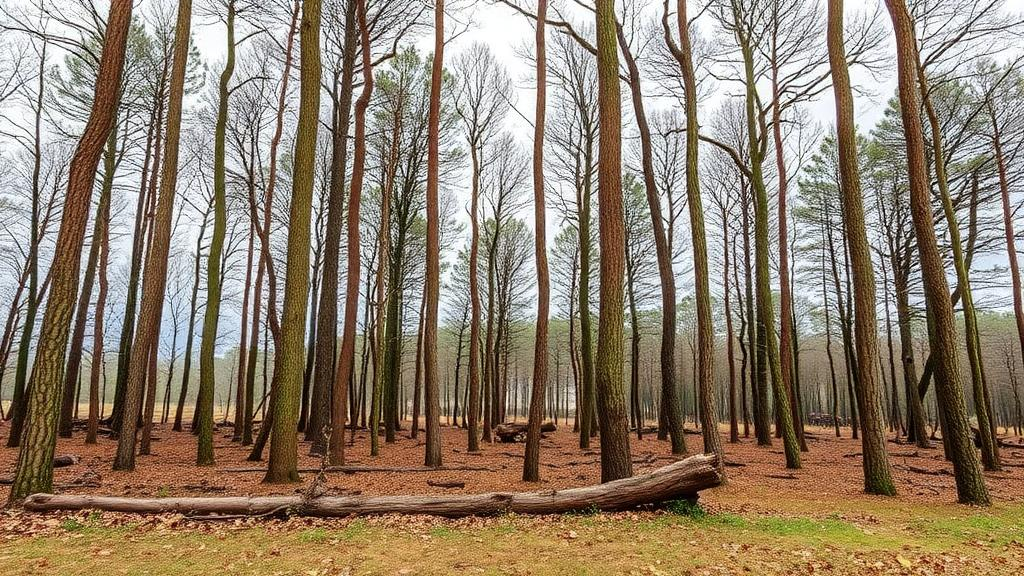
Pedunculate oak forests along southeastern Bulgaria’s Tundzha River contain large old trees and uneven diameter structures, but a four-stand field study found little evidence of replacement by young oak. Quercus robur remained dominant in the upper diameter classes while occurring sparingly among trees measuring 10–30 cm in diameter at breast height. Regeneration was dominated by other broadleaved trees and shrubs, and tree-ring records showed declining radial growth that began in different decades at the four sites.
The authors identified disruption of the river’s natural hydrological regime as a probable contributing factor rather than a cause established directly by the observations. The study examined two stands in the Tulovska Koriya Protected Site, one in the Yulievska Koriya Protected Site and one in the Gorna Topchiya Reserve, all situated in the Gornotrakiiska and Tundzhanska valleys of southeastern Bulgaria. The sites occupy river terraces and differ in climate, elevation and forest composition.
At stands ST1–ST3, the mean annual temperature was 11 °C and annual precipitation was 670 mm, including 190 mm during summer. At ST4, the corresponding figures were 12 °C and 550 mm, with only 130 mm falling in summer. Elevations ranged from 123 m above sea level at ST4 to 326 m at ST1.
These four stands represent a limited regional sample, but together they allowed the researchers to compare diameter structure, regeneration and growth within oak-dominated remnants of the Tundzha floodplain. To inventory the forests, researchers established 25 circular sample plots at each stand on a systematic grid with 30 m between plot centers. Each 100 m² plot contained records of every tree with a diameter at breast height above 8 cm.
A nested 25 m² circle was used to measure smaller trees, and regeneration was separated into height groups of up to 30 cm, 31–80 cm and 81–130 cm. Canopy closure was assessed with a spherical densiometer. The investigators tested nine theoretical distributions for tree-diameter data and used the Akaike Information Criterion to select among models with adequate fits.
A Gini index, ranging from zero for perfect equality to one for maximum inequality, quantified differences in tree size. They also collected 59 increment-borer cores from four sampling plots, cross-dated the rings, measured their widths and standardized the chronologies to reduce age-related growth trends. Gamma, lognormal and Weibull distributions gave the strongest overall fits to the diameter data, with the precise model varying among sites.
At Tulovska Koriya ST1, lognormal and gamma models performed best; ST2 fit lognormal and Weibull distributions well. At Yulievska Koriya, lognormal and gamma models captured a highly skewed diameter distribution. No model produced a statistically significant fit at Gorna Topchiya, although the uniform distribution had the lowest Akaike Information Criterion value there, followed by the normal and Weibull models.
The reported Gini values were 0.54 for ST1, 0.45 for ST2, 0.58 for ST3 and 0.39 for ST4. Under the study’s classification, ST1, ST2 and ST3 were uneven-sized, while ST4 was two-sized. Mean canopy closure ranged from 0.8 to 0.9 across all stands, and fewer than 5% of sample plots had closure below 0.7.
Species distributions showed that the dominant canopy trees were not being replaced by equally abundant young oak. Pedunculate oak dominated the classes at or above 30 cm in diameter but was nearly absent from the 10–30 cm classes, which mainly contained other broadleaved species. These included hornbeam, field maple, European field elm, narrow-leaved ash, wild cherry, Tatarian maple and other trees.
Oak was completely absent from the smallest diameter classes at Yulievska Koriya and Gorna Topchiya. The two Tulovska Koriya stands retained some oak in the lower classes, particularly ST2, but non-oak trees remained more abundant. The measured structure therefore consisted of large legacy oaks alongside a much larger pool of smaller trees belonging to other species, although the observations alone do not establish how rapidly future canopy composition will change.
The regeneration survey produced a similar pattern from seedlings through larger saplings. Oak was uncommon in every measured height and early-diameter class, while common hazel, hawthorn, European spindle, privet, dogwood, roses, blackthorn and black elder formed much of the understory. At Yulievska Koriya, total regeneration exceeded 24,000 individuals ha−1, yet pedunculate oak contributed only marginally.
Regeneration at Gorna Topchiya was less dense overall but was also dominated by non-oak species. Because seedlings and saplings of multiple sizes were present, the results indicate successful establishment by these other species. By contrast, the scarcity of oak across the measured classes provides no support for a conclusion that the current oak population is regenerating successfully.
Tree-ring measurements extended the assessment beyond a single survey of age structure. The longest core contained 135 annual rings and came from a Yulievska Koriya tree that germinated shortly before 1885. The oldest sampled trees at Tulovska Koriya were approximately 100 years old, while the oldest tree at Gorna Topchiya began growing around 1920.
Radial-growth declines became noticeable in the late 1930s and early 1940s at Yulievska Koriya and Gorna Topchiya and in the 1960s at the two Tulovska Koriya stands. Mean ring width was 4.01 mm at Tulovska Koriya, 3.16 mm at Yulievska Koriya and 3.21 mm at Gorna Topchiya. These chronologies document a decrease in growth over time, but they do not by themselves quantify the contribution of any particular cause.
The historical context offers a potential explanation for the parallel observations of reduced growth and poor oak recruitment. Pedunculate oak forests in lowland river valleys can supplement rainfall with groundwater and periodic floods, and the species’ seedlings can tolerate short periods of inundation. Beginning in the mid-20th century, the Koprinka and Zhrebchevo reservoirs were built on the Tundzha for water storage, irrigation and electricity generation.
Irrigation channels diverted river water, reservoirs retained much of the spring flow, and continuous embankments and drainage canals interrupted the recurrent inundation that had reached the river terraces. Such changes can lower the water table and alter flooding patterns. The authors therefore considered hydrological alteration a significant potential contributor, while also noting that grazing can compact soil and reduce its permeability and that the timing of major infrastructure does not align uniformly with the onset of growth decline at every site.
The four stands also differed in ecological composition. The Tulovska Koriya forests corresponded closely to a pedunculate-oak and common-hornbeam association, although oak had been replaced by hornbeam in parts of the overstory and understory, especially in ST1. Yulievska Koriya and Gorna Topchiya contained narrow-leaved ash but lacked hornbeam and were interpreted as closer to a more humid oak association.
In undisturbed examples of that association, brief recurring floods favor oak regeneration, while the absence of floods over recent decades has been associated with expansion of Tatarian maple. The study also noted reports of successful oak recruitment following heavy acorn crops in managed Croatian forests, but the scarcity of oak seedlings and saplings in the Bulgarian plots meant that those observations could not simply be transferred to these sites. Overall, the measured combination of senescing canopy oaks, little oak recruitment, abundant non-oak regeneration, high canopy closure and declining radial growth was interpreted as evidence of forest degradation, even though the diameter distributions retained uneven-aged structural characteristics.
They proposed that restoring at least partial hydrological connectivity, including seasonal inundation where feasible, should be considered alongside active planting of Q. robur, carefully planned canopy openings, removal of competing vegetation and suitable soil preparation. These are the study authors’ proposed responses to the observed conditions, not interventions tested by the field survey. The study therefore identifies a specific pattern of structural change in four Tundzha River oak stands and supports hydrological disruption as a plausible, important factor requiring further evaluation, rather than demonstrating a single cause or a tested restoration outcome.
Subject of Research: Structural diversity, regeneration and radial growth of pedunculate oak forests along Bulgaria’s Tundzha River
Article Title: Structural diversity as an indicator of forest degradation in Quercus robur stands along the Tundzha river, Southeast Bulgaria
Article References: Zlatanov, T., Tsvetanov, N., Tonchev, T., Zlatanova, M., Gogushev, G., & Hinkov, G. (2025). Structural diversity as an indicator of forest degradation in Quercus robur stands along the Tundzha river, Southeast Bulgaria. Nature Conservation, 59, 301-314. https://doi.org/10.3897/natureconservation.59.160003
Image Credits: AI Generated
DOI: 10.3897/natureconservation.59.160003
Keywords: pedunculate oak, forest degradation, Tundzha River, Bulgaria, forest regeneration, tree-ring analysis, hydrological change, riparian forests, diameter distribution, oak recruitment, Structural, diversity
Cite Scienmag News
Margaret Porter. (October 20, 2026). Structural diversity as an indicator of forest degradation in Quercus robur stands along the Tundzha river, Southeast Bulgaria. Scienmag. https://scienmag.com/structural-diversity-as-an-indicator-of-forest-degradation-in-quercus-robur-stands-along-the-tundzha-river-southeast-bulgaria/
Margaret Porter. "Structural diversity as an indicator of forest degradation in Quercus robur stands along the Tundzha river, Southeast Bulgaria." Scienmag, 20 October 2026, https://scienmag.com/structural-diversity-as-an-indicator-of-forest-degradation-in-quercus-robur-stands-along-the-tundzha-river-southeast-bulgaria/. Accessed 20 October 2026.
Margaret Porter. "Structural diversity as an indicator of forest degradation in Quercus robur stands along the Tundzha river, Southeast Bulgaria." Scienmag. October 20, 2026. https://scienmag.com/structural-diversity-as-an-indicator-of-forest-degradation-in-quercus-robur-stands-along-the-tundzha-river-southeast-bulgaria/


