


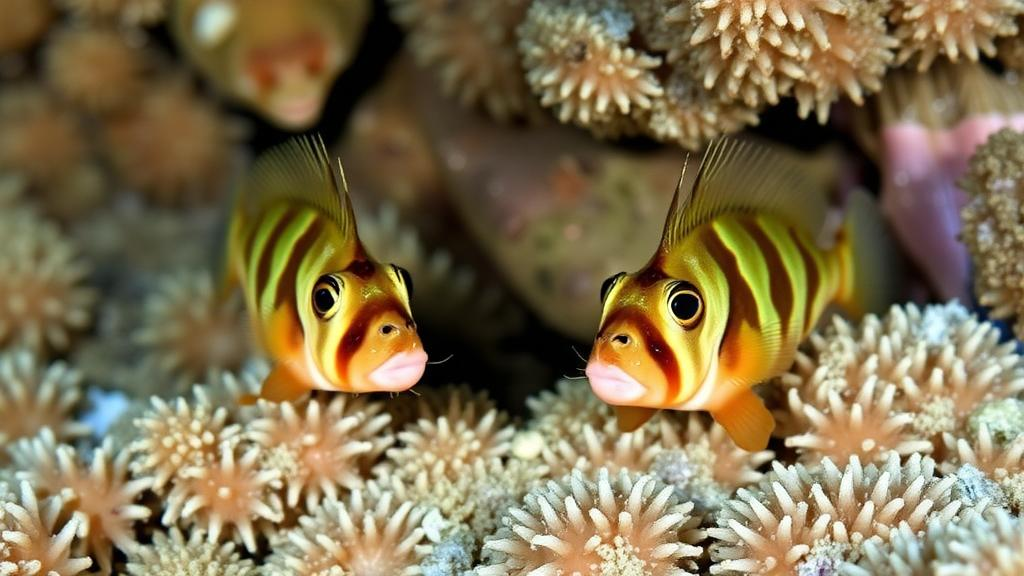
The new Australian record for E. rhothion is based on a single 32.5 mm male collected at Green Island, Queensland, in 1901. For E. olivaceus, researchers examined 18 specimens from Lizard Island, Queensland, and reassigned two specimens from Vanuatu that had previously been identified as Enneapterygius minutus. Detailed comparisons with type material confirmed both identifications, while also revealing a need to revise the recorded orbital-tentacle length and mandibular-pore formula of E. rhothion.
The study focused on Enneapterygius, a genus of triplefins in the family Tripterygiidae whose members inhabit intertidal rock pools as well as subtidal rocky and coral reefs across tropical and temperate Indo-Pacific waters. Members of the genus possess a discontinuous lateral line, three spines in the first dorsal fin, one anal-fin spine, and a pelvic fin with one spine and two soft rays. The head, opercle, pectoral-fin base and abdomen are scaleless in most species.
Before the new records, 19 Enneapterygius species had been reported from Australia. E. rhothion, described by Fricke in 1997, had been known only from New Caledonia and Vanuatu and was therefore regarded as endemic to those areas. E. olivaceus had been described in 2023 from the southern Ryukyu Islands in Japan and from Talampulan and Negros islands in the Philippines.
The Australian E. rhothion specimen, AMS I. 5088, was collected at Green Island in 1901 by C. Hedley. Researchers compared its measurements and counts with the holotype and eight paratypes from New Caledonia and Vanuatu.
Most characters agreed closely with the type series. The Australian fish was 32.5 mm standard length, had a body depth equal to 20.5% of standard length, a head length of 29.3% and 16 pored lateral-line scales followed by 20 notched scales. Its dorsal-fin formula was III, XIII, 10, compared with III, XIII, 9 in the holotype and III, XIII or XIV, 9 or 10 in the paratypes.
These values fell within the variation recorded for the species and supported the identification of the Green Island fish as E. rhothion. Examination of the preserved Australian fish also prompted a correction to the original description. The orbital tentacle of AMS I. 5088 measured 1.6% of standard length, while that of the holotype measured 2.1%; both are substantially longer than the previously reported range of 0.6% to 0.9%.
The researchers proposed revising the mandibular-pore formula to 3–4 + 2 + 3–4, representing eight to 10 pores in total, rather than the original formula of 4–5 + 2 + 4–5. The observed individual counts were 4 + 2 + 4 in the holotype and three paratypes, 3 + 2 + 3 in four paratypes and the Australian specimen, and 4 + 1 + 4 in one paratype. Preserved coloration remained broadly consistent with the species, although long-term preservation had removed the faint vertical dark streaks formerly recorded on the caudal fin.
The authors also addressed a possible confusion with Enneapterygius rufopileus, to which the Australian specimen had initially been assigned using an existing key. They identified errors in that key, which incorrectly listed the symphyseal mandibular pore and the coloration of the second dorsal fin in E. rhothion. The two species can be separated by several features: E. rhothion has a single symphyseal mandibular pore rather than two; in nuptial males its head, including the maxilla, and its pectoral-fin base are entirely black, while the posterior two-thirds of the jaws are white in E. rufopileus and that species has a black blotch at the pectoral-fin base.
E. rhothion also has seven body bands rather than five, black first and second dorsal fins in nuptial males, pigmentation on the third dorsal fin in both sexes, and vertical caudal-fin streaks in both sexes. Evidence for E. olivaceus came from 20 specimens measuring 12.1–22.1 mm standard length. Eighteen were collected around Lizard Island, Queensland: a 22.1 mm male from Bird Islet collected in 1981 and nine males and eight females from Lizard Island collected in 1989.
The remaining specimens were a 19.7 mm male from Vila on Efate and a 15.9 mm female from Vanua Lava in the Banks Islands, both collected in Vanuatu in 1903. The Vanuatu fish had originally been identified as E. minutus, but re-examination showed that they matched the diagnostic features of E. olivaceus. Together, the Australian and Vanuatu specimens constitute the first records of E. olivaceus from the Southern Hemisphere and the first from the southwest Pacific Ocean.
Characters supporting the revised identification included 11–13 second dorsal-fin spines, with a modal count of 12, and 18–21 notched lateral-line scales, with a modal count of 20. All examined specimens had a mandibular-pore formula of 3 + 1 + 3. Head length ranged from 28.9% to 32.3% of standard length, and upper-jaw length ranged from 9.3% to 12.0%.
The first spine of the first dorsal fin was relatively long, measuring 11.0% to 18.2% of standard length. The orbital tentacle was broad and leaf-shaped. In nuptial males, the head, pectoral-fin base and lower portion of the pectoral fin were brownish, while the caudal fin was whitish; females had a pectoral fin marked by about four or five broad vertical bands and an anal fin without distinct bars or lines.
The authors distinguished E. olivaceus from E. minutus, with which it occurs in both Japan and Vanuatu. E. olivaceus has a large, leaf-shaped orbital tentacle rather than the slender, pointed tentacle of E. minutus. It also has a longer head, with a reported range of 28.4% to 33.0% of standard length, and a longer upper jaw, measuring 9.3% to 13.1%, compared with 7.4% to 11.0% in E. minutus.
Its first dorsal-fin spine is relatively long, whereas that spine is short in E. minutus. The nuptial-male color pattern also differs: black areas in E. olivaceus are restricted to the head and fins except the caudal fin, while E. minutus has a largely black body apart from the nape and fins. Females of E. olivaceus show faint broad pectoral-fin bands rather than the distinct narrow bands of E. minutus.
Minor variations were retained as evidence of intraspecific diversity rather than treated as grounds for separating the specimens. The newly examined E. olivaceus had 29–32 longitudinal scale rows, compared with 30–32 in the type series, and two or three scales below the first notched lateral-line scale, compared with two to three in the original material. The authors regarded these differences as minor.
The revised distributions are now known from Japan, the Philippines, Lizard Island in Australia and Vanuatu for E. olivaceus, while E. rhothion is known from New Caledonia, Vanuatu and Green Island in Queensland. The latter record is both the first Australian record and the species’ northernmost known occurrence, showing that a fish previously considered endemic to New Caledonia and Vanuatu also occurred in Australia.
Subject of Research: Taxonomic range records of the triplefins Enneapterygius rhothion and E. olivaceus in Australia and Vanuatu
Article Title: First records of two triplefins, Enneapterygius rhothion and Enneapterygius olivaceus ( Actinopterygii : Blenniiformes : Tripterygiidae ), from Australia and Vanuatu
Article References: Dewa, Y., & Motomura, H. (2024). First records of two triplefins, Enneapterygius rhothion and Enneapterygius olivaceus (Actinopterygii: Blenniiformes: Tripterygiidae), from Australia and Vanuatu. Acta Ichthyologica et Piscatoria, 54, 261-268. https://doi.org/10.3897/aiep.54.135448
Image Credits: AI Generated
Keywords: triplefins, Enneapterygius rhothion, Enneapterygius olivaceus, Australia, Vanuatu, New Caledonia, range extension, fish taxonomy, morphology, museum specimens, First, records
Cite Scienmag News
Margaret Porter. (October 19, 2026). Two triplefin species newly recorded from Australian and Vanuatu waters. Scienmag. https://scienmag.com/two-triplefin-species-newly-recorded-from-australian-and-vanuatu-waters/
Margaret Porter. "Two triplefin species newly recorded from Australian and Vanuatu waters." Scienmag, 19 October 2026, https://scienmag.com/two-triplefin-species-newly-recorded-from-australian-and-vanuatu-waters/. Accessed 19 October 2026.
Margaret Porter. "Two triplefin species newly recorded from Australian and Vanuatu waters." Scienmag. October 19, 2026. https://scienmag.com/two-triplefin-species-newly-recorded-from-australian-and-vanuatu-waters/


