

West Virginia University researcher Piyush Mehta will lead a four-year, $2.7 million National Science Foundation initiative to improve forecasts of space-weather risks to satellites. The collaborative project will receive $1.4 million in NSF support for WVU and combine machine learning with physics models to estimate whether a solar storm will strike Earth, when it will arrive and how severe the resulting geomagnetic storm may be. It will also seek to quantify and track uncertainty in those forecasts so satellite operators can make more informed decisions when preparing for a storm.
Mehta, an associate professor of mechanical, materials, and aerospace engineering in WVU’s Benjamin M. Statler College of Engineering and Mineral Resources, said the project responds to a growing operational challenge as orbital traffic reaches what the university described as an all-time high. Geomagnetic storms are disturbances of Earth’s magnetic field and upper atmosphere triggered by solar eruptions or fast-moving streams of charged particles, known as solar wind.
They can disrupt radio signals, GPS navigation and satellites. Rather than providing only a warning that a storm will occur, the planned forecasting system is intended to communicate the probability and range associated with predicted outcomes. Mehta compared that need with everyday weather decisions.
If rain were certain, an observer might make one plan; if its chance were only 10%, the appropriate plan could be quite different. The project will bring together researchers from WVU, Ohio State University, George Mason University and the Southwest Research Institute, as well as the commercial satellite-tracking company LeoLabs. The Air Force Research Laboratory, the Japan Aerospace Exploration Agency and NASA will provide operational input.
The research teams will work in parallel throughout the four-year project rather than completing the component studies in sequence. WVU will lead two of the project’s four research thrusts. One will focus on storm forecasting in collaboration with Southwest Research Institute scientist Subhamoy Chatterjee, who will co-advise a WVU doctoral student.
The other will model how geomagnetic storms heat and expand the upper atmosphere, increasing atmospheric drag on satellites. Ohio State University will model how that drag changes satellite orbits and collision risk, while George Mason University will estimate the socioeconomic impact of space-weather disruptions. LeoLabs will supply radar-tracking data for use in the project’s modeling and validation work, and the three government and space-agency partners will contribute operational guidance.
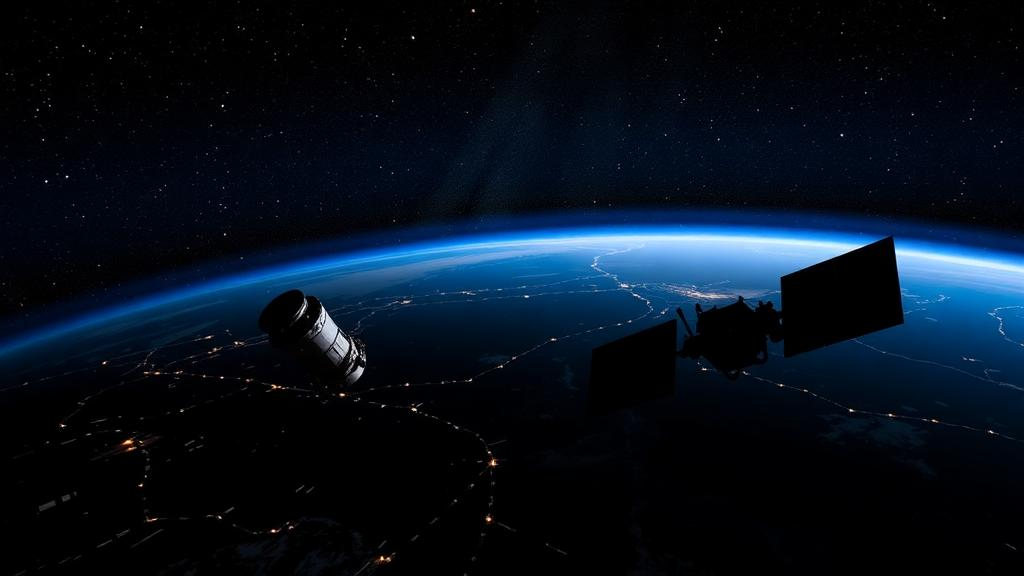
During a geomagnetic storm, the upper atmosphere heats and expands, thickening the air through which satellites fly. The resulting drag slows satellites and pushes them away from their expected positions. Operators can temporarily lose track of satellites in these circumstances, raising the risk of collisions.
Moving a satellite is unlike steering a car around an obstacle: many spacecraft use low-thrust propulsion to conserve fuel, so changes in orbit can require hours or days of lead time. For most operators, the process also remains largely manual, which becomes especially demanding for constellations containing thousands of spacecraft. Mehta cited two historical incidents to illustrate the stakes.
In 1989, a major geomagnetic storm caused the U.S. military to temporarily lose track of more than 1,000 objects it was monitoring in orbit. In 2022, roughly 40 newly launched SpaceX satellites failed to raise their orbits after a space-weather event and were destroyed during reentry into the atmosphere. He described uncertainty as a thread running through the entire sequence linking solar activity, atmospheric drag, satellite orbits and collision risk.
It also extends to governments, businesses and consumers who depend on satellite services that may be degraded, temporarily interrupted or lost. Operators sometimes divert a satellite to avoid a collision and suspend its operations in the process. Mehta said many collision warnings ultimately prove to be false alarms because the underlying uncertainties have not been characterized correctly.
The planned project therefore seeks to improve not only the forecast of a geomagnetic storm but also the quantification of uncertainty along the chain from solar conditions to atmospheric changes, orbital motion and collision risk. The source did not report completed models, measured forecast performance or evidence that the initiative has already reduced false alarms or prevented satellite losses; those outcomes remain to be tested during the planned research. The scale of satellite operations is increasing.
According to Mehta, fewer than 2,000 total satellites were orbiting Earth in 2017, while Starlink now has more than 11,000 satellites in orbit. Technology companies including SpaceX and Google are pursuing plans to launch data centers into space, and Mehta said such facilities could eventually involve millions of satellites. Although the grant focuses on spacecraft, space weather can affect other services.
Scrambled radio signals may hinder communication during natural disasters and other emergencies, and geomagnetic storms have disrupted electrical power grids. The 1989 storm that affected military tracking also caused a nine-hour power outage in Quebec, affecting millions of people during winter. Beyond the technical research, the grant will fund educational work related to space weather.
The team plans to develop teaching materials, engage K-12 students in science and engineering and train the next generation of scientists and engineers in the field. The researchers also intend to release the resulting framework as open-source software, with the stated aim of encouraging innovation across the satellite industry. Mehta founded the ASSIST Lab—Astrodynamics, Space Science, and Space Technology—shortly after joining WVU in 2018.
He also leads the WVU Center for Innovation in Space Exploration and Research, established in 2023, which focuses on space situational and domain awareness, space safety and sustainability. Mehta’s previous NSF-supported work has included modeling Earth’s magnetosphere with artificial intelligence and machine learning, along with experiments on plasma-atmosphere interactions related to space-weather forecasting. He is a member of the National Oceanic and Atmospheric Administration’s Space Weather Advisory Group and previously served on the NASA Space Weather Council.
The new initiative will connect those areas of experience with the operational problem described in the grant announcement: developing forecasts that specify the likelihood, timing and potential severity of solar-storm effects for satellite operators. Its planned contribution is a framework for propagating uncertainty through forecasting, atmospheric-drag modeling, orbit prediction, collision-risk assessment and estimates of socioeconomic consequences.
Subject of Research: Probabilistic space-weather forecasting for satellite operations and orbital safety
Article Title: WVU researcher leads $2.7M effort to forecast space weather risks to satellites
Article References: WVU researcher leads $2.7M effort to forecast space weather risks to satellites. Original publication (Bibliographic details unavailable.)
Image Credits: AI Generated
DOI: Not provided
Keywords: space weather, solar storms, geomagnetic storms, satellite safety, atmospheric drag, orbital forecasting, collision risk, machine learning, satellite tracking, National Science Foundation, researcher, leads
Cite Scienmag News
Cameron Wolfe. (October 19, 2026). WVU researcher leads $2.7M effort to forecast space weather risks to satellites. Scienmag. https://scienmag.com/wvu-researcher-leads-2-7m-effort-to-forecast-space-weather-risks-to-satellites/
Cameron Wolfe. "WVU researcher leads $2.7M effort to forecast space weather risks to satellites." Scienmag, 19 October 2026, https://scienmag.com/wvu-researcher-leads-2-7m-effort-to-forecast-space-weather-risks-to-satellites/. Accessed 19 October 2026.
Cameron Wolfe. "WVU researcher leads $2.7M effort to forecast space weather risks to satellites." Scienmag. October 19, 2026. https://scienmag.com/wvu-researcher-leads-2-7m-effort-to-forecast-space-weather-risks-to-satellites/


