


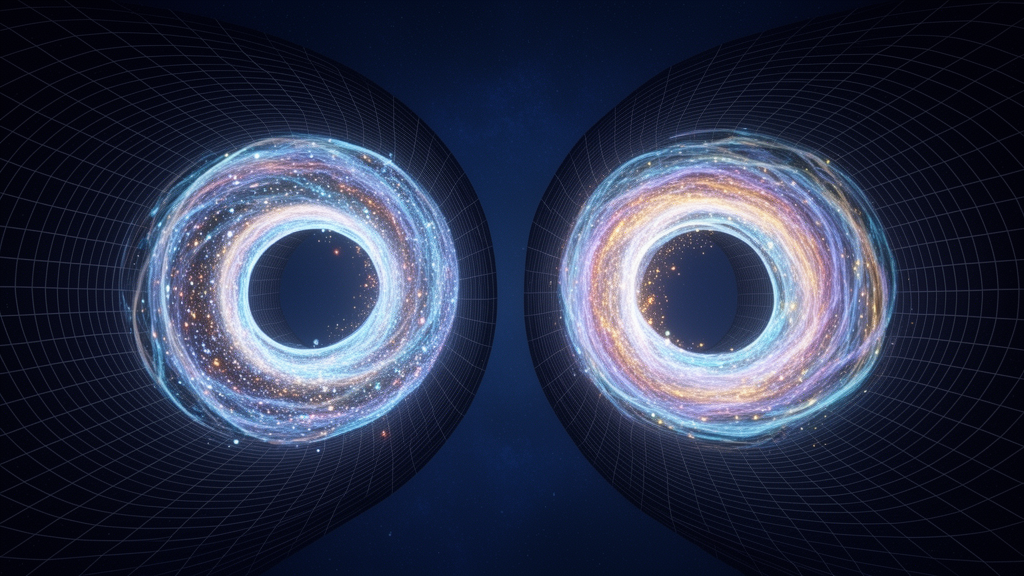
Traversable wormholes have long been the most tantalizing shortcuts in theoretical physics: tunnels through spacetime that, at least on paper, could connect two distant regions of the universe. But keeping a wormhole open requires matter that violates the null energy condition, the so-called exotic matter that no known substance provides. For years, physicists have wondered whether alternative theories of gravity might sidestep this requirement. A new study published in The European Physical Journal C by Marco Bosquez, Erick Pastén, Mauricio Cataldo and Norman Cruz delivers a sobering and surprisingly elegant answer: in unimodular gravity, an alternative to Einstein’s general relativity, wormholes still need exotic matter, and the real difference between the two theories lies not in the geometry of spacetime at all, but in the invisible machinery of the matter and vacuum energy that sustains it.
Unimodular gravity is not a new idea; Einstein himself toyed with a version of it. The theory imposes a strict constraint that the determinant of the metric, the mathematical object encoding distances and times in spacetime, must remain fixed. This restriction shrinks the full freedom of general relativity down to transformations that preserve volumes, and it changes the field equations into the traceless part of Einstein’s equations. One celebrated consequence is that the cosmological constant, the mysterious energy density driving the accelerated expansion of the universe, emerges as a constant of integration rather than a parameter inserted by hand into the theory. Another, more radical consequence is that energy-momentum conservation is no longer automatically enforced, allowing matter and geometry to exchange energy in ways that general relativity forbids.
The research team focused on a classic family of wormhole solutions of the Morris-Thorne type, static and spherically symmetric geometries in which the shape of the tunnel is controlled by a power-law shape function. The exponent of that power law, which the authors call xi, is determined by two parameters alpha and beta describing a barotropic equation of state, in which the radial pressure is proportional to the energy density and the tangential pressure is proportional to the radial one. Requiring the throat of the wormhole to flare outward, the geometric signature of a traversable tunnel, restricts these parameters to specific regions of the parameter space. Within that allowed domain, the researchers proved that the combination of energy density and radial pressure entering the null energy condition is strictly negative at every radius. Both the null and weak energy conditions are violated everywhere in the spacetime, confirming that unimodular gravity does not eliminate the need for exotic matter.
Then comes the study’s most striking conceptual move. Because the motion of any test particle, whether a spacecraft, a photon, or a falling astronaut, is dictated entirely by the spacetime metric, the researchers showed that the geodesic structure of the wormhole is absolutely identical in unimodular gravity and general relativity. Solving the geodesic equations on the equatorial plane, using the conserved energy and angular momentum that follow from the time-translation and axial symmetries of the metric, they found two qualitatively distinct classes of trajectories. Particles with sufficiently high energy cross the throat and emerge in the opposite asymptotic region of the wormhole, while lower-energy trajectories are reflected at a finite-radius turning point before ever reaching the throat. The transition between these regimes depends only on the geometry and the conserved quantities, so no experiment based on the motion of particles through the wormhole could ever distinguish the two theories.
If the geometry and the kinematics are the same, where does unimodular gravity actually differ from Einstein’s theory? The answer, the authors demonstrate, lies in the source sector, the matter and vacuum energy required to hold the wormhole open. They explored three comparison strategies. In the first, they imposed local energy-momentum conservation as an extra condition on the unimodular solution. This turns out to be a severe restriction: the two-parameter family of barotropic wormholes collapses to a one-parameter subset in which the exponent xi is fully fixed by alpha alone. Remarkably, this restricted solution coincides exactly with the unique wormhole obtained by solving the full Einstein equations directly, a consistency check guaranteed by the Bianchi identity, the mathematical statement that underlies energy conservation in general relativity.
The second strategy is more permissive. Instead of forcing energy-momentum conservation, the researchers allowed the spacetime-dependent effective vacuum contribution, which they call the internal cosmological constant, to act as part of the source. In this picture, the same wormhole geometry can be embedded within general relativity by adding an inhomogeneous vacuum energy component whose density varies with radius and whose pressure is equal and opposite, exactly like a vacuum fluid. The price of this interpretation is that the original barotropic equation of state is replaced by a position-dependent effective fluid with radius-varying equations of state. The wormhole looks the same from the outside, but the stuff holding it open has been fundamentally reinterpreted.
To quantify how much exotic matter each scenario demands, the team employed the Volume Integral Quantifier, a standard diagnostic that integrates the null-energy-condition-violating combination over the entire wormhole spacetime. The integral converges only when the exponent xi is less than minus one, and the authors mapped the full parameter plane into three regions: one where no traversable wormhole exists at all, one where the geometry is admissible but the total exotic matter content diverges to infinity, and a physically complete sector where the throat exists and the exotic matter is finite. Intriguingly, the quantifier is blind to the vacuum contribution, because the vacuum’s density and pressure cancel exactly in the relevant combination. Both theories can share the same integrated exotic matter content while differing in how that matter is conserved, which means the amount of exotic matter alone cannot settle the debate between the two theories.
The most conceptually rich result concerns the fate of the cosmological constant itself. In unimodular gravity, the effective vacuum term acquires a radial profile whenever the non-conservation current is active. The researchers solved for this profile exactly, imposing the natural boundary condition that the vacuum energy approaches a constant value at spatial infinity, and found that the value at the wormhole throat is generally shifted away from that asymptotic constant by an offset they call delta Lambda. The sign and magnitude of this shift are controlled by the same combination of parameters that governs the energy-momentum exchange between matter and geometry. Only on the special curve where the offset vanishes, precisely the curve corresponding to the exact general-relativistic limit, does the vacuum energy remain uniform throughout the spacetime. The approach to the asymptotic value follows a rapid power-law decay, and for strongly flared geometries the throat-to-infinity offset can grow without bound.
This mechanism has no analogue in Einstein’s theory, where the cosmological constant is a fixed parameter of the action and cannot vary across spacetime. The authors are careful to note that this does not solve the cosmological constant problem, the decades-old puzzle of why vacuum energy is so absurdly small compared to quantum estimates. But it identifies a genuinely new geometric mechanism: compact objects in unimodular gravity can generate local shifts in the effective vacuum energy, raising the question of whether an ensemble of such structures could contribute to an emergent cosmological background. It is a speculative but testable-in-principle avenue for future work.
The broader lesson is profound. Two gravitational theories can produce exactly the same spacetime geometry, the same bending of light, the same particle trajectories, and the same traversable tunnel, while requiring fundamentally different matter and vacuum sectors to sustain it. Spacetime geometry alone does not uniquely determine the physical content of a gravitational system. For wormhole hunters, this means that observations based on geodesic motion are powerless to discriminate between unimodular gravity and general relativity when the geometry is shared; the discriminating evidence, if it exists, is hidden in the source sector. Wormholes, it turns out, are not just cosmic shortcuts. They are precision instruments for dissecting what we actually mean when we say a theory of gravity is different from another.
Subject of Research: Traversable wormholes in unimodular gravity versus general relativity
Article Title: On the geometrical and dynamical distinction between unimodular and general relativistic wormholes
Article References: Bosquez, M., Pastén, E., Cataldo, M., & Cruz, N. (2026). On the geometrical and dynamical distinction between unimodular and general relativistic wormholes. The European Physical Journal C, 86(10), Article 1178. https://doi.org/10.1140/epjc/s10052-026-16472-8
Image Credits: AI Generated
DOI: 10.1140/epjc/s10052-026-16472-8
Keywords: unimodular gravity, general relativity, traversable wormholes, exotic matter, null energy condition, cosmological constant, geodesics, Morris-Thorne wormholes, vacuum energy, energy-momentum conservation, theoretical physics, spacetime geometry
Cite Scienmag News
Grant Pearson. (October 19, 2026). Wormholes Look the Same in Two Gravity Theories, but the Matter Inside Tells a Different Story. Scienmag. https://scienmag.com/wormholes-look-the-same-in-two-gravity-theories-but-the-matter-inside-tells-a-different-story/
Grant Pearson. "Wormholes Look the Same in Two Gravity Theories, but the Matter Inside Tells a Different Story." Scienmag, 19 October 2026, https://scienmag.com/wormholes-look-the-same-in-two-gravity-theories-but-the-matter-inside-tells-a-different-story/. Accessed 19 October 2026.
Grant Pearson. "Wormholes Look the Same in Two Gravity Theories, but the Matter Inside Tells a Different Story." Scienmag. October 19, 2026. https://scienmag.com/wormholes-look-the-same-in-two-gravity-theories-but-the-matter-inside-tells-a-different-story/


