


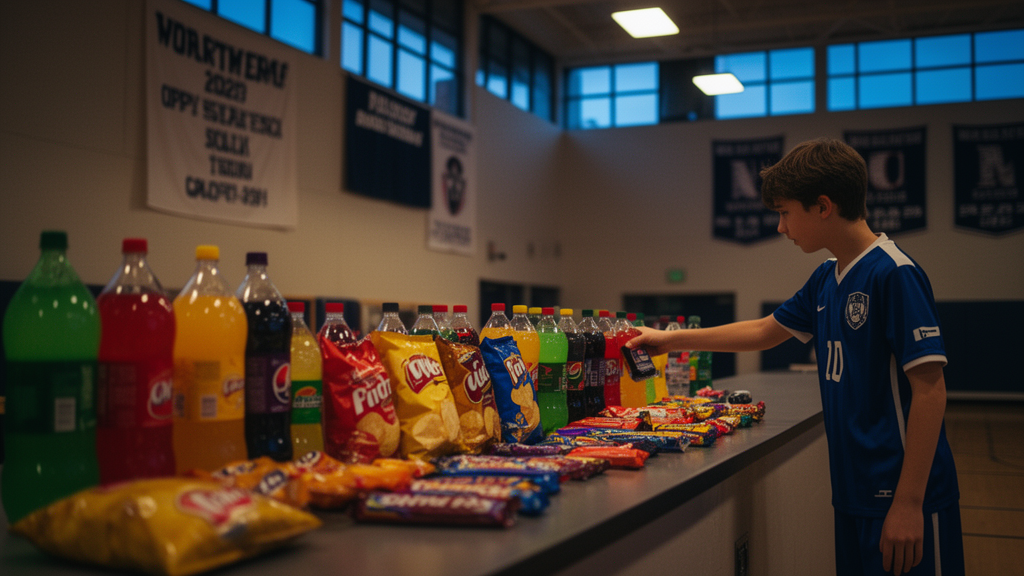
When researchers picture food marketing aimed at children, they usually imagine advertising beamed directly at individual consumers: television spots, social media campaigns, colorful packaging in the supermarket aisle. A new synthesis published in Frontiers in Nutrition argues that this picture misses the most consequential layer of all. In schools and organized youth sport, children’s exposure to food and beverage brands depends less on firms reaching individuals and more on institutions deciding which firms get in at all. School boards, district administrators, parent-teacher organizations, sport governing bodies, club officials, municipal facility managers, and food-service contractors all function as gatekeepers, controlling access to spaces, activities, communication channels, and contractual rights. Understanding how those decisions are made, the review’s authors contend, is essential to understanding what children actually see.
The review, a focused narrative synthesis by Lu Xing of Changsha Normal University and Taylor’s University and Xueqi Wu of Taylor’s Culinary Institute, introduces the analytical label of institutional gatekeeping for these meso-level arrangements. The concept sits between the macro world of corporate strategy and the micro world of individual consumer responses. It operates through procurement decisions, fundraising schemes, sponsorship agreements, branded programs, facility advertising, equipment and awards, and exclusive food-service contracts. The authors pair the gatekeeping lens with a descriptive use of resource dependence: institutions rely on company-provided money, equipment, products, or services, and the degree of that reliance is shaped by whatever alternatives are actually available. A school may prohibit the sale of a product while still displaying its parent brand through fundraising; a sport facility may adopt nutrition guidance while retaining branded infrastructure or an exclusive beverage contract. These apparent contradictions are not anomalies, the review suggests, but structural features of how commercial access is granted and sustained.
The evidence base behind the synthesis was assembled through database searches of Web of Science Core Collection and Scopus conducted on 29 July 2026, combining food and beverage, marketing, child and adolescent, and school or youth-sport setting terms. After offline checks and deduplication, the pool contained 893 records, from which 42 publications were purposively selected: 29 direct setting studies, two sport-sponsorship experiments, and 11 contextual publications. Notably, the authors used GPT-5 (OpenAI) for publication selection, source checking, evidence extraction, and classification, with human verification of all 42 publications against original sources. The findings were organized into four themes: commercial access and exposure; organizational rules, resources, and implementation; brand responses and sponsorship acceptability; and purchasing, dietary, and nutrition-related health outcomes. No formal risk-of-bias assessment or certainty-of-evidence grading was undertaken, a limitation the authors acknowledge openly.
The school findings reveal a striking gap between formal nutrition standards and the brand promotion that coexists with them. Canadian evidence identified branded-food fundraising, on-site advertising, incentive programs, product displays, and exclusive arrangements, with 84 percent of participating schools reporting at least one form of marketing and different patterns in primary and secondary schools. In Vancouver, promotions appeared in every surveyed secondary school and 80 percent of elementary schools; about one quarter depicted products prohibited for sale under provincial guidelines, and nearly one third promoted commercial items. A US assessment of a large school brand-reward program found that fewer than one third of participating entrées and snacks met federal Smart Snacks standards. The technical explanation is straightforward: standards governing the nutritional composition of products sold do not necessarily cover corporate logos, sponsorship and supply relationships, or fundraising through branded-product sales and incentives. The regulatory unit matters enormously, and product-level rules leave brand-level promotion outside their scope.
Implementation capacity emerges as a second decisive factor. Translating formal restrictions into practice means embedding them in procurement and sponsorship conditions, assigning responsibility, communicating requirements, monitoring compliance, and correcting violations. State policy guidance was positively associated with some district advertising restrictions in the United States, whereas technical assistance showed mixed associations with restrictive and healthy-promotion practices. Superintendents identified fundraising, budget constraints, and parent-group relationships as persistent barriers. In the Philippines, limited resources, ambiguous definitions, and weak monitoring impeded implementation. In Maine, an audit conducted after a statewide marketing ban found noncompliant advertising in 85 percent of 20 high schools, with administrators most often requesting implementation resources and clearer guidance. In Uruguay, school-principal accounts identified company visits, promotional activities, and branded refrigerators operating within a healthy-snacking policy environment. Repeated surveys of Minnesota secondary schools found that prohibitions on unhealthy-food advertising on school grounds actually became less common between 2008 and 2012. Formal adoption, in other words, is not sufficient evidence of change.
Dietary findings across school settings are more limited and heterogeneous than the marketing-presence evidence. A review of 27 school-marketing papers identified five studies of diet-related outcomes, of which three reported associations with purchasing or consumption, particularly for minimally nutritious products. In Minnesota, linked school-policy and adolescent survey data provided little consistent evidence of dietary differences associated with advertising bans or healthier-food promotion. In Brazil’s ERICA study, school soft-drink advertising was not significantly associated with sugary-drink intake in either public or private schools, while on-site sales showed positive associations. In 12 Addis Ababa schools, school advertising was not significantly associated with dietary diversity, healthy or unhealthy dietary scores, or BMI-for-age among 217 adolescents aged 15 to 19 years. Chile provides the strongest evidence on combined regulation: warning labels, marketing restrictions, and school-sales rules were followed by changes in household purchases and school-time intake. Repeated grade-level surveillance from 2013 to 2019 showed no sustained decline in overweight or obesity after the 2016 law, but a cohort difference-in-differences study using linked records for 321,597 children aged 4 to 6 years estimated lower excess-weight probabilities after 18 months of exposure. These evaluations concern the integrated policy package, with institutional rules operating alongside its other components, and interpretation depends on cohort comparability.
Youth sport presents a parallel picture with its own distinctive mechanisms. Sponsorship links commercial brands with physical activity, teamwork, and community participation, embedding unhealthy products within positive sporting meanings. Australian club research documented company signage on uniforms, branded rewards, and product vouchers; for most clubs, total sponsorship contributed less than one quarter of income. Observational studies subsequently documented food-company sponsorship and geographic differences across children’s clubs in Australia and Canada. Recent Canadian studies describe how agreements and institutional assets relate to exposure: among 85 recreation and sport facilities, marketing was more frequent where sponsorship agreements existed, and the study also reported an association with food-service contracts. A related manager survey documented cash and in-kind contributions exchanged for signage, branded materials, equipment, and exclusive rights. Photo analysis across 134 facilities identified 2,576 marketing instances, and among the 1,846 instances assessed for healthfulness, 1,583, or 85.8 percent, were classified as nutritionally of concern, with branded infrastructure, displays, and furniture serving as common promotional vehicles. Contractual access also reaches youth programs hosted by universities: among 139 beverage contracts from 132 US public universities, 15 addressed youth athletic camps and three addressed high-school athletic events, with provisions exchanging products, branded merchandise, or support for promotional opportunities.
Brand-response studies in youth sport measured sponsor recall, attitudes, and product preferences with experimental precision. Junior players recalled sponsors, described them positively, and reported receiving branded performance rewards. In an Australian online experiment, healthier-food or public-health sponsorship reduced preference for some unhealthy sponsor products, while unhealthy sponsorship produced no significant change in the measured child brand responses. A separate parent experiment found increased awareness, favorable attitudes, and product preference following unhealthy sponsorship. Both experiments used simulated sponsorship exposures and measured brand-related responses rather than dietary intake. Qualitative findings add a different dimension: children in Ontario soccer and hockey said they would continue playing without food rewards, and participants did not identify a conscious sponsorship influence on treat choices or motivation. Parents rated healthier-food brands and health-promotion campaigns as more appropriate sponsors of junior sport than unhealthy-food brands on a seven-point sponsorship-appropriateness scale. Surveys and interviews also identified concern about unhealthy sponsorship alongside funding and implementation barriers among parents and club officials. Sponsor acceptability and financial feasibility therefore represent distinct aspects of organizational change.
The policy implications that flow from this synthesis are structured around the gatekeeping framework itself. First, institutional benefits create a tension with commercial access: school leaders and club officials identified budget constraints and transition barriers, and in Ireland, 38 percent of 331 school respondents accepted for-profit sponsorship, predominantly citing insufficient equipment funding. Financial reliance varies, making contract value and replacement cost relevant to policy design. One proposed implementation pathway connects sponsor and asset rules with local contract clauses, agreement registers, and compliance audits, with exposure frequency, legacy-asset removal, replacement income, and participation costs offering measurable evaluation criteria. Second, restriction and substitution have different implications: healthier-food or public-health sponsorship can improve acceptability and selected brand responses, and transition options include sponsor eligibility standards, non-food or public-health replacements, pooled sponsorship, grants, and contract phase-outs. Third, institutional assets and brand promotion warrant attention alongside product rules: only 16 percent of countries in a review of policies collected in 2022 and 2023 had national school food-marketing restrictions, and monitoring and enforcement guidance was often absent. Fourth, equity concerns both exposure and implementation: restrictions without replacement resources could increase fees or reduce programs in lower-resource institutions, so evaluations need to track exposure, replacement income, participation costs, and enforcement capacity together.
The review’s authors frame two testable expectations for future research: dependence on commercial support may accompany greater exposure where rules omit promotional rights, and broader restrictions combined with replacement resources and monitoring may reduce exposure over time. Agreement values, replacement costs, and repeated audits would allow these propositions to be tested. Evidence is comparatively stronger for marketing presence, nutritional characteristics, brand recognition, attitudes, and selected preferences than for purchasing, intake, and longer-term health outcomes, which concern broader policy packages rather than isolated institutional marketing. Institution-specific longitudinal measures are needed to connect these domains, and natural experiments distinguishing marketing from labeling, sales, and procurement reforms would help identify the contribution of institutional restrictions. The authors also acknowledge limitations: much detailed institutional evidence comes from Canada and Australia, where resource availability, contractual arrangements, school governance, and sponsorship structures differ from other policy systems, and the AI-assisted selection process may have missed relevant publications. What the synthesis establishes clearly is that the door to children’s commercial food environments is opened, held open, or closed by institutions, and that any serious attempt to regulate what children see must engage with the gatekeepers themselves.
Subject of Research: Institutional gatekeeping of food and beverage marketing in schools and youth sport
Article Title: Institutional gatekeeping of food and beverage marketing in schools and youth sport
Article References: Xing, L., & Wu, X. (2026). Institutional gatekeeping of food and beverage marketing in schools and youth sport. Frontiers in Nutrition, 13, Article 1953630. https://doi.org/10.3389/fnut.2026.1953630
Image Credits: AI Generated
DOI: 10.3389/fnut.2026.1953630
Keywords: Institutional, gatekeeping, food, beverage, marketing, schools, youth, sport, scientific research
Cite Scienmag News
Daisy Hatcher. (October 19, 2026). How Schools and Sports Clubs Quietly Open the Door to Junk Food Brands. Scienmag. https://scienmag.com/how-schools-and-sports-clubs-quietly-open-the-door-to-junk-food-brands/
Daisy Hatcher. "How Schools and Sports Clubs Quietly Open the Door to Junk Food Brands." Scienmag, 19 October 2026, https://scienmag.com/how-schools-and-sports-clubs-quietly-open-the-door-to-junk-food-brands/. Accessed 19 October 2026.
Daisy Hatcher. "How Schools and Sports Clubs Quietly Open the Door to Junk Food Brands." Scienmag. October 19, 2026. https://scienmag.com/how-schools-and-sports-clubs-quietly-open-the-door-to-junk-food-brands/


