


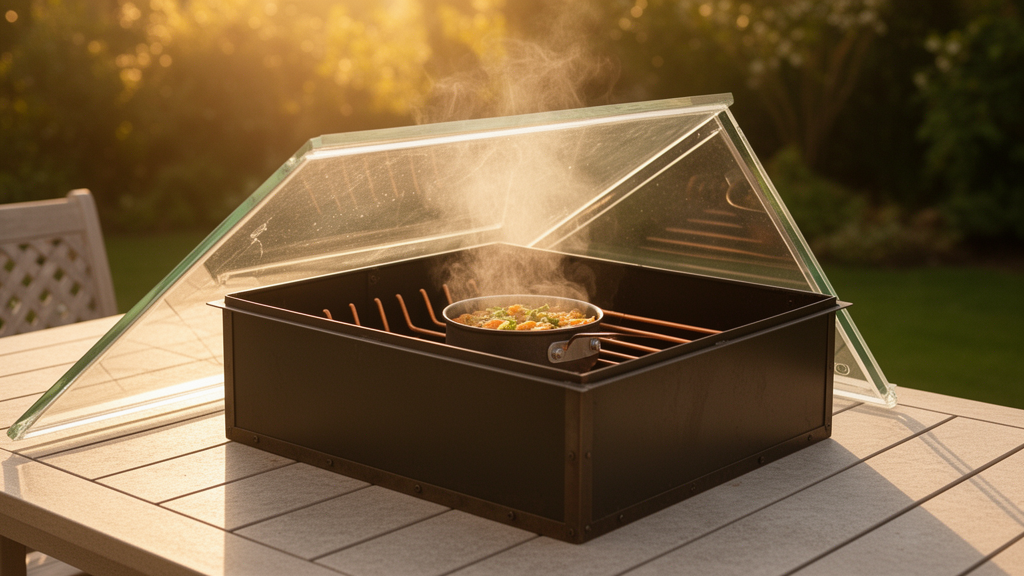
In the sun-scorched semi-arid city of Kairouan, Tunisia, a team of engineers has demonstrated that the key to a better solar cooker may not lie in fancier mirrors at all, but in the humble vessel that holds the food. In a study published in Results in Engineering, researchers at the University of Kairouan systematically tested dozens of receiver-side modifications to a hexagonal panel solar cooker and found that simple, cheap changes, lifting the pot a few centimeters, swapping an opaque metal lid for transparent glass, and bolting copper fins to the pot’s outer wall, delivered efficiency gains rivaling those achieved through years of reflector optimization. The findings could reshape how designers approach low-cost solar cooking for off-grid communities across the high-irradiance belt of North Africa and beyond.
Panel solar cookers occupy a distinctive niche among solar cooking technologies. Unlike parabolic concentrators with their curved dishes or box cookers with insulated chambers, panel cookers use flat reflective sheets arranged around a cooking vessel. They are cheap, lightweight, easy to assemble and highly portable, which makes them attractive for decentralized deployment without specialized tooling or infrastructure. Yet their adoption has been held back by comparatively low thermal efficiency. Conventional designs typically deliver standardized cooking power of 50 to 120 watts, with stagnation temperatures of 130 to 150 degrees Celsius under favorable irradiance. Previous research has largely focused on refining reflector geometry to squeeze more sunlight onto the pot, but as optical interception approaches practical limits, further reflector refinement alone appears unable to overcome the fundamental thermal shortcomings of these systems.
The Tunisian team set out to test a different hypothesis: that the dominant bottleneck in panel cookers is not optical interception but receiver-side thermal resistance, the heat that escapes through convection and radiation from the cooking vessel before it can reach the food. To investigate, they built two identical hexa-panel solar cookers, each with six trapezoidal reflector panels made of 3-millimeter polished aluminum, forming a hexagonal aperture of 0.84 square meters. A black-painted copper pot with a capacity of 4.6 liters sat at the center, enclosed in a transparent plexiglass shell that traps warm air around the vessel through the greenhouse effect. The cookers were mounted on a steel frame with manual dual-axis tracking, and the two prototypes were run side by side to allow strictly simultaneous paired comparisons under identical weather conditions.
The experimental campaign, conducted between May and September 2025, was unusually rigorous. Twenty distinct test conditions were evaluated across four pot heights ranging from 0 to 9 centimeters above the cooker base, three lid types, and four external fin arrangements, with each configuration repeated multiple times on independent days. The researchers also modified the standard ASAE S580.1 testing procedure in three deliberate ways: they cut the data acquisition interval from 600 seconds to 60 seconds to reduce averaging errors under fluctuating irradiance, lowered the load ratio from 7 to 4 kilograms per square meter of aperture to reflect realistic cooking practice, and extended the valid ambient temperature range to 40 degrees Celsius to suit Kairouan’s summer conditions. Prior work has shown that the standard 600-second interval can overestimate cooking power by up to 16.2 percent under variable skies.
The first variable examined was pot position, and the results revealed a clear geometric optimum. In no-load stagnation tests, the absorber temperature and the first figure of merit, a ratio combining optical efficiency and heat loss, peaked when the vessel sat 3 centimeters above the cooker base, reaching an average stagnation temperature of 217.37 degrees Celsius with the plexiglass enclosure. Under load tests with 3.5 kilograms of water, the same position delivered the highest standardized cooking power of 138.95 watts, an average thermal efficiency of 14.3 percent, and the fastest heating time of about 104 minutes. The researchers interpret this as a balance point: low positions sit below the convergence zone of reflected rays from the six panels, while higher positions expose more of the pot to ambient convective losses. Statistical analysis confirmed the position effect was highly significant, although the difference between the two lowest positions was too small to be statistically distinguished.
The lid experiments produced perhaps the most counterintuitive finding. Although copper conducts heat roughly 8,000 times better than air and vastly better than glass, the transparent glass lid outperformed the opaque copper lid decisively, raising standardized cooking power by 12.5 percent. The reason lies in how panel cookers deliver energy: a significant fraction of incident sunlight strikes the pot lid directly. A transparent lid lets that radiation pass through and be absorbed by the blackened interior surfaces of the pot, while an opaque lid absorbs the energy at its outer surface, where much of it dissipates to the surroundings through radiation and convection before conducting down to the water. The second-law analysis made this vivid: the opaque lid produced the highest entropy generation and exergy destruction of all configurations tested, showing that optical transmittance at the receiver matters more thermodynamically than material conductivity.
That said, finned lids offered a practical compromise. When the researchers fitted hollow cylindrical copper fins extending into the cooking fluid on the opaque lid, the configuration recovered roughly 74 percent of the performance gap between the glass and plain opaque versions. This is significant for deployment contexts where tempered glass lids may be unavailable, fragile or cost-prohibitive. Meanwhile, adding fins to the outside of the pot produced a steady, monotonic improvement across every configuration tested. One small fin of 1-centimeter height lifted cooking power by 4 percent; two fins of 2-centimeter height, riveted radially around the pot, pushed standardized cooking power to 152.775 watts, an overall gain of 12.3 percent, and raised thermal efficiency to 15 percent, 15.4 percent above the conventional pot. Heating time dropped from 112 minutes to just 96 minutes.
The exergy analysis, which quantifies the thermodynamic quality of the energy conversion rather than just its quantity, reinforced these findings with unusual depth. Using the Gouy-Stodola theorem to link cumulative entropy generation to exergy destruction, the team showed that the two-fin, 2-centimeter configuration achieved the lowest entropy generation, 1,152.37 joules per kelvin, and the lowest exergy destruction, 349.35 kilojoules, of all seven receiver configurations. Remarkably, the statistical analysis revealed that fin number, not fin height, was the dominant geometric parameter: doubling the number of fins reduced entropy generation more than doubling their height. The overall second-law gains were substantial, with the optimized configuration cutting exergy destruction by nearly 25 percent relative to the worst-performing opaque-lid case, confirming that the improvements reflect genuine reductions in thermodynamic irreversibility rather than artefacts of increased heat input.
The integrated economic and environmental assessment, the fourth E in the study’s 4E framework alongside energy, exergy and economics, suggests these gains translate into real-world value. The capital cost of the cooker ranged from about 134 to 146 dollars depending on configuration, yet the fin-assisted design reduced the lifetime cost per meal by 17.2 percent compared with the least efficient version and shortened the payback period to 0.861 years against LPG fuel savings. A sensitivity analysis testing pessimistic assumptions, a shorter 7-year lifespan, only 230 cooking days per year and a 12 percent interest rate, still kept the payback period below 14 months. Environmentally, the optimized configuration achieved 53.7 percent higher cumulative avoided carbon dioxide emissions over its 10-year life than the least efficient design, earning an estimated carbon credit of about 27 dollars, with net lifetime mitigation of 1.87 tons of carbon dioxide.
The study does carry caveats the authors acknowledge candidly. The mechanistic explanation of the optimal pot height rests on geometric arguments rather than direct optical flux mapping, and the relative contributions of enhanced convection versus additional solar interception by the fins remain unseparated. Fins also introduce practical trade-offs: more crevices to clean, potential coating degradation under prolonged ultraviolet exposure, and additional rivet points that could corrode over time. All experiments were conducted at a single site with one cooker geometry. Still, the broader message stands out clearly. In the loss-dominated regime where panel cookers operate, receiver-side thermal resistance is a genuine and addressable bottleneck, and attacking it with a few centimeters of copper and a sheet of glass can match the gains of far more complex reflector engineering, at a cost of a few dollars per modification.
Subject of Research: Receiver-side heat-transfer enhancement and 4E performance evaluation of a panel solar cooker
Article Title: Passive receiver-side enhancement of a panel solar cooker: Experimental quantification of fin-assisted heat transfer and integrated 4E performance assessment
Article References: Mankai, S., Ouled Saad, F., Madiouli, J., Chemkhi, S., Shigidi, I., & Sghaier, J. (2026). Passive receiver-side enhancement of a panel solar cooker: Experimental quantification of fin-assisted heat transfer and integrated 4E performance assessment. Results in Engineering, 32, Article 113539. https://doi.org/10.1016/j.rineng.2026.113539
Image Credits: AI Generated
DOI: 10.1016/j.rineng.2026.113539
Keywords: solar cooker, panel cooker, heat transfer, fins, exergy analysis, entropy generation, cooking power, renewable energy, techno-economic analysis, carbon mitigation, Tunisia, ASAE S580.1
Cite Scienmag News
Denise Maddox. (October 19, 2026). Simple Copper Fins and a Glass Lid Boost Panel Solar Cooker Performance, Study Finds. Scienmag. https://scienmag.com/simple-copper-fins-and-a-glass-lid-boost-panel-solar-cooker-performance-study-finds/
Denise Maddox. "Simple Copper Fins and a Glass Lid Boost Panel Solar Cooker Performance, Study Finds." Scienmag, 19 October 2026, https://scienmag.com/simple-copper-fins-and-a-glass-lid-boost-panel-solar-cooker-performance-study-finds/. Accessed 19 October 2026.
Denise Maddox. "Simple Copper Fins and a Glass Lid Boost Panel Solar Cooker Performance, Study Finds." Scienmag. October 19, 2026. https://scienmag.com/simple-copper-fins-and-a-glass-lid-boost-panel-solar-cooker-performance-study-finds/


