


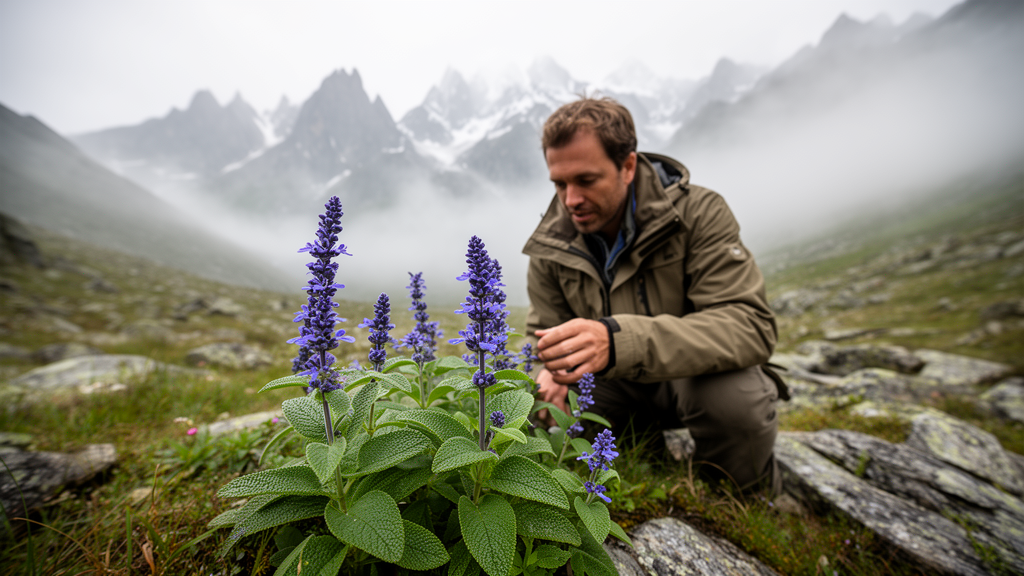
Deep in the folds of the Hengduan Mountains, the botanically richest corner of China, two previously unknown species of sage have slipped past science until now. Researchers surveying remote valleys in the Xizang Autonomous Region and Sichuan Province have formally described Salvia zayuensis and Salvia toxantha, two perennial herbs belonging to the mint family, Lamiaceae. The discovery, published in the journal PhytoKeys, brings the global count of Salvia species — a genus of roughly 1,000 species prized for medicine, cooking, ornament and essential oils — one step closer to completeness, and adds fresh evidence that the Hengduan Mountains remain one of the planet’s great engines of plant diversification.
The story began in April 2019, when a field team working in Zayu County, at the western end of the Hengduan range in Nyingchi City, encountered a sage that looked superficially like the known species Salvia cyclostegia but carried larger leaves and a dense coating of grayish-white felted hairs on its young stems and the undersides of leaves and bracts. Even more striking was the plant’s early inflorescence: a bud-like structure wrapped in layers of broad, ovate bracts that gave it the appearance of a small peach. Follow-up surveys in 2020 and 2021 confirmed the plant was consistent in form, and herbarium specimens were prepared for the Shanghai Chenshan Herbarium.
The second species surfaced four years later and several hundred kilometers away. In August 2023, botanists exploring Songpan County in Sichuan Province’s Aba Tibetan and Qiang Autonomous Prefecture found a sage growing on shaded limestone cliffs near the forest edge. Its flowers resembled those of Salvia smithii, but the plant lacked the distinctive lemon scent of that species and bore an unmistakable corolla — slender and curved upward like an archer’s bow, its lower lip freckled with purple-brown spots. The bow-shaped flower inspired the species epithet toxantha, and the plant carries the Chinese vernacular name gong hua shu wei cao, or bow-flower sage.
Distinguishing closely related sage species demands attention to fine anatomical detail, and the team measured an extensive suite of characters in the field and on cultivated seedlings. Salvia zayuensis stands apart from S. cyclostegia in several respects: its stem leaves reach 18.2 to 24.0 centimeters in length, far larger than those of its relative; its young flowering stalks and leaf undersides carry densely hoary, appressed hairs; and its inflorescences mature into branched panicles up to 40 centimeters long. Its two-toned corolla is also diagnostic, with a purplish-brown upper lip set against a predominantly yellow lower lip, and its anther connectives are shorter in arc length — 0.60 to 0.67 centimeters compared with a mean of 0.79 centimeters in S. cyclostegia. The two species even flower at different times, with the new species blooming from August to September while its congener flowers in spring.
Salvia toxantha shows a parallel pattern of subtle but consistent divergence from S. smithii. Beyond the absence of lemon scent, it produces longer pedicels and calyxes, a corolla of 4.1 to 4.8 centimeters that is more slender and distinctly bow-shaped, and a corolla tube lined internally with purple-brown longitudinal stripes. The arc length of its anther connective averages 0.78 centimeters, roughly 0.4 centimeters shorter than that of S. smithii. The plant is a modest perennial, reaching no more than about 60 centimeters in height, with broadly ovate to heart-shaped leaves whose petioles often flush reddish-purple. Such quantitative differences, replicated across specimens, provide the morphological evidence required for a formal species description under the rules of botanical nomenclature.
Morphology alone, however, is no longer sufficient to anchor a new species in the sage family tree. To establish where the two plants belong, the researchers turned to chloroplast genomes — the DNA housed in the plastids of plant cells, which is inherited intact through seed lineages and is therefore a powerful tool for tracing evolutionary relationships. Whole genome sequencing was performed on an Illumina HiSeq platform for the new species and their close relatives, and the chloroplast genomes were assembled with the software tool GetOrganelle and deposited in the National Genomics Data Center. These were combined with published chloroplast sequences retrieved from the NCBI database, building a dataset of 44 accessions representing 26 species drawn from across the genus.
The team reconstructed the evolutionary tree using maximum likelihood analysis in IQ-TREE, a method that searches for the phylogeny best explaining the observed DNA sequence patterns, with 1,000 bootstrap replicates to gauge confidence. Every repeated sample received support above 97 percent, indicating a highly reliable tree. Both new species emerged as independently monophyletic clades with maximum support of 100 percent. Salvia zayuensis was recovered as the closest relative of S. cyclostegia, with 99 percent support, while S. toxantha and S. smithii were sister to one another, that pair in turn grouping robustly with S. roborowskii and S. tricuspis. Critically, both newcomers fall within the subclade Eurysphace of the subgenus Glutinaria, a group centered on East Asia and containing nearly 100 species.
The phylogenetic results also flagged an open question. The branch uniting S. toxantha with S. smithii carried only modest bootstrap support — around 70 percent — and their sister group was placed within another branch of subgenus Glutinaria, the subclade Annua. The authors suggest this ambiguity may stem from incomplete lineage sorting, the stochastic process by which ancestral genetic variation is distributed unevenly among descendant species, or from the existence of still-undescribed close relatives of S. toxantha. Resolving the matter will require expanded taxon sampling and more comprehensive molecular datasets, a reminder that even in a well-studied genus, the tree of life remains a work in progress.
The two species also differ sharply in how they face the future. Salvia zayuensis is known from eight populations in Zayu County, totaling approximately 6,000 individuals, growing in semi-open woodlands, forest edges and roadside habitats between 1,920 and 2,640 meters in altitude. Given the species’ robust growth, the high humidity of its habitat and minimal human disturbance in the region, and the likelihood that further populations await discovery, it has been tentatively assessed as Least Concern under the IUCN Red List criteria. Salvia toxantha, by contrast, is known from a single site at Hongyanwo in Songpan County, where an estimated 300 to 500 mature individuals cling to shaded limestone cliffs and moist valley cliffs at around 2,800 meters. Until surveys are complete, it is classified as Data Deficient — a designation that underscores how vulnerable a narrow endemic can be to any disturbance of its tiny range.
Beyond their taxonomic novelty, the discoveries carry a broader message about the Hengduan Mountains. The range hosts 44 species and 12 varieties of Salvia, accounting for 52.8 percent of China’s total, making it the undisputed center of diversity for the genus in the country and a critical hotspot for speciation and endemism within the Eurysphace subclade. That two distinctive species — one with a peach-shaped juvenile inflorescence, the other with an archer’s-bow corolla — could remain undetected in these mountains until the second decade of the twenty-first century says much about both the region’s biological riches and the incompleteness of its botanical inventory. The authors argue that continued, comprehensive field surveys are essential to uncover the hidden floral diversity that still shelters in these valleys, and each new species described strengthens the case for protecting the habitats that sustain them.
Subject of Research: Description and phylogenetic placement of two new Salvia species from the Hengduan Mountains, China
Article Title: Salvia zayuensis and Salvia toxantha ( Lamiaceae ), two new species from the Hengduan Mountains, China
Article References: Huang, Y.-B., Lin, C.-H., Guo, Z.-N., Chen, X.-L., Shi, D.-S., Luo, Y., Wang, Q., & Liu, F.-L. (2026). Salvia zayuensis and Salvia toxantha (Lamiaceae), two new species from the Hengduan Mountains, China. PhytoKeys, 280, 181-193. https://doi.org/10.3897/phytokeys.280.208592
Image Credits: AI Generated
DOI: 10.3897/phytokeys.280.208592
Keywords: Salvia, Lamiaceae, Hengduan Mountains, new species, chloroplast genome, phylogenetics, taxonomy, biodiversity, China, conservation, Zayu County, Songpan County
Cite Scienmag News
Margaret Porter. (October 19, 2026). Two New Sage Species Uncovered in China’s Hengduan Mountain Biodiversity Hotspot. Scienmag. https://scienmag.com/two-new-sage-species-uncovered-in-chinas-hengduan-mountain-biodiversity-hotspot/
Margaret Porter. "Two New Sage Species Uncovered in China’s Hengduan Mountain Biodiversity Hotspot." Scienmag, 19 October 2026, https://scienmag.com/two-new-sage-species-uncovered-in-chinas-hengduan-mountain-biodiversity-hotspot/. Accessed 19 October 2026.
Margaret Porter. "Two New Sage Species Uncovered in China’s Hengduan Mountain Biodiversity Hotspot." Scienmag. October 19, 2026. https://scienmag.com/two-new-sage-species-uncovered-in-chinas-hengduan-mountain-biodiversity-hotspot/


