


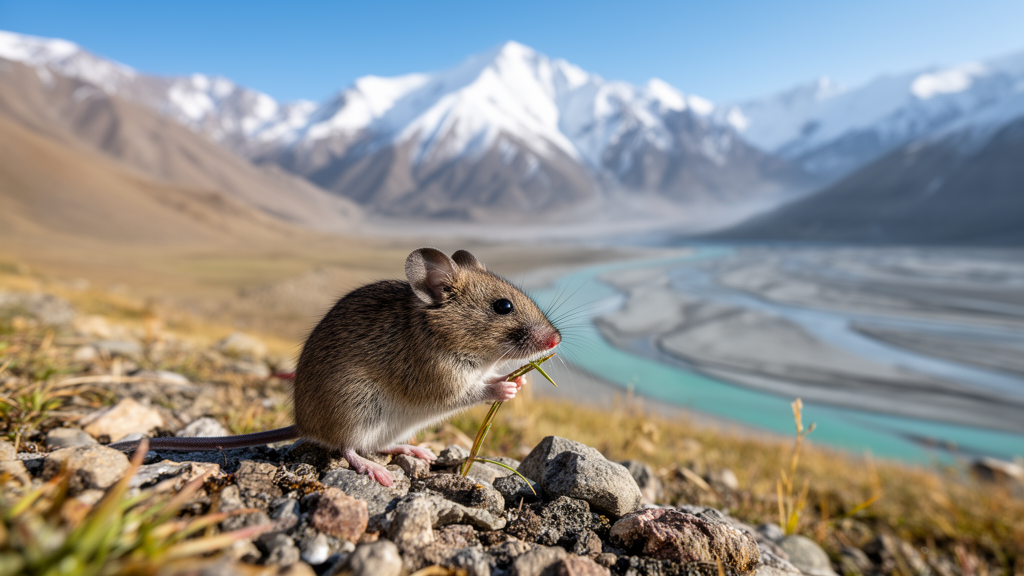
High on the southern edge of the Qinghai-Tibet Plateau, in shrublands hugging mountain streams, lives a small rodent that has been hiding in plain sight. An international research team working in Tibet has now formally described it as a species new to science: Alticola yarlungia, the Yarlung Zangbo Mountain Vole. The discovery, published in the journal Zoosystematics and Evolution, adds a new branch to the tree of mountain voles, a genus of compact, ash-brown rodents that scurry across the rocky and alpine expanses of Central Asia.
The story began in 2008, when surveyors captured a single distinctive vole in Lang County, on the right bank of the middle reaches of the Yarlung Zangbo River. The specimen was initially identified as A. stracheyi, a name later synonymized under A. stoliczkanus in a broad taxonomic revision of the genus. But the oddities never quite fit. That earlier revision had already flagged five different molar patterns within A. stoliczkanus and reported a surprisingly large genetic gap, roughly 4.3 percent at the cytochrome b gene, between Tibetan populations from Lang and Pulan counties. When eight more specimens turned up in 2023 from Lang and Longzi counties, closely resembling the 2008 animal and forming a single genetic lineage with it, the researchers decided the identification as A. stoliczkanus was untenable.
To test whether the vole represented something genuinely new, the team assembled an unusually broad evidence base. They sampled 93 specimens across much of the genus’s range, spanning Russia, Mongolia, Pakistan, Kazakhstan and northwestern China, and generated sequences from three mitochondrial genes, cytochrome b, cytochrome c oxidase subunit I and NADH dehydrogenase subunit 2, plus four nuclear genes, GHR, LCAT, BRCA1 and IRBP. Separate analyses of mitochondrial data, nuclear data, and the combined dataset all converged on the same result: the five sequenced individuals of the putative new species form a well-supported clade that is sister to A. stoliczkanus, meaning the two share an immediate common ancestor unique to them.
Three independent species delimitation methods, Bayesian assignment in BPP, automatic partitioning with ASAP, and the multi-rate PTP model, consistently treated the lineage as an independent species, recognizing 12, 11 and 14 candidate species within Alticola respectively. The genetic distances tell a striking story: Kimura-2-parameter distances at cytochrome b between the new vole and its eleven named relatives range from 4.0 percent against A. stoliczkanus to 10.3 percent against A. macrotis, averaging 8.1 percent. That 4.0 percent minimum is comparable to distances between other recognized species pairs in the genus, such as A. olchonensis and A. tuvinicus at 4.1 percent and A. argentatus and A. albicauda at 4.7 percent.
Dating the split with a relaxed molecular clock calibrated against the oldest fossils of Alticola and its sister genus Myodes revealed that the new species diverged from A. stoliczkanus roughly 490,000 years ago, with a 95 percent credible interval of 200,000 to 770,000 years. That makes it the youngest divergence node in the genus’s reconstructed tree, a product of recent Pleistocene speciation on a plateau whose complex topography and climatic history have repeatedly isolated small mammal populations in valleys and along river drainages.
Morphology backs up the molecules. The new vole carries the simplest third upper molar in the entire genus, marked by a distinctly truncated posterior lobe, a feature even simpler than that of A. stoliczkanus, which was previously considered the most reduced. It also has a slender, sparsely haired tail about a quarter of its head-body length, darker brown dorsal fur than any of its close relatives, and a body size larger than A. stoliczkanus but smaller than many other congeners. Factor analysis of sixteen external and cranial measurements from 67 intact specimens separated the new species from six of the seven other Alticola species occurring in China, with only A. macrotis overlapping heavily in overall morphospace, though post-hoc tests confirmed significant differences in head-body length, tail length and nasal length between the two.
Perhaps the most unexpected evidence came from reproductive anatomy, a classic but rarely deployed tool in microtine systematics. The glans penis and baculum of the new species differ markedly from both A. stoliczkanus and A. macrotis. Where A. stoliczkanus bears a single outer crater papilla on each side and A. macrotis has none, the new vole has four to five. Its proximal baculum has a semicircular base rather than a slightly enlarged one, its distal and lateral bacula are slender with a sharp tip on the lateral element, its urethral lappet forks into two long, deeply bifurcated branches, and its dorsal papilla carries a distinctive digitiform projection. In mammals, such differences in genital morphology often signal reproductive isolation, reinforcing the case that this is a genuinely separate evolutionary lineage rather than a geographic variant.
The holotype, an adult male weighing 29 grams with a head-body length of 104 millimeters, was trapped in August 2023 beside the Naijiaxiongqu stream in Longzi County at 4,022 meters elevation. All nine known specimens, four males and five females, came from riparian shrubland between 3,228 and 4,022 meters in Longzi and Lang counties, an habitat distinctly lower and lusher than the stony, glacial-moraine slopes above the timber line where A. stoliczkanus makes its home at 3,900 to 5,450 meters. The species epithet yarlungia honors the Yarlung Zangbo River, Tibet’s largest, whose basin drains the entire known range of the animal.
The discovery carries a broader message about how much life remains undocumented even in well-studied groups. Mountain voles are not obscure; they are widespread across Central Asian mountains and have been described and revised repeatedly since the nineteenth century. Yet the genus’s remote, high-elevation habitats have limited comprehensive sampling, particularly in China, where rugged terrain and poor transport infrastructure have left parts of the Yarlung Zangbo basin essentially unsurveyed. The researchers suggest that species diversity within Alticola remains underestimated and that the new vole likely also occupies the southern slopes of the eastern Himalayas, given the continuity of habitat across national borders.
For biodiversity science, the case of Alticola yarlungia is a textbook example of integrative taxonomy done right. No single line of evidence, geography, genetics, molar shape, pelage, or genital anatomy, would have been sufficient on its own to convince a skeptical reviewer. Together, they establish a species that diverged from its closest relative in the Middle Pleistocene and has since persisted, unnoticed, in the streamside shrubs of one of the planet’s most biologically productive and least explored highland regions. As surveying intensifies across the eastern Himalayan hotspot, more such hidden vertebrates are likely to come to light.
Subject of Research: A newly described species of mountain vole from the Yarlung Zangbo River basin in southern Tibet
Article Title: A new species of Alticola ( Mammalia , Rodentia , Arvicolinae ) from southern Tibet, China
Article References: Tang, M. K., Qiu, H., Peng, B. Q., Liao, R., Murphy, R. W., Wang, X. M., Pan, X., Wang, X., & Liu, S. Y. (2025). A new species of Alticola (Mammalia, Rodentia, Arvicolinae) from southern Tibet, China. Zoosystematics and Evolution, 101(4), 2387-2403. https://doi.org/10.3897/zse.101.170704
Image Credits: AI Generated
Keywords: Alticola yarlungia, mountain vole, Tibet, new species, integrative taxonomy, Qinghai-Tibet Plateau, rodents, phylogenetics, Yarlung Zangbo River, species delimitation, cytochrome b, Himalayas
Cite Scienmag News
Margaret Porter. (October 19, 2026). New vole species hidden on the Tibetan Plateau named after the Yarlung Zangbo River. Scienmag. https://scienmag.com/new-vole-species-hidden-on-the-tibetan-plateau-named-after-the-yarlung-zangbo-river/
Margaret Porter. "New vole species hidden on the Tibetan Plateau named after the Yarlung Zangbo River." Scienmag, 19 October 2026, https://scienmag.com/new-vole-species-hidden-on-the-tibetan-plateau-named-after-the-yarlung-zangbo-river/. Accessed 19 October 2026.
Margaret Porter. "New vole species hidden on the Tibetan Plateau named after the Yarlung Zangbo River." Scienmag. October 19, 2026. https://scienmag.com/new-vole-species-hidden-on-the-tibetan-plateau-named-after-the-yarlung-zangbo-river/


