


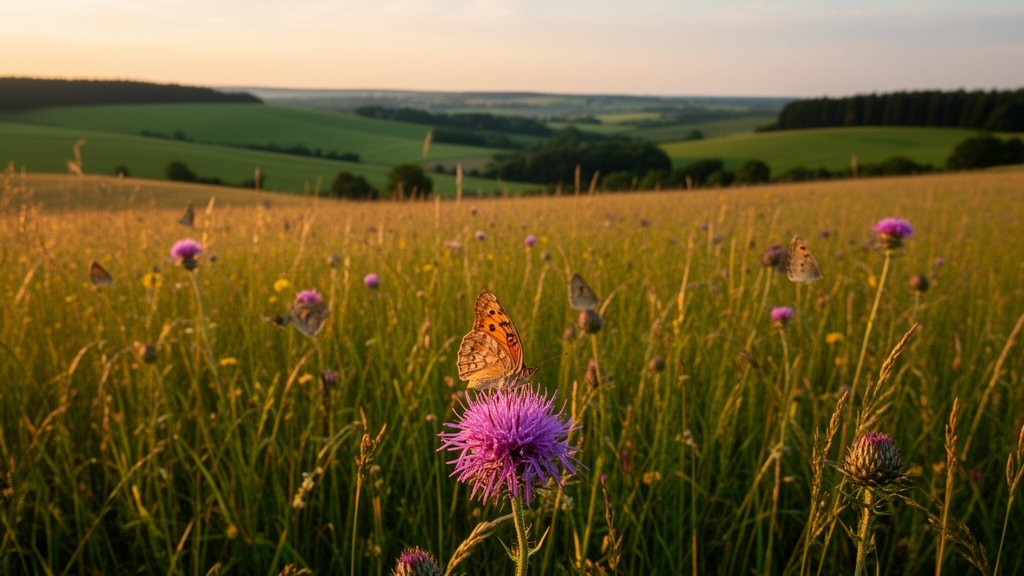
Butterflies flitting across Germany’s meadows have long served as silent messengers about the health of the country’s agricultural landscapes. Now, for the first time, scientists have assembled a national Grassland Butterfly Index for Germany, drawing on nearly two decades of volunteer-collected data, and the message is troubling. The new study, published in the journal Nature Conservation, calculated the index using records from the German butterfly monitoring scheme between 2006 and 2023, and found that while the overall trajectory over the full period was stable or moderately declining depending on the method applied, both approaches revealed a significant and accelerating downturn over the most recent ten years.
The timing of the research is politically significant. In 2024, the European Union brought its Nature Restoration Regulation into force, a landmark piece of legislation designed to restore degraded ecosystems and reverse biodiversity loss across the bloc. Among its requirements, Member States must demonstrate increasing trends in at least two of three agricultural indicators: the Grassland Butterfly Index, the stock of organic carbon in cropland mineral soils, and the share of agricultural land with high-diversity landscape features. Butterflies, it turns out, have become official arbiters of restoration success, making a robust national index not merely an academic exercise but a legal reporting obligation.
The scale of the underlying data is extraordinary. Germany’s national butterfly monitoring scheme, launched in 2005, relies on more than 1,000 volunteers who walk fixed transect routes of up to 500 metres, divided into 50-metre sections, ideally once a week from April to September. Observers record every butterfly within an imaginary 5-by-5-by-5-metre box moving along the route, alongside environmental conditions such as temperature, wind and cloud cover. Between 2005 and 2023, over 1,600 transects were established, more than 130,000 transect walks were completed, and roughly 4.4 million butterflies were counted, producing the most extensive time series on butterfly populations ever assembled in Germany.
The index itself follows the European model, combining the population trends of 17 butterfly species selected by experts for their association with semi-natural grasslands. Seven are widespread generalists and ten are habitat specialists, and all occur in Germany. However, data for two rare specialists, the Large Blue and the Marsh Fritillary, were too scarce for reliable trend estimation, leaving 15 species in the German version. Each species brings its own vulnerabilities: many depend on specific host plants and microhabitats for larval development, which makes them acutely sensitive to land-use change, agricultural intensification and shifting climate patterns.
Transforming thousands of irregular volunteer counts into a statistically defensible index is a formidable technical challenge. Because volunteers cannot always survey weekly, time series contain gaps that fall awkwardly within the short flight periods of many species. The researchers therefore employed a two-stage modelling approach: first estimating an annual flight curve for each species across all sites using a generalised additive model with a Poisson error structure, then interpolating missing weekly counts from that curve and the observed data. Sites with fewer than five visits per season, or whose visits covered less than 10 percent of a species’ flight period, were excluded from the corresponding calculations.
To test how methodological choices shape the outcome, the team computed the index twice using different standard approaches. The first followed the method prescribed by the Nature Restoration Regulation, using non-parametric bootstrapping with 1,000 resampling iterations to quantify uncertainty, and fitting Poisson generalised linear models to derive collated indices and trends. The second used log-linear regression models from the widely applied rtrim software, which corrects for over-dispersion and serial correlation and interpolates missing values using information from all other sites. Confidence intervals in this framework were generated through Monte Carlo simulations of the species indices.
The results diverged in an instructive way. Over the full 2006 to 2023 period, the first approach classified the index as stable, with a non-significant annual change of -0.7 percent, while the second revealed a moderate but significant decline of -0.66 percent per year. Both methods, however, agreed on the crucial recent picture: over the last decade the index fell by -2.82 percent per year under the first approach and -3.26 percent per year under the second, a moderate decline in both cases. The deterioration has clearly intensified in recent years, and the authors suggest that unusually low butterfly abundances in recent seasons, likely linked to droughts and heatwaves that have become more frequent in Central Europe since 2018, are a major contributor.
Species-level patterns add a sobering dimension. Positive trends were confined entirely to widespread generalist species, while the declining roster included both generalists and specialists of nutrient-poor grasslands such as the Small Blue and the Dingy Skipper. This echoes a well-documented pattern across Europe: habitat specialists, constrained by narrow host-plant and habitat requirements, suffer disproportionately when semi-natural grasslands degrade, whether through intensification, abandonment or nitrogen enrichment. The German findings align closely with national indices from Sweden, the Netherlands, Luxembourg and Catalonia, and with the European Grassland Butterfly Indicator, which recorded an approximate 50 percent decline across the EU between 1991 and 2023.
The probable drivers form a familiar but dispiriting list. Intensive mowing can strip habitat quality; the specialist Dusky Large Blue, whose early larvae feed exclusively on flower-heads of great burnet, is particularly vulnerable to mistimed cutting regimes. Pesticides, habitat fragmentation, the loss of small landscape features such as hedgerows and road verges, and atmospheric nitrogen deposition, which alters plant communities and may even raise larval mortality in plants of nutrient-poor sites, all likely play roles. Abandonment of marginal grasslands, such as dry calcareous pastures, adds a second front of habitat loss. The study’s authors are careful to note that their data cannot yet isolate the relative contribution of each factor, and they call for targeted research to disentangle the interacting pressures of land use and climate change.
The study also exposes genuine challenges in turning the index into a reliable policy instrument. The regulation demands restoration until a satisfactory level is reached, yet that term remains undefined, and setting a single-year baseline is problematic when butterfly populations can naturally fluctuate by several hundred percent between years. The volunteer-based scheme’s spatial coverage skews toward populated areas and underrepresents rare-species habitats, as illustrated by the exclusion of the Large Blue and Marsh Fritillary. The researchers propose several remedies: multi-year averaged baselines, regionally adapted species sets, weighting species by their preference for open habitats using newly developed indices, integrating data from professional monitoring programmes such as the planned federal insect monitoring scheme, and species-targeted surveys for rare butterflies. What the first German Grassland Butterfly Index makes unmistakably clear is that the country’s meadow butterflies are under real threat, that their decline has accelerated sharply in the past decade, and that expanding and refining the monitoring network will be essential if Europe’s most ambitious restoration law is to be judged by more than hope.
Subject of Research: Calculation of the Grassland Butterfly Index for Germany as a biodiversity indicator under the EU Nature Restoration Regulation
Article Title: The Grassland Butterfly Index for Germany
Article References: Harpke, A., Kühn, E., Schmitt, T., Settele, J., & Musche, M. (2025). The Grassland Butterfly Index for Germany. Nature Conservation, 59, 315-334. https://doi.org/10.3897/natureconservation.59.162812
Image Credits: AI Generated
DOI: 10.3897/natureconservation.59.162812
Keywords: Grassland Butterfly Index, Germany, butterfly monitoring, biodiversity, Nature Restoration Regulation, citizen science, agricultural landscapes, habitat specialists, grassland conservation, population trends, climate change, EU biodiversity policy
Cite Scienmag News
Gavin Prescott. (October 19, 2026). Germany’s Grassland Butterflies Show Alarming Decline Over the Last Decade. Scienmag. https://scienmag.com/germanys-grassland-butterflies-show-alarming-decline-over-the-last-decade/
Gavin Prescott. "Germany’s Grassland Butterflies Show Alarming Decline Over the Last Decade." Scienmag, 19 October 2026, https://scienmag.com/germanys-grassland-butterflies-show-alarming-decline-over-the-last-decade/. Accessed 19 October 2026.
Gavin Prescott. "Germany’s Grassland Butterflies Show Alarming Decline Over the Last Decade." Scienmag. October 19, 2026. https://scienmag.com/germanys-grassland-butterflies-show-alarming-decline-over-the-last-decade/


