


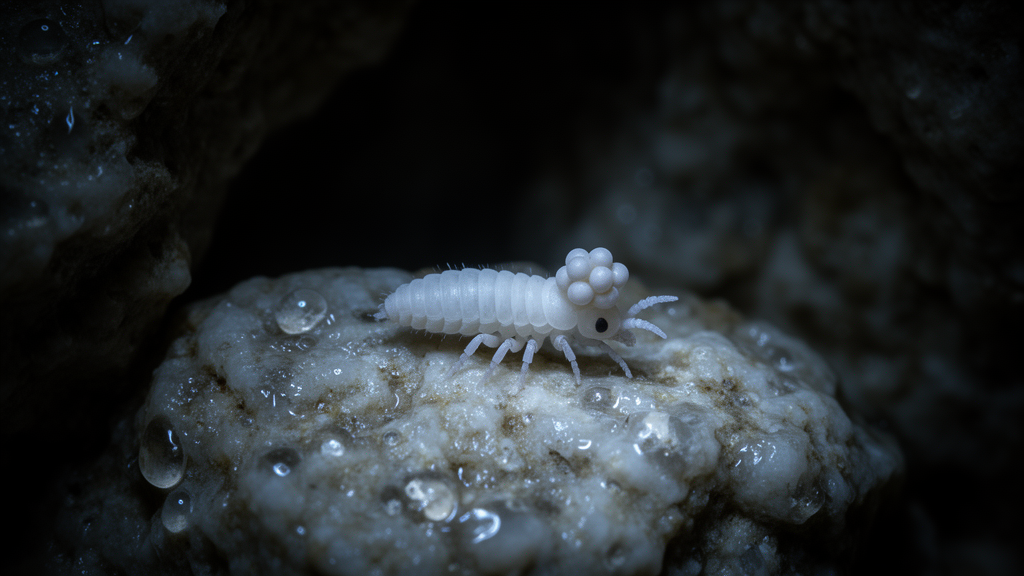
Deep inside a limestone mountain in northeastern Iran, in a pool of still water where sunlight has never reached, scientists have found a creature that looks like it was designed by committee: an eyeless, pigmentless springtail barely a millimeter long, bristling with feather-like bristles, hooks, and a sensory organ so ornate that it instantly rewrites the identification keys for its entire genus. The animal, formally described as Oncopodura moghanensis sp. nov. in the journal Subterranean Biology, is the first cave-dwelling springtail ever recorded in Iran, and it turns out to be stranger than almost any of its roughly fifty known relatives.
Springtails, or Collembola, are six-legged arthropods so abundant that a square meter of forest soil can harbor tens of thousands of them. They get their common name from a spring-loaded appendage, the furca, folded under the abdomen that flicks the animal into the air when danger threatens. Most springtails are drab soil dwellers, but a subset has traded the surface world for the permanent night of caves. The genus Oncopodura is a specialist in this underground lifestyle: of its fifty described species, thirty-one are known only from subterranean habitats. All are eyeless, ghost-pale, and armored with scales and elaborately modified bristles that taxonomists use like fingerprints to tell species apart.
The discovery site could hardly be more dramatic. Moghan Cave opens at 2,193 meters above sea level on the eastern flank of the Kopet Dag mountain range, about 35 kilometers southwest of the city of Mashhad. The cave runs roughly 500 meters into the mountain and drops 44 meters through two floors connected by wells up to 25 meters deep. Its five halls end in a water pond measuring about 5.7 by 6.9 meters and up to 60 centimeters deep, where the air holds a constant 12 degrees Celsius and relative humidity above 73 percent. It was on the surface of this pool, in the deepest part of the second floor, that the first specimen of the new species was collected in September 2022, with four more taken from a stalagmite weeks later.
What makes Oncopodura moghanensis immediately remarkable is its postantennal organ, or PAO, a sensory structure found near the base of the antenna in many springtails and thought to be involved in detecting chemicals or humidity. In most members of the genus this organ is a simple cluster of a few lobes. In the new species it is a giant, roughly 24-micrometer rosette built from six long, equal lobes arranged around a central circle, and here is the extraordinary part: each of those six lobes is itself subdivided into three to six irregular finger-like projections. No other species in the genus combines six lobes with this degree of secondary subdivision, and the feature alone separates the Iranian animal from every one of its congeners.
The rest of the anatomy is equally distinctive. The jumping apparatus, the furca, carries a dense armature of modified bristles: the basal part of the dens bears two dorsointernal hooks and one dorsoexternal hook, while the distal part carries three dorsointernal and one dorsoexternal hook, alongside feather-like macrosetae so long they reach halfway along the dens. The manubrium, the muscular stalk of the furca, sports long feather-shaped bristles of its own. The mucro, the toothed tip that grips the ground before the spring fires, has exactly four teeth, with the apical tooth sharply pointed, and two scales on its basal half. The animal is white, unpigmented, and covered in hyaline scales, with a normal, untoothed claw rather than the elongated claws seen in some of its more extreme cave-adapted relatives.
To pin down those details, the team mounted specimens cleared in potassium hydroxide and chlorophenol and examined them under a Leica DM 2500 light microscope with phase and DIC contrast, mapping every seta, sensillum, and pseudopore. The antennae proved especially informative: the fourth segment carries a row of four thick, pointed sensilla equally spaced along its length, plus two modified subapical setae, while the third segment’s sensory organ consists of two expanded, wrinkled sensilla accompanied by a blunt basal one. The mouthparts follow the genus pattern, with a left mandible bearing four teeth and a right mandible three, and a labrum set in four rows of two, three, five, and four setae.
Taxonomically, the new species sits in a small club of Oncopodura species whose postantennal organs have more than four lobes, a group that includes O. crassicornis from England and France, O. pelissiei from French caves, and O. yosiiana from Japan and Korea. A comparison across nineteen diagnostic characters shows the closest relative to be O. yosiiana, which differs in only four traits, chiefly in having six simple, unsubdivided PAO lobes and a manubrium crowded with sixteen pairs of feather-like setae. The Iranian species is more divergent from the rest: thirteen characters separate it from O. ambigua, twelve from O. atoyacensis and O. tunica. The authors updated the world key to the genus and added a differential table, and the species slots into the key precisely because of its subdivided PAO lobes, its hook count, and the basal scale on the mucro.
Perhaps the most intriguing aspect is what the new species does not show. Deep cave animals that have evolved in isolation for millions of years often display troglomorphy: elongated claws for gripping wet rock, multiplied sensory hairs, exaggerated antennae. O. moghanensis, despite living in the permanent dark of the deepest cave zone, has a normal, unelongated claw and a modest complement of sensilla. That restraint suggests the species may be a relatively recent arrival underground, or that its lineage’s cave adaptation followed a different evolutionary route than that of its more grotesque relatives in Europe, Mexico, and Japan, where troglomorphic Oncopodura abound.
The discovery also fills a conspicuous gap on the map. Iran sits in the Palearctic biogeographic region, with more than half its territory mountainous, and its Zagros, Alborz, and Kopet Dag ranges are riddled with karst caves, the most common cave type on Earth. Yet until now no study of cave Collembola had ever been conducted in the country, and only two Oncopodura species, both soil dwellers, were known from its territory. The Kopet Dag range, formed of massive sedimentary limestone along Iran’s northeastern border, has now yielded the first troglobiotic springtail of the region, hinting that the caves between the Alborz and Central Asian karst systems may hold an unexplored community of endemic subterranean arthropods.
The specimens themselves are now split between the Zoology Museum of Ferdowsi University of Mashhad and the Collembola collection at Pavol Jozef Šafárik University in Košice, Slovakia, preserved on sealed slides for future study. For a genus whose members are usually found one painstakingly collected specimen at a time, the message of the Moghan find is clear: even in a country as well surveyed as Iran, the deepest, wettest corners of its caves remain terra incognita, and the next turn of a taxonomic key may depend on a millimeter-long animal waiting on the surface of an underground pond.
Subject of Research: Description of a new subterranean springtail species, Oncopodura moghanensis sp. nov., from Moghan Cave, Iran
Article Title: A new subterranean species of Oncopodura Carl & Lebedinsky, 1905 ( Collembola , Entomobryomorpha , Oncopoduridae ) from a cave in Northeastern Iran
Article References: Mehrafrooz Mayvan, M., Parimuchová, A., & Kováč, Ľ. (2024). A new subterranean species of Oncopodura Carl & Lebedinsky, 1905 (Collembola, Entomobryomorpha, Oncopoduridae) from a cave in Northeastern Iran. Subterranean Biology, 49, 31-51. https://doi.org/10.3897/subtbiol.49.118293
Image Credits: AI Generated
DOI: 10.3897/subtbiol.49.118293
Keywords: Oncopodura moghanensis, Collembola, springtail, cave biology, subterranean fauna, troglobiont, Kopet Dag, Iran, taxonomy, postantennal organ, Oncopoduridae, speleobiology
Cite Scienmag News
Drew Townsend. (October 19, 2026). Blind Cave Springtail With Six-Lobed Sensory Organ Discovered in Iranian Cave. Scienmag. https://scienmag.com/blind-cave-springtail-with-six-lobed-sensory-organ-discovered-in-iranian-cave/
Drew Townsend. "Blind Cave Springtail With Six-Lobed Sensory Organ Discovered in Iranian Cave." Scienmag, 19 October 2026, https://scienmag.com/blind-cave-springtail-with-six-lobed-sensory-organ-discovered-in-iranian-cave/. Accessed 19 October 2026.
Drew Townsend. "Blind Cave Springtail With Six-Lobed Sensory Organ Discovered in Iranian Cave." Scienmag. October 19, 2026. https://scienmag.com/blind-cave-springtail-with-six-lobed-sensory-organ-discovered-in-iranian-cave/


