


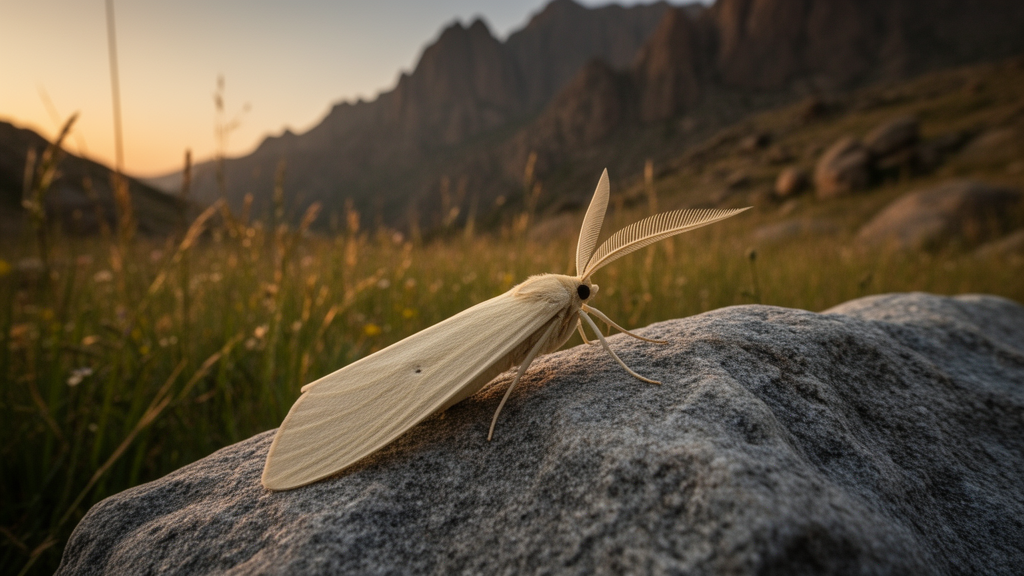
High in the Zagros Mountains, where oak woodlands give way to mountain steppe between 1,100 and 2,800 meters, lives a delicate geometrid moth that has puzzled scientists for more than eight decades. First described in 1938 from specimens collected in Iran and Iraq, the species spent its taxonomic life in the genus Somatina, a grouping defined largely by a single feature of its wing veins. Now, an integrative study combining DNA sequences with detailed anatomical examination has shown that this classification was wrong. The moth has been formally reclassified as Problepsis wiltshirei, a move that resolves its identity, clarifies the evolutionary history of an entire tribe of moths, and shines a spotlight on one of the Middle East’s most biologically rich and most threatened landscapes.
The study, published in the journal Nota Lepidopterologica, grew out of a broader effort to revise the geometrid moth fauna of Iran. Geometridae, the family that includes the familiar inchworm caterpillars, is one of the largest moth families on Earth, and its internal classification has long relied on subtle wing and genital structures. Within the subfamily Sterrhinae, the tribe Scopulini contains several genera that were traditionally separated by counting the areoles of the forewing, the small closed cells formed where wing veins loop and rejoin. Genera such as Problepsis and Scopula were defined by a single areole, while Somatina was reserved for species with two.
That system, elegant as it seemed, turned out to be built on a shaky foundation. Earlier work by one of the study’s authors showed that the number of forewing areoles is homoplastic, meaning the trait has evolved independently multiple times across the tribe. Two areoles appear not only in genuine Somatina species but also in some Problepsis and Scopula species, so the character alone cannot reliably diagnose a genus. The consequence has been that a number of species sat in the wrong genus, a problem that has gradually been unpicked as morphological and molecular phylogenetic studies have accumulated evidence. The reclassification of the Zagros endemic represents the latest step in that cleanup.
To determine where the moth truly belongs, the researchers took a two-pronged approach. On the molecular side, they amplified one mitochondrial gene region, the barcode standard cytochrome oxidase subunit I, together with up to nine protein-coding nuclear genes, including wingless, RpS5, EF-1alpha, GAPDH and others, from a single museum specimen. These sequences were combined with published data for other Scopulini taxa, producing a concatenated alignment of 6,800 base pairs covering 29 taxa. Maximum likelihood analyses run on the CIPRES Science Gateway produced a phylogenetic tree rooted with members of the tribe Lissoblemmini, the established sister group of Scopulini.
The result was unambiguous: Somatina wiltshirei clustered firmly within the genus Problepsis. On the morphological side, the evidence agreed. The moth bears ocellate, eye-like discal spots on both forewing and hindwing, a hallmark of Problepsis. Its male hind tibia is laterally flattened and spoon-shaped and carries a hair pencil, a brush of modified scales that, under scanning electron microscopy, revealed two distinct scale types: some flattened at the tip, others tubular and hollow. Most tellingly, the male genitalia show strongly fused socii and a smooth internal margin of the tegumen, structures characteristic of Problepsis and quite different from the unfused, asymmetric configurations that define Somatina. Taken together, the molecular and anatomical lines of evidence left no reasonable doubt about the moth’s generic placement.
Perhaps the most interesting detail is what the reclassification says about wing venation. Problepsis wiltshirei has two forewing areoles, the trait that originally earned it a place in Somatina, yet its type species and many relatives have only one. The new study documents this venation with detailed vector drawings, showing that the veins R1, the common stalk of R2 to 4, and R5 all arise from the second areole, while the genus type species Problepsis ocellata has a single areole. This is a textbook demonstration of why counting areoles is no longer sufficient: the same venation pattern can arise in species that are only distantly related, while close relatives may differ in this very feature.
Because the original description from 1938 was superficial by modern standards, the authors provided a full re-description supported by rich illustrations. Males span 24 to 28 millimeters and females 29 to 32, with beige wings sprinkled with darker ochreous scales and small yellowish ocelli bordered in dark lines. The female genitalia proved equally diagnostic, with a strongly sclerotized antrum and lamella antevaginalis and a corpus bursae bearing a narrow, dentate signum. Genetically, the closest neighbours based on COI barcodes are P. ocellata and the Iranian P. cinerea, each at a genetic distance of 4.2 percent under the Kimura two-parameter model, a distance comfortably consistent with separate species status. In the phylogeny, P. cinerea emerged as a weakly supported sister species, and the authors note that additional species and genetic data will be needed to pin down its closest relative.
The new study also extends the moth’s known range. In addition to records from northern Iraq and across the Iranian provinces of Kohgiluyeh and Boyer-Ahmad, Khuzestan, Esfahan and Fars, examined material includes specimens from Hakkari province in southeastern Turkey, making this the first record of the species for the Turkish fauna. The apparent gap between the northern populations and those of the central Zagros may simply reflect insufficient sampling in the intervening terrain. Adult moths fly from as early as April through October, possibly in two generations, and the caterpillar, described in wartime-era work, is grayish with a complex pattern of dots and pale dorsal lines, spinning its cocoon between leaves and litter. Fraxinus, the ash trees, are documented food plants, and maple has been suggested though not yet confirmed.
The moth’s restricted distribution makes it a meaningful indicator for conservation. Its range falls into two areas: the northern Zagros and adjacent regions within the Irano-Anatolian biodiversity hotspot, one of the world’s recognized centers of endemism, and the southwestern Zagros, a region of exceptional biological richness. The Zagros Mountains as a whole stretch some 2,000 kilometers from eastern Turkey through northern Iraq into western and southwestern Iran, and they harbor the highest endemism rate of any Iranian mountain range; roughly 45 percent of the region’s vascular plants grow nowhere else. The mountains also served as refugia during the Last Glacial Maximum, sheltering everything from brown bears and yellow-spotted mountain newts to the moth genus Gnopharmia and its host plants, which later expanded from southwestern Zagros populations as the climate warmed.
That evolutionary heritage is now under pressure. Wildfires swept through more than 50,000 hectares of Zagros oak forest in 2020 alone, with some 15,000 hectares of Iranian forest burning each year, destroying centuries-old trees in the process. Overgrazing by sheep and goats in marginal arid areas, land erosion from agriculture, poaching and occasional poisoning of animals even within protected areas add to the toll. Although protected zones such as Arjan and Bakhtegan exist within the moth’s range, its full distribution and biology remain poorly known. The authors argue that the fate of this single, easily overlooked moth illustrates a broader point: understanding and conserving biodiversity hotspots requires continued fieldwork and integrative taxonomy, because species cannot be protected until they are properly recognized, mapped and studied.
Subject of Research: Taxonomic reclassification of the Zagros-endemic geometrid moth Somatina wiltshirei into the genus Problepsis using molecular phylogenetics and morphology
Article Title: Systematics of Problepsis wiltshirei (Prout, 1938), comb. nov. ( Lepidoptera , Geometridae , Sterrhinae ) – an endemic species to the Zagros Mountains in the Middle East
Article References: Wanke, D., Krogmann, L., Murillo-Ramos, L., Sihvonen, P., & Rajaei, H. (2021). Systematics of Problepsis wiltshirei (Prout, 1938), comb. nov. (Lepidoptera, Geometridae, Sterrhinae) – an endemic species to the Zagros Mountains in the Middle East. Nota Lepidopterologica, 44, 175-192. https://doi.org/10.3897/nl.44.67345
Image Credits: AI Generated
DOI: 10.3897/nl.44.67345
Keywords: Geometridae, Sterrhinae, Scopulini, Problepsis wiltshirei, Zagros Mountains, taxonomy, integrative systematics, molecular phylogenetics, endemism, Iran, Turkey, conservation
Cite Scienmag News
Margaret Porter. (October 19, 2026). Ghost moth of the Zagros: DNA reveals an endemic mountain moth belongs in a different genus. Scienmag. https://scienmag.com/ghost-moth-of-the-zagros-dna-reveals-an-endemic-mountain-moth-belongs-in-a-different-genus/
Margaret Porter. "Ghost moth of the Zagros: DNA reveals an endemic mountain moth belongs in a different genus." Scienmag, 19 October 2026, https://scienmag.com/ghost-moth-of-the-zagros-dna-reveals-an-endemic-mountain-moth-belongs-in-a-different-genus/. Accessed 19 October 2026.
Margaret Porter. "Ghost moth of the Zagros: DNA reveals an endemic mountain moth belongs in a different genus." Scienmag. October 19, 2026. https://scienmag.com/ghost-moth-of-the-zagros-dna-reveals-an-endemic-mountain-moth-belongs-in-a-different-genus/


