


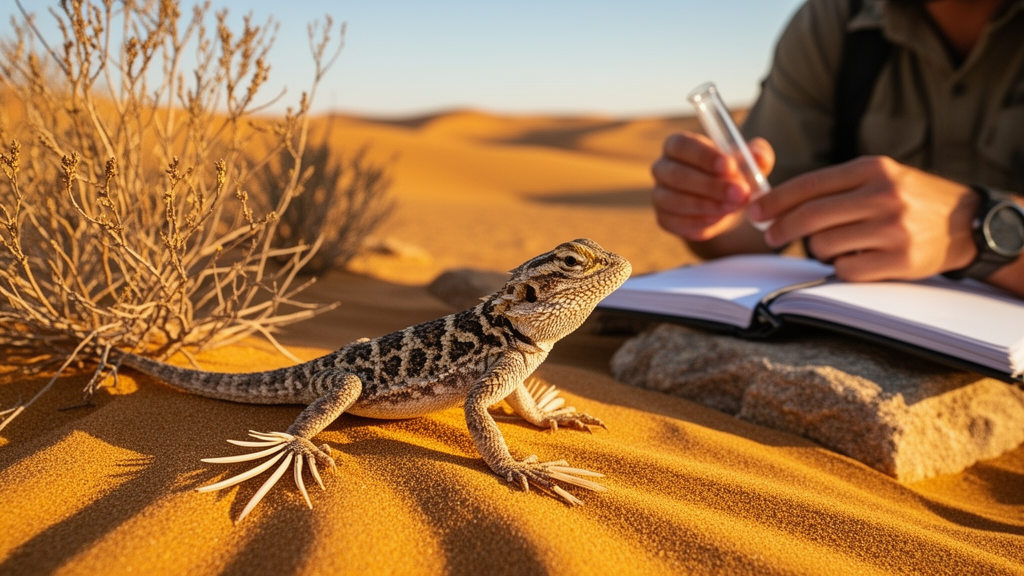
The fringe-toed lizards of North Africa have long been a source of frustration and fascination for systematists. These fast-moving, sun-loving reptiles of the genus Acanthodactylus sprint across sandy and rocky habitats from the Iberian Peninsula through the Maghreb and the Arabian Peninsula to western India, and they harbor a level of hidden diversity that has repeatedly confounded attempts to sort them into clean species boundaries. A new study, published in the journal Herpetozoa, adds fresh genetic data from dozens of lizards across Morocco and beyond, and the results are reshaping what scientists thought they knew about where these lineages live and how they relate to one another.
The focus of the new work is the Acanthodactylus erythrurus complex, a group built around the red-fringed or fringe-toed lizard formally described back in 1838. Acanthodactylus as a whole is the most species-rich genus in the lizard family Lacertidae, with 44 recognized species, and the erythrurus complex is arguably its most taxonomically tangled branch. The species occupies Morocco and Algeria and is the only member of its genus to reach Europe, where it occurs in the southern Iberian Peninsula. Genetic evidence indicates the Iberian populations were founded by colonizers from North Africa, and the two sides of the Mediterranean still show high levels of mitochondrial DNA admixture, particularly in the northern part of the range.
Decades of morphological study failed to bring order to this variation. Early taxonomists recognized two North African subspecies, while later authorities added a third from the Atlas Mountains and even suggested that one form deserved full species status. Others argued that all Moroccan populations represented a single, highly variable species whose differences simply reflected local adaptation. Molecular work then complicated matters further: mitochondrial DNA sequences revealed that the Tunisian species Acanthodactylus blanci and the form known as lineomaculatus both nest inside the erythrurus complex. One species-delimitation analysis of Algerian material suggested as many as 15 potential taxonomic units, the highest count recorded for any species examined in that study, alongside a striking east-west divergence across the Maghreb.
A major step toward resolution came in 2020, when researchers combining multi-locus sequence data with morphology recovered five major lineages and described two new species from the Atlas Mountains of Morocco: Acanthodactylus montanus from the High Atlas region and Acanthodactylus lacrymae from the Middle Atlas. These mountain forms are more closely related to Algerian and Tunisian lizards than to the bulk of Moroccan diversity, which remained parked in an unresolved cluster labeled the Ibero-Moroccan clade. Subsequent attempts to dissect that clade with mitochondrial and nine nuclear gene fragments managed only to distinguish four broad population groups separated by barriers to gene flow, while a recent genome-wide RADseq analysis of a contact zone hinted at strong reproductive isolation, suggesting even more cryptic species may be hiding within it.
To sharpen the geographic picture, the authors of the new study sequenced a partial fragment of the mitochondrial ND4 gene, together with adjacent transfer RNA regions, for 42 individuals, most of them from Morocco. The animals were caught in the field over a 20-year period, a small piece of tail tissue was removed for analysis, and each lizard was released at its collection site. Because single individuals often cannot be identified to lineage by appearance alone, every animal was sequenced. The new sequences were combined with 105 previously published ones from public databases, producing an aligned dataset of 769 base pairs, and four other Acanthodactylus species served as outgroups to root the analysis.
The laboratory workflow followed established protocols. Total genomic DNA was extracted from alcohol-preserved tail tissue using standard high-salt methods, and the ND4 fragment was amplified with the polymerase chain reaction under a regime of 33 cycles with an annealing temperature of 47 degrees Celsius. Sequences were edited and aligned with ClustalW, uncorrected genetic distances were calculated, and the team reconstructed evolutionary relationships using two complementary methods: Maximum Likelihood with 5,000 bootstrap replicates and Bayesian Inference run for five million generations in two independent analyses. The two approaches produced nearly identical trees, differing only slightly at the deepest nodes, and both recovered the same five major clades identified in earlier work.
The surprises came from geography rather than topology. New samples from the Debdou region, in the Moulouya river valley, filled a wide gap in the known distribution of the Ibero-Moroccan clade, which had previously been confirmed near Taza and then only by a single record more than 200 kilometers away in eastern Algeria. This matters because the Moulouya valley is widely regarded as a major biogeographic barrier that splits North African herpetofauna into western and eastern forms, and the lizards east of the valley do form a distinct subgroup within the clade, underscoring just how intricate the phylogeography of this complex really is.
Even more striking were the findings for the two Atlas Mountain species. Samples of Acanthodactylus lacrymae from a locality just north of Aït Aïssa extend that species’ range more than 100 kilometers to the east of previously confirmed populations. Meanwhile, a single specimen assigned to Acanthodactylus montanus pushes that lineage roughly 200 kilometers to the northeast and, crucially, places it within about 10 kilometers of the known range of A. lacrymae. The two species, previously thought to be broadly separated from each other, can therefore no longer be considered highly allopatric. That specimen also proved genetically remarkable: although phylogenetic analysis strongly supports it as the sister lineage to A. montanus, it differs from southern A. montanus samples by around 8 percent at the ND4 marker, a divergence exceeding that recorded between some accepted lacertid lizard species, though comparable to divergence levels seen within another Moroccan lacertid that showed incomplete lineage sorting in its nuclear genes.
The authors caution that mitochondrial DNA alone cannot settle these questions. Because the two Atlas species are extremely similar in appearance and cannot be reliably separated in the field, extensive genetic sampling across their contact zone will be needed to determine whether the two lineages occur in strict sympatry or whether there is genetic admixture between them. Genome-wide RADseq approaches, which have already revealed cryptic species within the Ibero-Moroccan clade, will likely be required to establish the taxonomic status of the newly detected montanus-like lineage as well. The study’s broader message is that both more genetic markers and more geographic sampling are essential, particularly across the southeastern part of Morocco, where the ranges of the different species and lineages remain incompletely mapped. For a group that has puzzled scientists since the nineteenth century, the fringe-toed lizards of North Africa are only slowly giving up their secrets, and each new map drawn from their DNA reveals just how much biodiversity still awaits formal recognition in the mountains and valleys of the Maghreb.
Subject of Research: Mitochondrial DNA diversity and geographic distribution of lineages within the Acanthodactylus erythrurus lizard species complex in North Africa
Article Title: New data on the diversity and distribution of lineages of the Acanthodactylus erythrurus species complex in North Africa derived from mitochondrial DNA markers
Article References: Harris, D. J., Sergiadou, D., & Faria, J. F. (2024). New data on the diversity and distribution of lineages of the Acanthodactylus erythrurus species complex in North Africa derived from mitochondrial DNA markers. Herpetozoa, 37, 281-286. https://doi.org/10.3897/herpetozoa.37.e118175
Image Credits: AI Generated
DOI: 10.3897/herpetozoa.37.e118175
Keywords: Acanthodactylus erythrurus, fringe-toed lizards, mitochondrial DNA, phylogeography, Morocco, North Africa, Atlas Mountains, cryptic species, Lacertidae, ND4 gene, species delimitation, herpetology
Cite Scienmag News
Juliet Wilcox. (October 19, 2026). Fringe-Toed Lizard DNA Study Redraws the Map of North African Reptile Diversity. Scienmag. https://scienmag.com/fringe-toed-lizard-dna-study-redraws-the-map-of-north-african-reptile-diversity/
Juliet Wilcox. "Fringe-Toed Lizard DNA Study Redraws the Map of North African Reptile Diversity." Scienmag, 19 October 2026, https://scienmag.com/fringe-toed-lizard-dna-study-redraws-the-map-of-north-african-reptile-diversity/. Accessed 19 October 2026.
Juliet Wilcox. "Fringe-Toed Lizard DNA Study Redraws the Map of North African Reptile Diversity." Scienmag. October 19, 2026. https://scienmag.com/fringe-toed-lizard-dna-study-redraws-the-map-of-north-african-reptile-diversity/


