


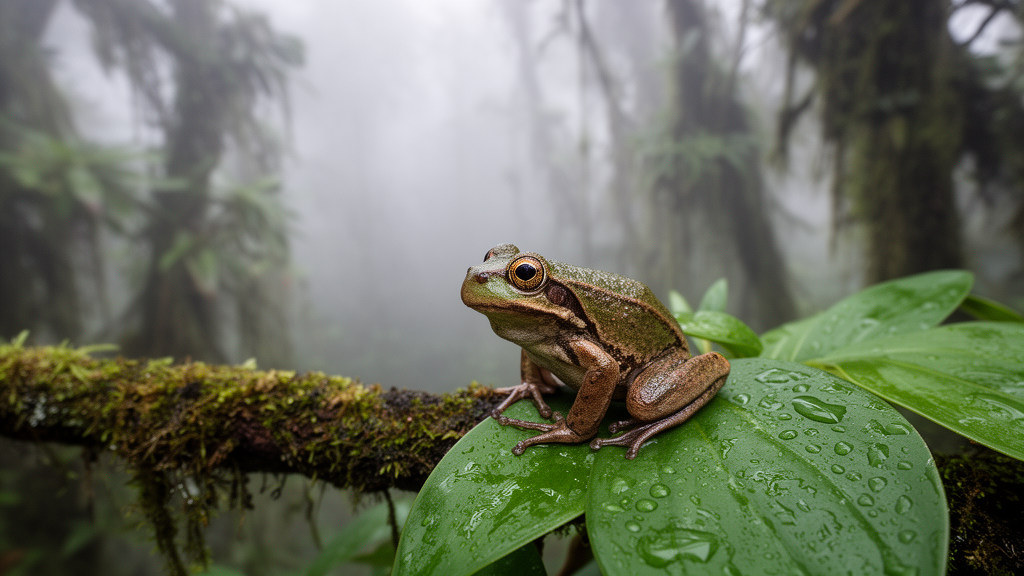
Deep in the mist-drenched cloud forests of Colombia’s western Andes, a small brown frog has been hiding in plain sight for decades, mislabeled as a species scientists thought they already knew. A research team surveying the Key Biodiversity Area of the Serranía de los Paraguas has now formally described it as Niceforonia tempestuosa, a new species of direct-developing frog in the family Strabomantidae. The name, derived from the Latin tempestas for storm, is a deliberate metaphor: the authors dedicated the frog to local communities confronting the climate emergency, whose intensifying storms threaten the very forests where it lives. The discovery, published in ZooKeys, matters far beyond one new name on a list, because the same study delivers something rarer and more valuable than a new species — a brand-new anatomical fingerprint that unites an entire branch of the frog family tree.
The new frog was found during two expeditions in October 2024 and April 2025 to the Reserva Natural Comunitaria Cerro El Inglés, a thousand-hectare cloud forest reserve in the municipality of El Cairo, Valle del Cauca, and from a second site at El Mirador in the municipality of Versalles. Ten researchers combed riparian zones, forest edges and interior leaf litter by day and night, shifting substrate by hand to flush out cryptic, ground-dwelling animals. The frogs were photographed alive, euthanized under approved protocols, and deposited in the amphibian collection of the Universidad del Quindío. The holotype, an adult male designated ARUQ-1885, was collected on 25 October 2024 at a site called Corazón, at 2,261 meters elevation, together with a type series of eleven additional specimens spanning adult males, females, subadults and juveniles.
Niceforonia tempestuosa is a small frog — adult males measure 21.5 to 25.1 millimeters from snout to vent, and the single adult female a heftier 31.1 millimeters — but it carries a distinctive combination of traits. It has dorsolateral folds and V-shaped scapular folds on its back, a visible tympanic membrane, a fleshy swelling of the upper lip in adult males, and small non-spinous nuptial pads on the thumbs. Circumferential grooves ring every finger, a feature absent from the first two fingers of several close relatives. In life the dorsum ranges from reddish-brown to grayish, marked by a dark facemask running from the snout through the lores and eyelids, while the belly, thighs and arms glow yellow and the groin and thigh surfaces blaze reddish-orange. Most tellingly, every specimen bears dark supra-inguinal spots — paired dark marks on the posterior flanks just above the groin — a character that turned out to be the key to the whole study.
Genetically, the new species is emphatically its own thing. The team sequenced fragments of two mitochondrial genes (12S and 16S ribosomal RNA, totaling 2,866 base pairs) and two nuclear genes (RAG-1 and tyrosinase, 631 and 531 base pairs respectively), comparing the new frog against every known Niceforonia species with available sequences, four candidate species, and a broad outgroup sampling of 198 terminals spanning all genera of Strabomantidae. Uncorrected p-distances at the 16S gene separate N. tempestuosa from all congeners by more than 7 percent — ranging from 7.44 percent against its closest relative, N. mantipus, up to 18.33 percent against N. philippi. In frog taxonomy, where new species are routinely recognized at 16S divergences of 3 to 5 percent, a gap that large is unambiguous.
The phylogenetic analyses, run under both maximum likelihood in IQ-TREE and parsimony in TNT with gaps treated as a fifth character state, recovered the new species as sister to N. mantipus. That relationship is biologically telling: N. mantipus is a widespread Colombian species, and the new frog had long been confused with it. By incorporating samples of N. mantipus from the Valle del Cauca and Quindío departments — including material from its type locality at Bosque de San Antonio, only about 15 kilometers west of Cali — the team confirmed that the two species are close but distinct, and hinted that further cryptic diversity may still lurk within N. mantipus across its range from Antioquia to Cauca.
But the study’s most consequential finding concerns those dark supra-inguinal spots. When the team mapped the presence or absence of this character across the family using the software YBYRÁ and TNT, the spots optimized unambiguously — with no homoplasy — as a shared derived character, or synapomorphy, for two separate clades within Strabomantidae. The first is a clade inside the genus Niceforonia comprising N. brunnea, N. dracula, N. elassodiscus, N. mantipus, N. nigrovittata, N. quilloturo, N. peraccai, four candidate species and the new species. The authors formally name this clade the Niceforonia nigrovittata species group, reviving a name proposed by William Lynch in 1989 and thereby preserving decades of established usage in the literature. Two additional species lacking molecular data, N. aderca and N. fallaciosa, show the spots and are tentatively added to the group pending genetic testing.
Remarkably, the same dark flank spots also diagnose a second, entirely unrelated clade: a strongly supported group (jackknife support of 99 percent) within the subfamily Holoadeninae, uniting the genera Bahius, Barycholos, Phyllonastes and Urkuphryne. This nested pattern dovetails with earlier anatomical work showing that the posterior origin of the iliacus externus muscle on the iliac shaft unites Phyllonastes and Barycholos. Taken together, muscle anatomy, DNA sequences and external coloration now independently corroborate the monophyly of the four-genus holoadenine group and of the Phyllonastes-plus-Barycholos subgroup — a textbook demonstration of how integrating molecular and phenotypic evidence can test and confirm evolutionary hypotheses in a group of frogs notorious for morphological conservatism.
The broader placement of Niceforonia within Brachycephaloidea, the superfamily of direct-developing frogs that skip the tadpole stage entirely, remains stubbornly unstable. Different studies have variously placed the genus in the subfamilies Strabomantinae, Holoadeninae, or Hypodactylinae, and the new analysis finds Niceforonia outside both Holoadeninae and Strabomantinae, though with weak support for its deeper affinities. The authors argue this reflects a genuine evolutionary or methodological conflict rather than mere lack of resolution, and they call for total-evidence analyses that fold phenotypic characters — carefully recoded, since traditional coding of digital discs conflates several independent traits — into molecular matrices. The genus itself, now 18 species strong, stretches from Colombia’s three Andean cordilleras south through Ecuador to central Peru and east into the Amazonian basin, and recent work in Ecuador suggests numerous cryptic species remain hidden under existing names.
Ecologically, N. tempestuosa is a creature of the forest floor. It inhabits the leaf litter of well-preserved forest interiors between 2,169 and 2,294 meters, showing a preference for sloping microhabitats, and has been observed sheltering in crevices formed by the buttress roots of large trees and among the stilt roots of Wettinia palms. It shares this litter layer with Strabomantis cerastes, another floor-dweller of the Serranía de los Paraguas. The region hosts more than 100 amphibian species, 32 of them threatened with extinction, yet parts of this hotspot have only recently begun to be explored — meaning both greater diversity and a wider range for the new frog may await discovery.
That discovery window is closing under pressure. The Serranía de los Paraguas faces habitat loss from illicit crop expansion, logging, agricultural frontier advance — including booming Hass avocado farming — and mounting large-scale mining interests promoted under the language of local development. Since 2019, the Fundación Calima and the community organization Corporación Serraniagua have run a joint conservation program, backed by the Rufford Foundation, the Prince Bernhard Nature Fund and the Critical Ecosystem Partnership Fund, combining acoustic and climatic monitoring, breeding-habitat protection, and community outreach. For the new frog specifically, zoning restricts foot traffic in dense leaf-litter zones where its populations peak, and fences are being installed with landowners to shield riparian forests from the agricultural frontier. A storm-named frog, protected by the people who live beneath those storms, is perhaps the most fitting emblem this biodiversity hotspot could have asked for.
Subject of Research: Description of a new Andean cloud-forest frog species and the phylogenetic significance of dark supra-inguinal spots in Strabomantidae
Article Title: A new species of Niceforonia ( Amphibia , Anura , Strabomantidae ) from the Serranía de los Paraguas, Colombia, with the description of a new phenotypic synapomorphy for the Niceforonia nigrovittata species group
Article References: Ospina-Sarria, J. J., Rodríguez-Betancourt, A. F., Gómez-Sepúlveda, X., Morales-Vertel, I. D., Vélez-Franco, V., Gallego-Posada, N., Herrera-Rengifo, J. D., Grajales Escobar, J. E., Ceballos-Castro, I., García-Gómez, I., Velásquez-Trujillo, D. A., Ortiz Baez, A. S., & Mendez Narvaez, J. (2026). A new species of Niceforonia (Amphibia, Anura, Strabomantidae) from the Serranía de los Paraguas, Colombia, with the description of a new phenotypic synapomorphy for the Niceforonia nigrovittata species group. ZooKeys, 1289, 159-184. https://doi.org/10.3897/zookeys.1289.198411
Image Credits: AI Generated
DOI: 10.3897/zookeys.1289.198411
Keywords: Niceforonia tempestuosa, Strabomantidae, new species, Colombia, cloud forest, phylogenetics, synapomorphy, 16S rRNA, Brachycephaloidea, Holoadeninae, cryptic species, conservation
Cite Scienmag News
Margaret Porter. (October 19, 2026). New stormy cloud-forest frog rewrites the family tree of Andean direct-developers. Scienmag. https://scienmag.com/new-stormy-cloud-forest-frog-rewrites-the-family-tree-of-andean-direct-developers/
Margaret Porter. "New stormy cloud-forest frog rewrites the family tree of Andean direct-developers." Scienmag, 19 October 2026, https://scienmag.com/new-stormy-cloud-forest-frog-rewrites-the-family-tree-of-andean-direct-developers/. Accessed 19 October 2026.
Margaret Porter. "New stormy cloud-forest frog rewrites the family tree of Andean direct-developers." Scienmag. October 19, 2026. https://scienmag.com/new-stormy-cloud-forest-frog-rewrites-the-family-tree-of-andean-direct-developers/


