


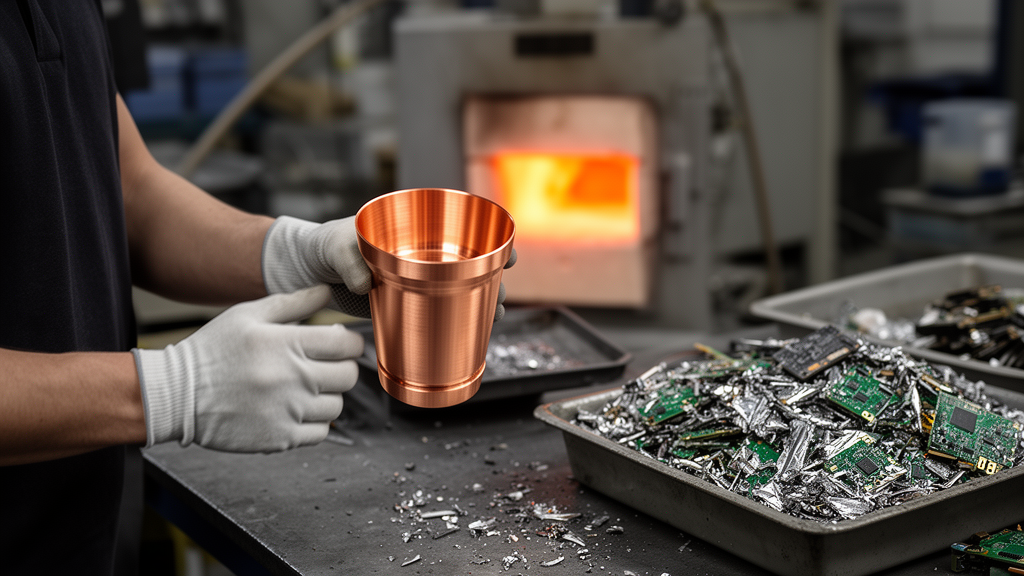
Every year, humanity discards tens of millions of tonnes of electronic waste, and buried inside that growing mountain of dead phones, cables, and circuit boards lies a genuinely valuable resource: copper. A new study published in Scientific Reports shows that copper recovered from e-waste can be partially substituted for virgin metal in a precision manufacturing process, cutting production costs and energy consumption while still producing functional parts. The research, led by S. P. Sundar Singh Sivam of SRM Institute of Science and Technology in India, together with colleagues at institutions in India and Ethiopia, examines how recycled feedstock performs in meso-scale fabrication.
The team focused on a process called incremental sheet meso-forming, or ISMF, a technique in which a computer-controlled tool progressively deforms a thin metal sheet into a desired shape. Unlike conventional stamping, ISMF does not require expensive dies, making it attractive for small-batch and customized production. The target geometry in this study was a meso-conical cup, a small conical component whose dimensions sit between the micro and macro scales. Two feedstocks were compared: as-received copper, designated AR, and a recycled copper-based composite feedstock, designated EW, containing 30 percent by weight of copper recovered from e-waste blended with 70 percent as-received copper.
The researchers treated four parameters as control factors: feed rate, depth of deformation, step size, and material type. Surface roughness, dimensional accuracy, production cost, and energy consumption served as the response variables. The experimental design was built with Response Surface Methodology, a statistical framework that models how inputs map to outputs and reveals interactions between process parameters. But the study went further, wrapping the RSM experiments in a hybrid decision-making framework that combined Spherical Fuzzy Analytic Hierarchy Process with Fuzzy Grey Relational Analysis, allowing the team to rank competing process conditions under uncertainty.
The results revealed a pronounced trade-off between quality on one side and cost and energy on the other. The best quality performance came from the A14 condition, which used as-received copper at a feed rate of 20 millimeters per minute, a depth of 0.15 millimeters, and a step size of 0.10 millimeters. Under this condition, the fabricated cups achieved a surface roughness of 1.0 micrometers and dimensional accuracy of 97.0 percent. In contrast, the A10 condition, which used the recycled e-waste-derived copper feedstock at a feed rate of 30 millimeters per minute with the same depth and step size, delivered lower production cost of 6.383 rupees per part and lower energy consumption of 2.289 watt-hours per part, compared with 9.291 rupees and 3.294 watt-hours for A14.
Relative to the recycled feedstock condition, the as-received copper condition improved surface roughness by 28.57 percent and dimensional accuracy by 1.57 percent, but it increased production cost by 45.56 percent and energy use by 43.91 percent. The study demonstrates that partially incorporating recovered e-waste-derived copper is technically feasible and can reduce production cost and operational energy demand under selected conditions. However, when surface finish and dimensional accuracy are the primary requirements, as-received copper remains the preferable choice.
The Spherical Fuzzy AHP component of the framework is particularly noteworthy. Traditional Analytic Hierarchy Process relies on crisp numerical judgments, but real-world manufacturing decisions involve uncertainty, hesitation, and ambiguity. Spherical Fuzzy numbers extend classical fuzzy sets by allowing decision-makers to express degrees of membership, non-membership, and hesitation independently, capturing the full spectrum of uncertainty in expert judgments. This makes the framework more robust when weighing competing criteria such as surface quality against cost savings, especially when the relative importance of these criteria is itself uncertain.
Fuzzy Grey Relational Analysis then served as the multi-objective optimization engine. Grey Relational Analysis is well suited to problems where data is incomplete or limited, converting multiple response variables into a single Grey Relational Grade that ranks each experimental condition. By combining this with fuzzy logic, the researchers could handle the inherent imprecision in measured responses and expert preferences. The hybrid RSM–Spherical Fuzzy AHP–Fuzzy GRA framework therefore offers a template for other sustainable manufacturing studies seeking to balance technical performance with environmental and economic criteria.
The implications for the circular economy are significant. E-waste is one of the fastest-growing waste streams globally, and recovering copper from it reduces the demand for virgin mining, which is energy-intensive and environmentally damaging. By showing that 30 percent recycled copper can be incorporated into a precision feedstock without catastrophic loss of quality, the study opens the door to more sustainable manufacturing practices. The cost and energy savings demonstrated here, while modest on a per-part basis, could scale meaningfully across industries that produce large volumes of small metal components.
The study also highlights the importance of process parameter optimization in sustainable manufacturing. The choice of feed rate, depth, and step size significantly influences both quality and resource consumption. By systematically exploring these parameters through RSM and then ranking conditions through the fuzzy decision-making framework, the researchers identified conditions that favor quality and conditions that favor sustainability. This kind of structured trade-off analysis is essential for manufacturers who must balance customer requirements with environmental targets and rising energy costs.
The reported comparison concerns specific feedstocks and processing conditions. It supports testing recycled copper in precision manufacturing, while showing why material choice must account for surface finish and dimensional requirements as well as cost and operational energy. The available results do not establish how higher recycled-copper proportions or other component geometries would perform.
Subject of Research: Sustainable meso-conical cup fabrication using recycled e-waste-derived copper: a hybrid RSM–Spherical Fuzzy AHP–fuzzy GRA optimization approach
Article Title: Sustainable meso-conical cup fabrication using recycled e-waste-derived copper: a hybrid RSM–Spherical Fuzzy AHP–fuzzy GRA optimization approach
Article References: Sivam, S. P. S. S., Lazar, P. J. L., Kesavan, S., & Santhosh, A. J. (2026). Sustainable meso-conical cup fabrication using recycled e-waste-derived copper: a hybrid RSM–Spherical Fuzzy AHP–fuzzy GRA optimization approach. Scientific Reports. https://doi.org/10.1038/s41598-026-75545-6
Image Credits: AI Generated
DOI: 10.1038/s41598-026-75545-6
Keywords: copper, e-waste, circular economy, incremental sheet meso-forming, sustainable manufacturing, response surface methodology, fuzzy optimization, Scientific Reports, Sustainable, meso-conical, fabrication, recycled
Cite Scienmag News
Denise Maddox. (October 19, 2026). Recycled E-Waste Copper Turns Old Electronics Into Precision Metal Cups. Scienmag. https://scienmag.com/recycled-e-waste-copper-turns-old-electronics-into-precision-metal-cups/
Denise Maddox. "Recycled E-Waste Copper Turns Old Electronics Into Precision Metal Cups." Scienmag, 19 October 2026, https://scienmag.com/recycled-e-waste-copper-turns-old-electronics-into-precision-metal-cups/. Accessed 19 October 2026.
Denise Maddox. "Recycled E-Waste Copper Turns Old Electronics Into Precision Metal Cups." Scienmag. October 19, 2026. https://scienmag.com/recycled-e-waste-copper-turns-old-electronics-into-precision-metal-cups/


