


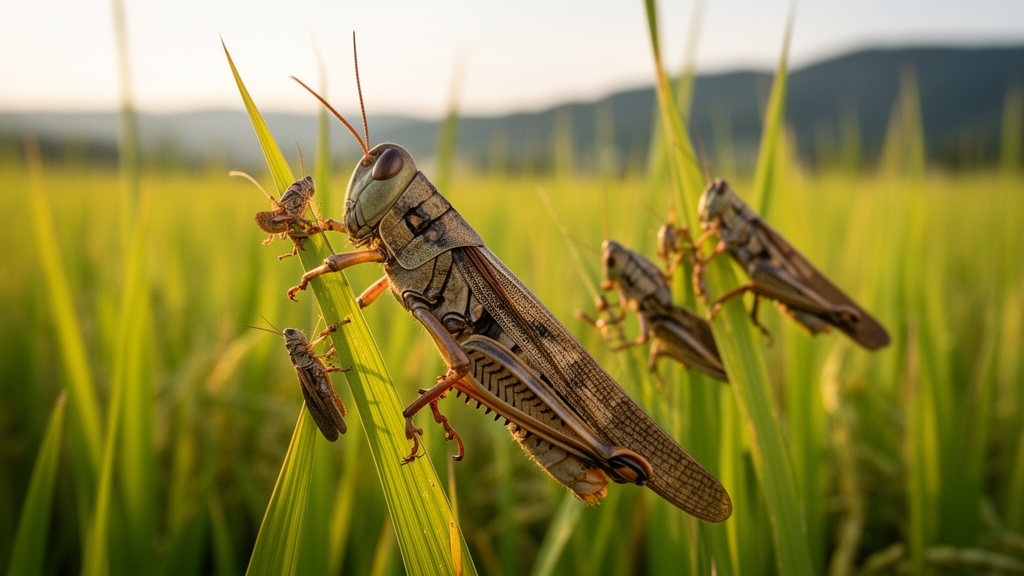
Few insects on Earth have shaped human history quite like the migratory locust. Locusta migratoria spans three continents, swarms in billions, and has been blamed for famines since biblical times. Yet for all its notoriety, one deceptively simple question has stubbornly resisted an answer: why do locusts from different places grow to different sizes? Now, a study published in the Journal of Orthoptera Research by Japanese researcher Seiji Tanaka has delivered the most complete picture yet, and the answer is stranger and more elegant than anyone expected. Across more than 2,500 kilometers of the Japanese Archipelago, from the subtropical Ryukyu Islands to the cool-temperate reaches of Hokkaido, locust body size does not simply rise or fall with latitude. Instead, it zigzags up and down in a saw-toothed pattern, tracking something far more intimate than geography: the number of generations each population squeezes into a single year.
The pattern has a name and a history. In the 1970s, ecologist Sinzo Masaki discovered that two species of ground crickets in Japan showed exactly this kind of jagged size gradient, rising southward in the north, dipping in the middle, and rising again further south. The explanation lay in voltinism, the number of generations per year, which shifts as you move along the archipelago. Where the growing season is short, insects manage only one generation, and a longer season allows bigger adults. But when the season becomes long enough for a second generation, the time available to each individual generation shrinks, and body size drops. The result is a repeating saw-tooth: size climbs to a peak at the southern edge of each voltinism zone, then falls sharply in the transition zone where an extra generation appears. The pattern became known as Masaki’s cline, and it has since been found in butterflies, water striders, and other insects. What makes the new study remarkable is that it confirms this famous cline in one of the world’s most economically important insects, and reveals that the locust achieves it through an entirely different mechanism than the crickets did.
The evidence comes from a monumental sampling effort. Between 2007 and 2019, adult locusts were collected at dozens of sites spanning the archipelago, and their head widths, hind femur lengths, and forewing lengths were measured with digital calipers to the nearest tenth of a millimeter. When head width was plotted against latitude, the saw-tooth emerged clearly in both sexes. Within the univoltine zone, where locusts produce a single generation per year, body size increased toward the south. In the transitional zone where populations switch from one generation to two, the trend reversed and size dropped. In the bivoltine zone, size climbed again, only to fall once more in the transition to three generations per year. The same pattern appeared when body size was plotted against annual mean temperature instead of latitude, confirming that the underlying driver is the thermal clock of the seasons rather than geography itself.
But here is where the story takes a technical turn that surprised even specialists. For Masaki’s crickets, the saw-tooth is generated by flexible development: nymphs in transitional zones stretch or compress their juvenile period in response to day length, and adult size is a direct function of how long the nymph develops. The locust, it turns out, does something completely different. When Tanaka measured the duration of nymphal development across populations, he found remarkably little variation, and crucially, no significant correlation between how long nymphs took to develop and how large the adults became. The crickets’ mechanism simply was not operating. Instead, the key variable was growth efficiency, calculated as adult head width divided by days of nymphal development. Populations from the bivoltine heartland packed more growth into each day of development, and growth efficiency correlated strongly with the body sizes of the field-collected parents. The locust, in other words, solves the seasonal puzzle not by changing its schedule but by changing its metabolic pace.
Is this pattern written in the genes, or is it a plastic response to local environments? To find out, Tanaka brought the locusts into the laboratory and reared their offspring for three consecutive generations under identical conditions of temperature, crowding, and light. If the field pattern were merely environmental, it should have washed out within a generation. It did not. The saw-toothed cline persisted in the first, second, and third laboratory generations, with the same two peaks in body size at the boundaries of the voltinism zones. This is strong evidence that the geographic size differences are primarily genetic, locally adapted traits shaped by natural selection acting on the length of the growing season. Photoperiod did leave its mark: locusts reared under long-day conditions grew significantly larger than their short-day siblings, a reminder that plasticity still modulates the genetic baseline, but the fundamental geography of size survived the move to the lab.
The study also uncovered a deep phylogenetic wrinkle. Previous mitochondrial DNA work had shown that Japanese migratory locusts belong to two distinct clades: a southern clade occupying the subtropical Ryukyu Islands and a northern clade covering the temperate main islands, separated by the Tokara Strait. The new measurements revealed that southern-clade locusts are significantly smaller than their northern relatives, and that females of the two clades differ in a suite of reproductive traits. Southern females developed fewer ovarioles, the egg-producing tubes within the ovary, laid slimmer egg pods with thinner protective foam, and packed fewer eggs into each pod. This means part of the overall latitudinal trend, the apparent tendency for locusts to be bigger in the north overall, is actually a byproduct of comparing two evolutionarily distinct lineages rather than a smooth adaptation to climate.
Body size, as the study confirms, is not a cosmetic trait. Across populations, larger females carried more ovarioles, produced wider egg pods, and laid more eggs per pod, with the number of ovarioles alone explaining a striking share of the variation in egg production. The arithmetic of locust fecundity is therefore written directly into adult size: a bigger female is, quite literally, a more fertile factory. Interestingly, hatchling weight showed no correlation with latitude or maternal size, averaging around 14 milligrams regardless of origin, suggesting that mothers invest in egg quantity rather than offspring quality across this species’ range. For an insect capable of erupting into devastating swarms, these reproductive details are far from academic; they hint at how quickly populations in different climates can rebound and multiply.
Then there is the matter of the sexes. The migratory locust is female-biased in size, and according to Rensch’s rule, a classic generalization from vertebrates, the size gap between females and males should shrink as species or populations get bigger. The locusts do the opposite. Sexual size dimorphism increased as population body size increased, with males staying relatively smaller in populations of larger females, a direct contradiction of Rensch’s rule. The dimorphism also tracked latitude, widening toward the north, and this too proved partly genetic, persisting across laboratory generations. Tanaka proposes an intriguing behavioral explanation: male locusts guard females by mounting them for many hours before mating, a risky undertaking in which a smaller male may be less conspicuous to predators and less burdensome to the female he is guarding. In northern populations, where conditions may heighten predation pressure, selection may favor modest males even as females grow large.
Finally, the study delivers a cautionary lesson about one of locust biology’s most famous phenomena: phase polyphenism, the dramatic transformation between solitary and gregarious forms that underlies swarm formation. When solitary field adults were reared in crowded laboratory cages, their bodies shifted in the expected gregarious direction: females shrank, males grew, and the classical F/C morphometric ratio, hind femur length relative to head width, dropped significantly and stabilized within a single generation. This confirms that F/C is a reliable, fast-responding indicator of gregarization, valuable for monitoring populations that might be gearing up to swarm. Yet the laboratory values never quite reached those recorded from truly gregarized field outbreaks, and the ratio also differed between the two genetic clades, a reminder that even the most trusted tools of locust science must be interpreted with genetics in mind.
What emerges from this decades-spanning effort is a portrait of adaptation operating on multiple levels at once: seasonal selection sculpting body size into a saw-toothed cline, ancient phylogenetic splits overlaying their own signature, metabolic efficiency doing the work that developmental flexibility performs in crickets, and social environment reshaping bodies within a single generation. The migratory locust, it turns out, carries its climate history, its family tree, and its crowd history all in the proportions of its head, legs, and wings. For researchers tracking how insects will respond to a warming world, the message is sobering: body size clines are not simple thermometers. They are composite records of seasonality, lineage, and plasticity, and untangling them, as this study shows, requires measuring thousands of legs across thousands of kilometers, one locust at a time.
Subject of Research: Geographic variation in body size of the migratory locust and Masaki's cline
Article Title: Geographic variation in body size of the migratory locust Locusta migratoria ( Orthoptera , Acrididae ): Masaki’s cline and phase polyphenism
Article References: Tanaka, S. (2024). Geographic variation in body size of the migratory locust Locusta migratoria (Orthoptera, Acrididae): Masaki’s cline and phase polyphenism. Journal of Orthoptera Research, 33(1), 27-40. https://doi.org/10.3897/jor.33.107242
Image Credits: AI Generated
Keywords: migratory locust, Locusta migratoria, Masaki's cline, body size, voltinism, phase polyphenism, sexual size dimorphism, Rensch's rule, growth efficiency, Japanese Archipelago, orthoptera, fecundity
Cite Scienmag News
Gavin Prescott. (October 19, 2026). Giant Locusts, Shrinking Males and a Saw-Toothed Secret: Japan’s Migratory Locusts Rewrite the Rules of Body Size. Scienmag. https://scienmag.com/giant-locusts-shrinking-males-and-a-saw-toothed-secret-japans-migratory-locusts-rewrite-the-rules-of-body-size/
Gavin Prescott. "Giant Locusts, Shrinking Males and a Saw-Toothed Secret: Japan’s Migratory Locusts Rewrite the Rules of Body Size." Scienmag, 19 October 2026, https://scienmag.com/giant-locusts-shrinking-males-and-a-saw-toothed-secret-japans-migratory-locusts-rewrite-the-rules-of-body-size/. Accessed 19 October 2026.
Gavin Prescott. "Giant Locusts, Shrinking Males and a Saw-Toothed Secret: Japan’s Migratory Locusts Rewrite the Rules of Body Size." Scienmag. October 19, 2026. https://scienmag.com/giant-locusts-shrinking-males-and-a-saw-toothed-secret-japans-migratory-locusts-rewrite-the-rules-of-body-size/


