


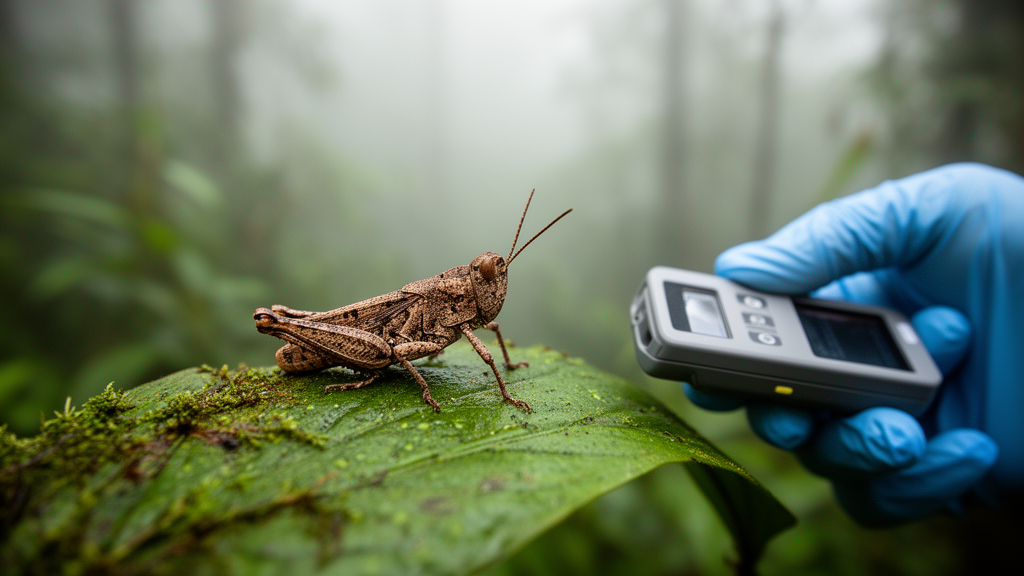
Deep in Ecuador’s Sucumbíos Province, a small brown insect sat unnoticed in a museum drawer for more than three decades. Now, an international team of researchers has identified it as an entirely new species, Phelene reinschmidti, and in a landmark move for the field, published the first-ever 3D scan of any pygmy grasshopper. The discovery, announced in the journal Evolutionary Systematics, sheds light on one of the most mysterious lineages in the grasshopper family Tetrigidae and hints at how artificial intelligence could transform the way scientists catalogue life on Earth.
Pygmy grasshoppers, or tetrigids, are a family of roughly 2,000 described species found across the globe, but the Neotropical region remains especially poorly studied. Among its most elusive members is the subfamily Lophotettiginae, which contains only two genera, Lophotettix and Phelene, and is the only tetrigid subfamily endemic to the Neotropics. Specimens are so rarely encountered that scientists have never been able to propose where this group sits on the grasshopper family tree. The new study changes that, offering the first hypothesis about the subfamily’s evolutionary relationships.
The holotype, a single adult female, was collected in early 1993 by collector Duffner along the upper Aguarico River and deposited at the State Museum of Natural History Karlsruhe in Germany. Measuring just over nine millimetres in body length with a pronotum extending to 12.33 millimetres, the insect is uniformly brown without distinct patterns, a feature that immediately distinguishes it from its closest relative, Phelene maroon, known only from French Guiana. The researchers, Niko Kasalo, Martin Husemann, Thomas van de Kamp and Josip Skejo, named the species after Professor Matthias Reinschmidt, director of the Karlsruhe Zoo, in recognition of his dedication to nature protection in Ecuador and worldwide.
What sets this description apart is not just the insect itself but the technology used to document it. The team employed synchrotron X-ray microtomography at the KIT Light Source in Germany, scanning the specimen in six height steps with a filtered polychromatic beam. Using a fast indirect detector system with a 200-micrometre LuAG scintillator and a high-speed camera, they captured 3,000 radiographic projections over a 180-degree rotation with an effective pixel size of just 6.11 micrometres. The resulting data was reconstructed, segmented semi-automatically with the software Biomedisa, and converted into a scaled, interactive 3D model that preserves every taxonomically important character.
This is the first time any member of Tetrigidae has been digitised in this way. Until now, the vast majority of insect type specimens worldwide have never been photographed at all, and those that have been imaged typically show only a dorsal view, severely limiting their scientific usefulness. Physical specimens are fragile and irreplaceable; sending holotypes between institutions risks damage or loss, and examining them consumes curators’ time. A scaled 3D model, by contrast, allows researchers anywhere on the planet to inspect the specimen from every angle, take precise measurements, and even perform geometric morphometric analyses without ever touching the original.
The implications reach far beyond a single grasshopper. Modern high-throughput X-ray imaging can already digitise large numbers of insects in a short time, and the authors argue that artificial intelligence and machine learning approaches will further automate both data acquisition and large-scale analysis. In the future, statistical species delimitation based on such digital specimens could accelerate taxonomy itself, a critical improvement at a time when biodiversity is declining faster than scientists can document it. Virtual specimens also serve as insurance: if a physical holotype is ever lost, the digital copy preserves a detailed record of what existed.
Comparing the new species with its congeners revealed a subtle but important picture. Phelene turgida, originally described from Peru, is now known to occur in French Guiana as well, where it sometimes lives alongside P. maroon. Specimens from different localities show variation in the shape of the pronotal crest, leaving open the question of whether this trait simply varies within a species or whether the distribution of Phelene species is more complex than currently understood. The authors note that photographs of the P. turgida type specimens are not available, and that while morphological characters remain sufficient to describe new tetrigid species, DNA studies are becoming increasingly necessary to resolve such biogeographical puzzles.
The study also tackles a long-standing mystery: where does Lophotettiginae belong in the grasshopper family tree? The researchers found that the subfamily most closely resembles the Neotropical subfamily Metrodorinae, suggesting the two are likely related. Shared features, including similar facial morphology, elongated first tarsal segments, the placement of pronotal crests, and sideways-projected lateral lobes, link Phelene not only to Metrodora but also to the genus Chiriquia, which was briefly synonymised with Phelene in 2015 before being separated again. These similarities, the authors argue, cannot be dismissed as mere convergence.
Looking further afield, many members of the predominantly African tribe Xerophyllini, currently placed in the subfamily Cladonotinae, share the same suite of characters. The authors propose that Lophotettiginae, Metrodorinae and Xerophyllini may together form a monophyletic group, with the morphology of the genus Morphopus potentially representing the ancestral condition from which the others diversified. Such a grouping would also explain the distribution of these lineages across the southern half of the ancient supercontinent Gondwana. The researchers caution that all of these higher taxa require extensive revision, and that Asian species currently assigned to Metrodorinae may not truly belong there.
For now, Phelene reinschmidti is known from a single specimen, and much about its ecology and distribution remains unknown. But the combination of a careful morphological description, an identification key to all three species in the genus, and a pioneering 3D digital record sets a new standard for how rare and cryptic species can be documented. As more collections are digitised and AI tools mature, discoveries like this one may become both more common and more rigorous, helping scientists catalogue Earth’s fading diversity before it disappears.
Subject of Research: Taxonomic description of a new pygmy grasshopper species from Ecuador and the first 3D scan of a tetrigid specimen
Article Title: Description of Phelene reinschmidti from Ecuador with notes on the subfamily Lophotettiginae ( Orthoptera , Tetrigidae )
Article References: Kasalo, N., Husemann, M., van de Kamp, T., & Skejo, J. (2024). Description of Phelene reinschmidti from Ecuador with notes on the subfamily Lophotettiginae (Orthoptera, Tetrigidae). Evolutionary Systematics, 8(1), 119-125. https://doi.org/10.3897/evolsyst.8.124285
Image Credits: AI Generated
DOI: 10.3897/evolsyst.8.124285
Keywords: pygmy grasshoppers, Tetrigidae, Phelene reinschmidti, Ecuador, taxonomy, 3D scanning, synchrotron microtomography, Neotropics, Lophotettiginae, biodiversity, new species, digital specimens
Cite Scienmag News
Gavin Prescott. (October 19, 2026). New pygmy grasshopper species from Ecuador revealed in world-first 3D scan. Scienmag. https://scienmag.com/new-pygmy-grasshopper-species-from-ecuador-revealed-in-world-first-3d-scan/
Gavin Prescott. "New pygmy grasshopper species from Ecuador revealed in world-first 3D scan." Scienmag, 19 October 2026, https://scienmag.com/new-pygmy-grasshopper-species-from-ecuador-revealed-in-world-first-3d-scan/. Accessed 19 October 2026.
Gavin Prescott. "New pygmy grasshopper species from Ecuador revealed in world-first 3D scan." Scienmag. October 19, 2026. https://scienmag.com/new-pygmy-grasshopper-species-from-ecuador-revealed-in-world-first-3d-scan/


