


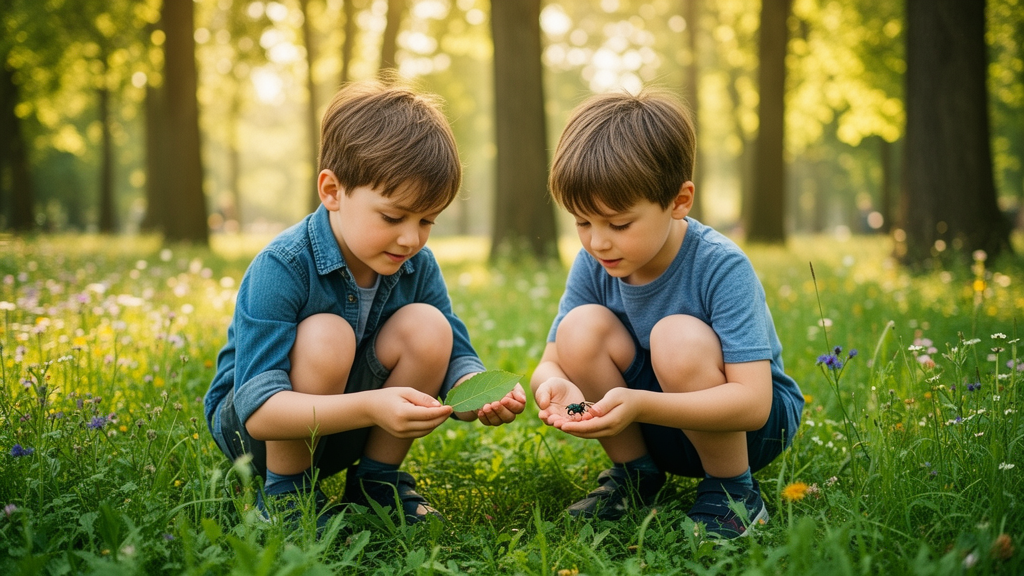
Children who grow up surrounded by greener, more natural landscapes develop a significantly stronger connection to the natural world than their peers in built-up neighbourhoods, according to a new study of more than 500 primary schoolchildren in north-eastern Italy. The research, published in the journal One Ecosystem, combined psychological questionnaires with satellite imagery to reveal, for the first time at a regional scale, how the structure of the places where children live shapes their attitudes towards nature during the critical years when that lifelong bond is formed.
The study targeted a question that has long puzzled environmental psychologists: does the everyday landscape around a child’s home actually influence their sense of affiliation with nature, or is that bond driven mainly by personality, family culture and individual experiences? Because connectedness to nature is considered a stable trait that emerges early in childhood and is difficult to change in adolescence or adulthood, understanding what strengthens or weakens it during the primary school years carries considerable weight for conservation policy and education alike. Adults with a strong sense of affiliation with nature tend to avoid environmentally harmful behaviour, and children who feel connected to the living world show sustainable habits from a young age and greater willingness to engage in pro-environmental actions as they grow.
Between November 2020 and April 2021, the researchers administered an anonymised online questionnaire to 533 primary schoolchildren aged six to eleven, with an average age of eight, living across three Italian regions: Trentino-Alto Adige, Friuli Venezia Giulia and Veneto. Ultimately, 527 complete responses were analysed. The instrument included the Connectedness to Nature Scale for children, a validated seven-item psychometric measure rated on a five-point scale that gauges how much a child feels part of the natural world. The questionnaire also carried a version of the Perceived Restorativeness Scale for children, an eighteen-item tool rooted in Attention Restoration Theory that measures how strongly a place helps recover from mental fatigue through four factors: being-away, fascination, coherence and scope. The children rated both their favourite natural place and their schoolyard.
To characterise the landscapes those children inhabited, the team turned to remote sensing. They retrieved 32 multispectral images captured by the Sentinel-2 satellite fleet through the Copernicus portal, selecting spring-time scenes from March and April 2021 with cloud cover below 9.9 percent. After atmospheric correction, they calculated two standard spectral indices: the Normalised Difference Vegetation Index, which exploits the fact that healthy plants reflect near-infrared light strongly, and the Normalised Difference Built-up Index, which highlights artificial surfaces using short-wave infrared bands. Combining the two produced a novel Green versus Built Index, calculated as twice the vegetation index minus the built-up index, which assigns high values to vegetated land, negative values to asphalt and concrete, and near-zero values to water, verified against a separate water index.
The choice of spring imagery was deliberate and technically pointed. In northern Italy, cultivated fields show lower vegetation-index values in spring than naturally vegetated areas, allowing the algorithm to distinguish year-round natural vegetation from seasonal crops. The combined index even separated cultivated from non-cultivated cropland, with tree canopy consistently scoring above 0.60. The team then computed the average index value within a 10-kilometre buffer around each of the 68 residential towns, a radius chosen to reflect the typical daily travelling range of Italian schoolchildren, and classified the buffers into four categories: coastal, low, average and high naturalness. Coastal zones were treated separately because of their distinctive lagoon landscapes, including the Venice Lagoon, the Grado and Marano Lagoons and the Po River Delta.
The results were striking. Overall, the children scored a mean of 3.25 out of 4 on the connectedness scale, and scores did not differ by age or school. But the group comparisons revealed a clear pattern: children living in areas of high naturalness scored significantly higher than those in areas of average naturalness and those in low naturalness areas, with adjusted p-values of 0.027 and 0.031 respectively. Notably, children in rural, agriculturally dominated areas of merely average naturalness still maintained relatively high connectedness, suggesting that even cropland landscapes can nurture what the authors describe as an innate, physiological affiliation with nature during childhood.
The perceived restorativeness findings followed a similar trajectory. Children consistently rated their favourite natural places as far more restorative than their schoolyards, with the difference highly significant across every group. The highest restorativeness scores for natural places appeared in the high-naturalness group, which simultaneously assigned the lowest scores to schoolyards, widening the gap between the two environments. Intriguingly, children from the most natural and coastal areas rated their favourite places significantly higher than children in average-naturalness areas, hinting that greater exposure to a wider range of natural settings sharpens a child’s ability to distinguish genuinely natural places from semi-natural or artificial ones.
Perhaps the most telling detail lay in where children located their favourite places. Most participants named parks, gardens, beaches and the sea, places that are easily accessible but offer limited wilderness. Children in low and average naturalness areas frequently mentioned locations beyond their 10-kilometre daily range, even outside their municipality, while those in high naturalness and coastal areas chose places close to home. The researchers suggest this reflects a fundamental constraint of childhood: a young child’s world extends only as far as parents and family routines allow, so the availability and viewability of natural spaces within the immediate neighbourhood becomes essential. The study also found that frequency of visits did not predict connectedness or restorativeness scores, indicating that the quality and intensity of direct experience matters more than simple exposure counts.
The consistent inferiority of schoolyards, which were perceived as less regenerative regardless of neighbourhood naturalness, offers a concrete target for intervention. Since children spend substantial daily time in schoolyards under the guidance of teachers with whom they share an educational bond, the authors argue that greening these spaces, incorporating mini-forests in place of conventional geometric parks, valuing trees and natural elements among streets and buildings, and creating green spaces for physical activity, could deliver both immediate well-being benefits and long-term gains in nature connectedness, particularly when paired with teacher training. Such measures align with nature-based solution strategies under the United Nations’ Post-2020 Global Biodiversity Framework and carry special urgency in northern Italy, which records some of the country’s highest land consumption rates.
The authors caution that the study is limited to schoolchildren in north-eastern Italy and may not generalise to other populations, and whether today’s connectedness differences translate into tomorrow’s pro-environmental behaviour remains a question for further research. Still, the message for urban planners and policymakers is clear: the spatial distribution of green and blue spaces in residential areas is not merely an amenity but a developmental resource. Because today’s children are tomorrow’s citizens and decision-makers, ensuring equitable access to natural, or at least semi-natural, surroundings may be one of the most effective long-term investments a society can make in its own environmental future.
Subject of Research: The relationship between the naturalness of residential landscapes and children's connectedness to nature in north-eastern Italy
Article Title: The influence of naturalness of the landscape structure on children’s connectedness to Nature in north-eastern Italy
Article References: Stocco, A., Tabacchi, C., Barbiero, G., & Pranovi, F. (2023). The influence of naturalness of the landscape structure on children’s connectedness to Nature in north-eastern Italy. One Ecosystem, 8, Article e111973. https://doi.org/10.3897/oneeco.8.e111973
Image Credits: AI Generated
Keywords: children, connectedness to nature, satellite imagery, Sentinel-2, urban planning, restorativeness, north-eastern Italy, ecosystem services, biophilia, schoolyards, remote sensing, environmental psychology
Cite Scienmag News
Margaret Porter. (October 19, 2026). Children Living Near Greener Landscapes Feel Deeper Bonds with Nature, Satellite Study Finds. Scienmag. https://scienmag.com/children-living-near-greener-landscapes-feel-deeper-bonds-with-nature-satellite-study-finds/
Margaret Porter. "Children Living Near Greener Landscapes Feel Deeper Bonds with Nature, Satellite Study Finds." Scienmag, 19 October 2026, https://scienmag.com/children-living-near-greener-landscapes-feel-deeper-bonds-with-nature-satellite-study-finds/. Accessed 19 October 2026.
Margaret Porter. "Children Living Near Greener Landscapes Feel Deeper Bonds with Nature, Satellite Study Finds." Scienmag. October 19, 2026. https://scienmag.com/children-living-near-greener-landscapes-feel-deeper-bonds-with-nature-satellite-study-finds/


