


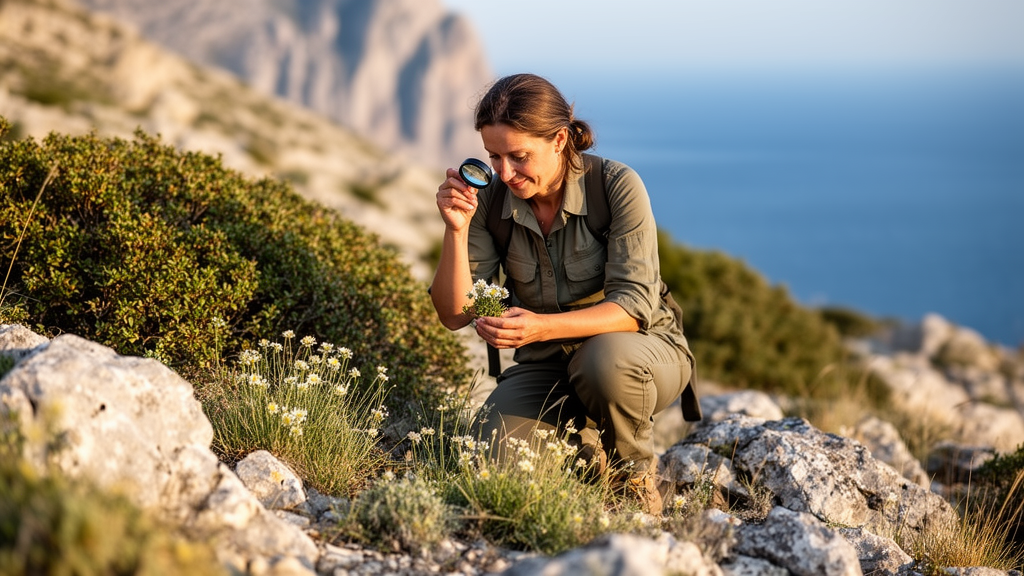
A five-day botanical expedition across some of the most isolated landscapes in the western Mediterranean has delivered one of the most detailed vegetation surveys ever compiled for western Sicily, documenting hundreds of plant communities and revealing a plant species never before recorded on the island. The findings, published in the journal Italian Botanist, come from the annual excursion of the Working Group for Vegetation Science of the Italian Botanical Society, which brought specialists together from 23 to 27 April 2022 to explore the Egadi Islands and the dramatic coastal mountains of Mount San Giuliano and Mount Cofano in the province of Trapani.
The expedition followed the phytosociological tradition established by the late Spanish botanist Salvador Rivas-Martínez, whose celebrated Itinera Geobotanica series inspired the Italian team’s approach. In total, the researchers produced 29 original vegetation relevés and 11 synthetic relevés compiled from earlier bibliographic sources, allowing them to describe, classify and compare the plant communities encountered along five carefully chosen geobotanical itineraries. Each relevé records every species within a defined plot along with estimates of cover and abundance, providing a quantitative snapshot of the vegetation that can be compared across the entire Mediterranean region.
The study area is geologically and climatically remarkable. Mount San Giuliano, rising to 791 metres above sea level with the ancient town of Erice on its summit, and Mount Cofano at 659 metres are both built of Mesozoic carbonate rocks interspersed with Pleistocene calcarenites. The Egadi Islands of Marettimo and Levanzo emerged during the early Miocene as part of the so-called Egadi Range. Marettimo, dominated by Pizzo Falcone at 686 metres, consists of dolomite, marl and limestone dating from the Middle Triassic to the Lower Lias, while Levanzo is formed of Mesozoic and Tertiary carbonate and clastic-terrigenous substrates. All the sites enjoy a classic Mediterranean climate with markedly dry summers and mild winters, moderated by the surrounding sea, and all belong to the Natura 2000 network as Special Areas of Conservation.
The first itinerary took the group to Erice on Mount San Giuliano, a mountain often cited as one of the richest biotopes in Sicily despite centuries of human pressure. On the walls of the Castle of Venus and the surrounding carbonate outcrops, the botanists documented a chasmophytic community known as Scabioso creticae-Centauretum ucriae subass. brassicetosum drepanensis, bristling with endemics such as Brassica villosa subsp. drepanensis, the striking knapweed Centaurea erycina and the cliff-loving Dianthus rupicola subsp. rupicola. In cool, shaded gullies below the Torretta Pepoli, the team recorded patches of laurel woodland referred to Acanthomollis-Lauretum nobilis, a rare micro-forest sustained by moisture condensing from the fogs that frequently cloak the summit, where average annual temperatures fall to about 14.5 degrees Celsius compared with more than 18 degrees on the coast.
Marettimo proved to be the scientific heart of the expedition. Unlike the other Egadi islands, which were joined to Sicily during the last glacial maximum, Marettimo remained isolated, turning it into a refuge for numerous species missing elsewhere in Sicily. The island’s vascular flora of 499 taxa includes eight endemics: three palaeoendemics, Oncostema ughii, Bupleurum dianthifolium and Thymus richardii subsp. nitidus, and five schizoendemics, Allium franciniae, Helichrysum panormitanum subsp. messeriae, Limonium tenuiculum, Prospero hierae and Senecio aegadensis. Relict shrubs such as Daphne sericea and Thymelaea tartonraira, both completely absent from the rest of Sicily, survive in the island’s higher stands, while rosemary climbs to elevations unusual for Sicily, probably because isolation shielded the island from the climate-driven plant migrations of past glaciations.
On the island’s north-western coast, the team made one of the expedition’s headline discoveries: a previously undescribed plant community dominated by the cornflag, Moraea sisyrinchium, an iris relative of southern Mediterranean distribution. The new association, formally named Catapodio pauciflori-Moraeetum sisyrinchii ass. nova, describes an ephemeral coastal dry grassland flourishing on shallow red soils over carbonate rock, blooming in early spring alongside annuals such as Plantago coronopus, Catapodium pauciflorum, Silene colorata and Bellis annua. The authors framed it within the alliance Plantagini-Catapodion balearici of the order Stipo-Bupleuretalia semicompositi and the class Stipo-Trachynietea distachyae, and supported the description with a synoptic table comparing 17 Mediterranean plant communities in which Moraea sisyrinchium is frequent, from Sardinia and Malta to the Balearic Islands and southern Spain. Notably, no association with absolute dominance of this species had been described before.
The Marettimo excursions also stirred a lively taxonomic debate over the island’s holm oak woods. The association Daphno sericeae-Quercetum ilicis, described in 1983 for the fog-drenched heights around Pizzo Falcone, carries nomenclatural priority over the more widely used name Pistacio lentisci-Quercetum ilicis published two years later for thermophilous holm oak woods across western and southern Sicily. Because the phytosociological code forbids downgrading an earlier validly published name, the authors conclude that only two solutions exist: either treat the Daphne-rich Marettimo woods as distinct from the rest of Sicily’s holm oak forests, or petition the nomenclature committee to conserve the later name. Pending resolution, the team adopted the older name in accordance with the code, illustrating how field excursions can expose unresolved threads in the classification of Mediterranean vegetation.
The debate extended to the pine forests of Marettimo, where Aleppo pine woods referred to Erico multiflorae-Pinetum halepensis grow on steep, partially consolidated screes. Many of these stands derive from 1970s plantations that have matured into self-reproducing naturalised woods now advancing into surrounding garrigue and maquis. Their higher-rank classification remains formally undecided: a 2021 proposal to create a new class, Pinetea halepensis, separate from the broadleaved-dominated Quercetea ilicis, is being evaluated by the European Vegetation Classification Committee, which has flagged concerns including the lack of true diagnostic species and the inclusion of anthropogenic plantations in the underlying analysis. A vote was scheduled for 2023, meaning the Marettimo pines sit at the centre of an ongoing continent-wide argument about how Mediterranean conifer forests should be classified.
Levanzo, the driest and least verdant of the two islands visited, offered a contrast shaped by decades of intense agro-silvo-pastoral land use. Its landscape of low scrub, garrigue and grassland is dominated by the wintergreen Periploca angustifolia and tree spurge maquis known as Periploco angustifoliae-Euphorbietum dendroidis, which degrades into Hyparrhenia grasslands and ephemeral Stipellula capensis meadows on eroded soils. The island’s flora of 468 taxa includes 15 endemics, none exclusive to Levanzo, but several species of phytogeographical interest, among them Periploca angustifolia and Aristolochia navicularis, both absent from mainland Sicily, and Crocus longiflorus at the westernmost limit of its range. Near the coast, halophytic vegetation of Limonietum bocconei fringes the wave-beaten rocks.
The final itinerary skirted the coastline of Mount Cofano, a Nature Reserve whose 651 vascular taxa include 48 endemics, three of them exclusive to the mountain: Erica sicula subsp. sicula, Helichrysum panormitanum subsp. brulloi and Limonium cophanense. Centuries of deforestation and near-annual wildfires have replaced the original forests with dwarf palm scrub and vigorous Ampelodesmos grasslands, both fire-adapted pyrophytes that now dominate the slopes. The expedition concluded with floristic updates across all sites: five taxa proved new to Marettimo, including Lysimachia loeflingii recorded for the first time in Sicily, but also the invasive ornamental hybrid Kalanchoë ×houghtonii, flagged as a potential threat to the island’s native flora. Further novelties emerged on Levanzo and Mount Cofano, including the discovery of the narrowly Mediterranean grass Hyparrhenia sinaica. The authors emphasise that these results confirm the value of collaborative fieldwork among specialists in vascular flora and vegetation science for charting the plant diversity of the Italian territory, in one of the richest biodiversity hotspots of the entire Mediterranean basin.
Subject of Research: Vegetation science and phytosociological survey of the Egadi Islands and western Sicily, Italy
Article Title: Itineraries of the Working Group for Vegetation Science of the Italian Botanical Society – 1 (2022): Excursion to the Egadi Islands, Mount San Giuliano and Mount Cofano (Trapani, western Sicily, Italy)
Article References: Gianguzzi, L., Guarino, R., Bazan, G., Di Pietro, R., Acosta, A. T. R., Bajona, E., Bolliger, P., Bonomi, C., Camuffo, A., Console, C., Fascetti, S., Fortini, P., Frattaroli, A., Mei, G., Mondello, F., Olivari, S., Rizzieri, M., Rosati, L., Sarmati, S., … Stinca, A. (2023). Itineraries of the Working Group for Vegetation Science of the Italian Botanical Society – 1 (2022): Excursion to the Egadi Islands, Mount San Giuliano and Mount Cofano (Trapani, western Sicily, Italy). Italian Botanist, 16, 1-57. https://doi.org/10.3897/italianbotanist.16.103989
Image Credits: AI Generated
DOI: 10.3897/italianbotanist.16.103989
Keywords: phytosociology, Sicily, Egadi Islands, Marettimo, vegetation science, plant endemism, Mediterranean flora, new plant association, holm oak woods, Natura 2000, biodiversity hotspot, Italian Botanical Society
Cite Scienmag News
Drew Townsend. (October 19, 2026). Botanists Unveil Hidden Plant Worlds of Sicily’s Egadi Islands and Coastal Mountains. Scienmag. https://scienmag.com/botanists-unveil-hidden-plant-worlds-of-sicilys-egadi-islands-and-coastal-mountains/
Drew Townsend. "Botanists Unveil Hidden Plant Worlds of Sicily’s Egadi Islands and Coastal Mountains." Scienmag, 19 October 2026, https://scienmag.com/botanists-unveil-hidden-plant-worlds-of-sicilys-egadi-islands-and-coastal-mountains/. Accessed 19 October 2026.
Drew Townsend. "Botanists Unveil Hidden Plant Worlds of Sicily’s Egadi Islands and Coastal Mountains." Scienmag. October 19, 2026. https://scienmag.com/botanists-unveil-hidden-plant-worlds-of-sicilys-egadi-islands-and-coastal-mountains/


