


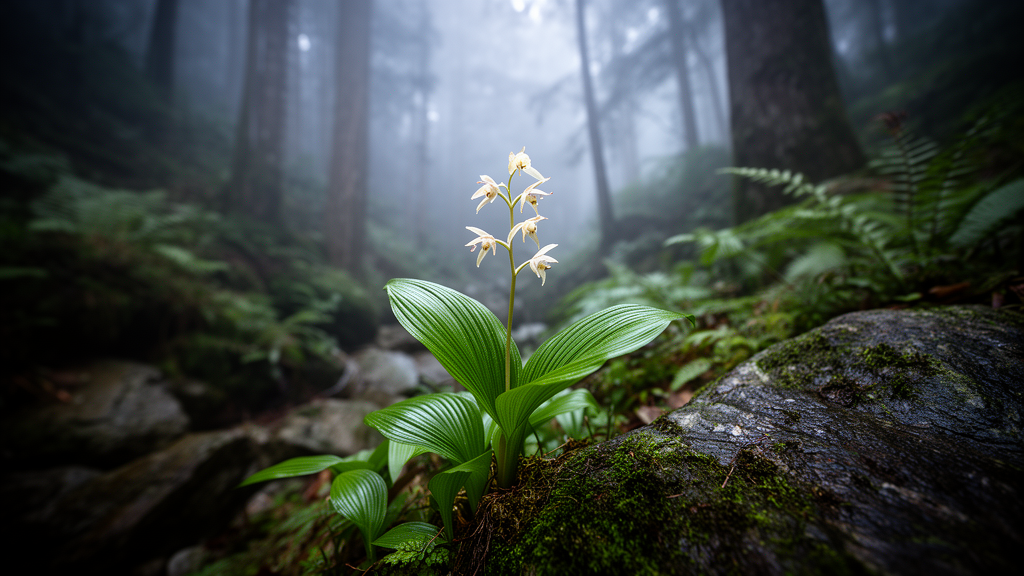
Deep in the subtropical mountain forests of China, a slender-flowered orchid has quietly survived ice ages, monsoon shifts, and now the accelerating pressures of a warming world. Calanthe graciliflora, a perennial herb in the orchid family endemic to China, is the most widely distributed member of its genus, occupying the highest latitudinal range and showing the strongest cold tolerance of any Calanthe species. Those traits have made it an attractive model for asking a question that matters far beyond one orchid: how do montane plants respond to climate change across deep time, and where should conservationists focus their efforts as the climate continues to warm?
A new study published in the journal Nature Conservation tackles that question by reconstructing the species’ potential distribution across six climatic periods, from the Last Interglacial roughly 120,000 years ago to projected conditions in the 2050s and 2070s. Using an ecological niche modeling approach known as maximum entropy, or MaxEnt, the researchers combined 75 rigorously filtered occurrence records with 19 bioclimatic variables drawn from field surveys and herbarium collections. The result is the first comprehensive climate-driven distribution modeling ever conducted for this species, and it fills a long-standing gap in understanding how this orchid has weathered the Quaternary glacial cycles and what its future may hold.
The modeling workflow began with an extensive data-cleaning effort. The team gathered 229 latitude and longitude records from the Chinese Virtual Herbarium, the Global Biodiversity Information Facility, the Flora of China, and their own fieldwork, then applied a one-square-kilometer buffer across China to eliminate spatial bias from clustered sampling. Redundant and misidentified records were removed, leaving a single occurrence point per buffer zone. This kind of spatial thinning is critical for niche models, which can be misled by dense clusters of records that reflect collector access rather than true ecological preference.
Climate data came from the WorldClim database at a 30-arc-second resolution, generated by the CCSM4 general circulation model developed at the National Center for Atmospheric Research under the Coupled Model Intercomparison Project Phase 5. For future projections, the researchers used the Representative Concentration Pathway 2.6 scenario, a relatively optimistic low-emission trajectory aligned with global mitigation goals. Because multicollinearity among the 19 bioclimatic variables can cause model overfitting, the team screened them with Pearson correlation analysis, removing any factor with a correlation coefficient at or above 0.8. Seven variables survived the screening, and four of them ultimately dominated the model’s predictions.
Those four factors tell a clear story about what this orchid needs. Precipitation of the driest month contributed the most, at 30.6 percent, followed by annual precipitation at 27.0 percent, mean temperature of the warmest quarter at 25.9 percent, and mean diurnal temperature range at 8.5 percent. Together, these four variables accounted for 92 percent of the model’s total contribution. The pattern makes ecological sense: orchids are notoriously sensitive to water availability and seasonal drought, and C. graciliflora inhabits subtropical monsoon zones where rainfall is abundant but strongly seasonal. The response curves revealed surprisingly narrow tolerances. When the probability of occurrence exceeded 0.5, annual precipitation fell between 1,500 and 2,800 millimeters, precipitation of the driest month between 30 and 170 millimeters, mean diurnal range between 6.3 and 8 degrees Celsius, and mean temperature of the warmest quarter between 21.5 and 25 degrees Celsius. These thresholds represent the climatic envelope within which the species can grow and reproduce normally.
The model’s performance was exceptional. The average area under the receiver operating characteristic curve, a standard measure of predictive accuracy, reached 0.989 with a standard deviation of only 0.001, far exceeding the random-prediction benchmark of 0.5. With that level of confidence, the researchers could trace the species’ range through time with meaningful precision. During the Last Interglacial, suitable habitat covered roughly 123,770 square kilometers, concentrated in present-day Chongqing, Yunnan, Guizhou, Hainan, Fujian, and Zhejiang, with a notable concentration in the southern Hengduan Mountains. During the Last Glacial Maximum, those southern Hengduan habitats vanished entirely while suitable areas expanded northward into the Qinling Mountains, the Luoxiao Mountains, and Mount Wuyi.
That shift during the Last Glacial Maximum is the study’s most striking biogeographic finding. It suggests that the Qinling Mountains, Luoxiao Mountains, and Mount Wuyi served as glacial refugia where the orchid survived the coldest millennia of the Pleistocene. The evidence points to two distinct survival strategies operating simultaneously. In the Qinling Mountains, the species appears to have followed a migratory model, retreating northward into northern subtropical transitional forests as ice advanced. At Mount Wuyi, by contrast, suitable habitat persisted continuously through every Quaternary climatic event, consistent with a model of in situ evolution, where populations endured through genetic variation or phenotypic plasticity rather than range shifts. Both patterns have been documented in other Chinese plant species responding to glacial cycles, but this is the first time they have been identified for C. graciliflora specifically.
By the Middle Holocene, roughly 6,000 years ago, the distribution had largely returned to its present-day configuration, with highly suitable areas concentrated along the border of Chongqing and Hubei and in southern Hunan, Fujian, Zhejiang, and Taiwan. Today, the total suitable habitat covers approximately 98,080 square kilometers, about 1.014 percent of China’s land area, centered on the subtropical evergreen broad-leaved forests of central and eastern China. The highly suitable core regions sit in the Jiangxi-Hunan border area and in Fujian and Zhejiang, closely associated with the Luoxiao Mountains and Mount Wuyi, where montane forests between 600 and 2,500 meters elevation provide the humid, acidic, humus-rich soils and shaded understories the orchid requires.
The future projections are sobering. Under the RCP2.6 scenario, total suitable habitat is expected to shrink by approximately 52 percent by the 2050s, dropping from 98,080 to about 46,860 square kilometers, before partially recovering to roughly 69,400 square kilometers by the 2070s. The highly suitable area is projected to collapse by nearly 60 percent, from 29,220 to 11,700 square kilometers, in the 2050s, then rebound to 25,910 square kilometers by the 2070s. The researchers interpret this bimodal decline-and-recovery pattern as evidence of the species’ historical resilience to climate fluctuations. The initial crash likely reflects rapid warming that disrupts the fog-shade equilibrium in core montane habitats, while the subsequent recovery may result from elevational migration as warming pushes subtropical forest communities upward into newly suitable zones. Notably, a highly suitable region is predicted to emerge in the high-altitude areas of Taiwan by the 2050s but disappear again by the 2070s, underscoring how transient even newly available habitat can be under continued warming.
The conservation implications are concrete. The authors recommend prioritizing in situ protection south of the Qinling-Huaihe line, particularly montane forests between 800 and 1,200 meters in the Nanling Mountains and between 1,200 and 1,600 meters on Mount Wuyi, integrating these zones into existing or planned national park systems. For newly identified climatically suitable areas such as Taiwan, small-scale protected zones could facilitate species migration and buffer against human impacts. Ex situ measures, including seed banking, botanical garden cultivation, and assisted reproduction, are recommended where natural habitats are projected to decline, especially given the species’ characteristically low seed set and germination rates. The study also cautions that its focus on bioclimatic variables alone leaves out topography, competition, and other biological factors, and that plant responses to climate change often lag behind model projections. Still, as a baseline for future research on Calanthe and other terrestrial orchids, and as a call to incorporate climate vulnerability into Red List reassessments for a species already listed as near threatened and regulated under CITES, the work offers a template for how phylogeography and conservation planning can converge on the mountains where this resilient orchid has survived everything the past could throw at it.
Subject of Research: Climate-driven distribution modeling and conservation of the Chinese endemic orchid Calanthe graciliflora
Article Title: The past, present, and future distribution of Calanthe graciliflora : implications for conservation and phylogeography
Article References: Guo, P., Lu, A., Zheng, J., Chen, L., Wu, S., Hu, C., Li, M., Huang, W., & Zhai, J. (2025). The past, present, and future distribution of Calanthe graciliflora: implications for conservation and phylogeography. Nature Conservation, 60, 21-38. https://doi.org/10.3897/natureconservation.60.156661
Image Credits: AI Generated
DOI: 10.3897/natureconservation.60.156661
Keywords: Calanthe graciliflora, orchid conservation, MaxEnt, ecological niche modeling, glacial refugia, climate change, Qinling Mountains, Mount Wuyi, phylogeography, Last Glacial Maximum, habitat suitability, subtropical forests
Cite Scienmag News
Sloane Callahan. (October 19, 2026). Ancient refugia and a warming future: mapping China’s cold-hardy orchid Calanthe graciliflora. Scienmag. https://scienmag.com/ancient-refugia-and-a-warming-future-mapping-chinas-cold-hardy-orchid-calanthe-graciliflora/
Sloane Callahan. "Ancient refugia and a warming future: mapping China’s cold-hardy orchid Calanthe graciliflora." Scienmag, 19 October 2026, https://scienmag.com/ancient-refugia-and-a-warming-future-mapping-chinas-cold-hardy-orchid-calanthe-graciliflora/. Accessed 19 October 2026.
Sloane Callahan. "Ancient refugia and a warming future: mapping China’s cold-hardy orchid Calanthe graciliflora." Scienmag. October 19, 2026. https://scienmag.com/ancient-refugia-and-a-warming-future-mapping-chinas-cold-hardy-orchid-calanthe-graciliflora/


