


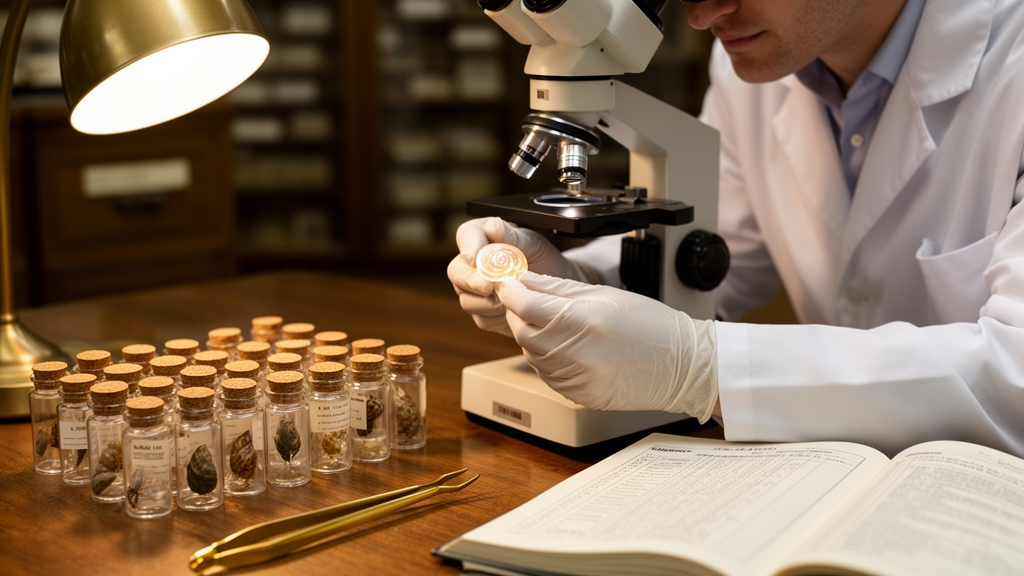
Two lots of microscopic cave snail shells described in 1856 and long believed lost to science have resurfaced in an unexpected place: a nineteenth-century natural history collection held at the University of Natural Resources and Life Sciences in Vienna, Austria (BOKU). The specimens are the syntypes of Carychium reticulatum and Carychium bidentatum, described by the Slovenian-Austrian naturalist Heinrich Hauffen, and their rediscovery during a routine inventory has now allowed researchers to settle a taxonomic puzzle that has confounded snail specialists for more than 160 years.
The shells belong to the genus Zospeum, a group of tiny, eyeless, troglobitic gastropods that live in the caves of the Dinaric Karst and neighboring regions. These snails, barely two millimeters tall, are among the smallest land snails in Europe and are entirely dependent on subterranean habitats. Because they are so small and their shells so variable, nineteenth-century taxonomists argued bitterly over how many species the group actually contained, relying on external features such as ribbing, reticulation, and the number and position of denticles inside the aperture.
Hauffen, who was born in 1836 and died tragically young in Mexico in 1866 at the age of 30, was a pioneering biospeleologist working in the historical region of Krain, parts of which lie in today’s Slovenia and Carinthia, Austria. He described both species in 1856 based on material he collected from Slovenian caves. His collaborator and close friend, the Cistercian monk and naturalist Dominik Bilimek (1813–1884), assembled an extensive natural science collection that eventually came to BOKU. How Hauffen’s shells became part of Bilimek’s holdings is not documented, but the two men worked together closely, including during a joint expedition to Mexico from 1865 to 1867 as members of the Austrian Volunteer Corps under Archduke Ferdinand Maximilian. It is assumed that Bilimek inherited Hauffen’s scientific collection after the younger man’s death from severe illness.
The rediscovered material comprises six syntype lots, each accompanied by original collection labels written in Hauffen’s own hand, featuring his characteristic numbering system and locality information. The research team, publishing in Subterranean Biology, examined the shells using light microscopy, scanning electron microscopy (SEM), and three-dimensional X-ray micro-computed tomography (Micro-CT), comparing them against Hauffen’s original illustrations and descriptions preserved in the Archive of the National Museum of Slovenia.
Micro-CT imaging proved particularly powerful. Three selected specimens were scanned intact using a Bruker SkyScan 1272 system at the University of Vienna, with a tungsten X-ray source set at 60 kV and a 0.25 mm aluminum beam filter, achieving reconstructed voxel sizes of 2.0 or 3.0 micrometers. Additional scans at the Natural History Museum Vienna using a YXLON FF35 CT system produced volume data sets with isotropic voxel sizes of 1.8 micrometers. These scans allowed the team to visualize the columellar apparatus — the internal coiling structure of the shell’s central pillar — which is invisible from the outside but carries critical taxonomic signatures such as the shape and form of the lamella and the configuration of the umbilical zone.
SEM imaging of shell microstructure revealed the fine details of the protoconch, the larval shell at the apex, which in Zospeum spelaeum is covered with pits that aggregate into rows on top and are distributed more randomly on the sides of the whorls. The reticulated sculpture that gave C. reticulatum its name — a network pattern formed by crossing vertical and horizontal ribs — was confirmed on the teleoconch, the main body of the adult shell, beginning at the fourth whorl.
The results are unambiguous. Hauffen’s Carychium reticulatum, from the type locality Bidou sturm (today Dobruška jama) and from Douga jama, corresponds morphologically to Zospeum spelaeum (Rossmaessler, 1839), confirming its status as a junior synonym. Meanwhile, Carychium bidentatum, from Glaven vrh and the Grotte hinter Laak, matches Zospeum costatum (Freyer, 1855), corroborating its placement as a junior synonym of that species. The columellar apparatus, aperture shape, whorl and spire formation, and umbilical configuration of the shells all match the character states recognized in the most recent integrative taxonomic treatment of the genus.
The resolution of this puzzle depended on diagnostic characters that Hauffen and his contemporary Georg von Frauenfeld could only debate in the abstract. In 1856, the two naturalists argued over whether the number and position of apertural denticles and the density of reticulate microstructure were unique, diagnostic characters. Today’s imaging tools have revealed that structures such as the internal coiling configuration of the columellar apparatus, lamella formation in relation to the columella, and the degree and size of the umbilical depression are far more reliable indicators of species identity than external shell sculpture alone.
The team also untangled a thicket of confusing geographical names. Cave and town names in the region have changed repeatedly through border reshuffling and language shifts, and Hauffen himself tended to interchange locality annotations. The type locality of Z. reticulatum, recorded as Bidou sturm in 1856, was later called Bidov šturm and is now officially Dobruška jama. The type locality of Z. bidentatum, Glaven vrh, has been identified through LiDAR imagery and historical manuscripts as a small flooded cave called Ručigaj, located in a canyon below the village Dobeno near Mengš, with sand-covered floors and a small stream running through it.
While the morphological evidence firmly places both Hauffen species within known taxa, the researchers caution that DNA sequence data from new material collected in these caves would ultimately sharpen our understanding of the Z. spelaeum clade. They do not rule out the possibility that Hauffen’s reticulated populations represent genetically separated evolutionary lineages within Z. spelaeum, with distinct DNA barcodes and nuclear DNA signatures. Cave systems in the region of Loka pri Mengšu are densely represented and often contiguous, sharing subterranean drainage systems through which the snails are washed during seasonal water flows, so the potential for population mixing is high. The team strongly encourages further speleological exploration and specimen collection at Dobruška jama and Hauffen’s other listed cave localities. Beyond the taxonomic resolution, the study underscores the enduring scientific value of preserving and maintaining historical natural science collections, where material considered lost for generations can reappear and reshape our understanding of biodiversity.
Subject of Research: Rediscovery of Hauffen's lost cave snail syntypes in the Bilimek collection at BOKU University, Vienna, with contemporary taxonomic assessment within the genus Zospeum using Micro-CT, SEM, and light microscopy.
Article Title: Lost & Found – Rediscovery of H. Hauffen’s Carychium material in the Dominik Bilimek Collection, BOKU University, including a contemporary assessment within the genus Zospeum ( Gastropoda , Ellobioidea , Carychiinae )
Article References: Lukeneder, P., Ottner, F., Harzhauser, M., Winkler, V., Metscher, B., Ruthensteiner, B., & Jochum, A. (2024). Lost & Found – Rediscovery of H. Hauffen’s Carychium material in the Dominik Bilimek Collection, BOKU University, including a contemporary assessment within the genus Zospeum (Gastropoda, Ellobioidea, Carychiinae). Subterranean Biology, 49, 97-116. https://doi.org/10.3897/subtbiol.49.130692
Image Credits: AI Generated
DOI: 10.3897/subtbiol.49.130692
Keywords: Lost, Found, Rediscovery, Hauffen, Carychium, material, Dominik, Bilimek, Collection, BOKU, University, including
Cite Scienmag News
Drew Townsend. (October 19, 2026). Lost for 160 years, tiny cave snail types rediscovered in Vienna collection. Scienmag. https://scienmag.com/lost-for-160-years-tiny-cave-snail-types-rediscovered-in-vienna-collection/
Drew Townsend. "Lost for 160 years, tiny cave snail types rediscovered in Vienna collection." Scienmag, 19 October 2026, https://scienmag.com/lost-for-160-years-tiny-cave-snail-types-rediscovered-in-vienna-collection/. Accessed 19 October 2026.
Drew Townsend. "Lost for 160 years, tiny cave snail types rediscovered in Vienna collection." Scienmag. October 19, 2026. https://scienmag.com/lost-for-160-years-tiny-cave-snail-types-rediscovered-in-vienna-collection/


