


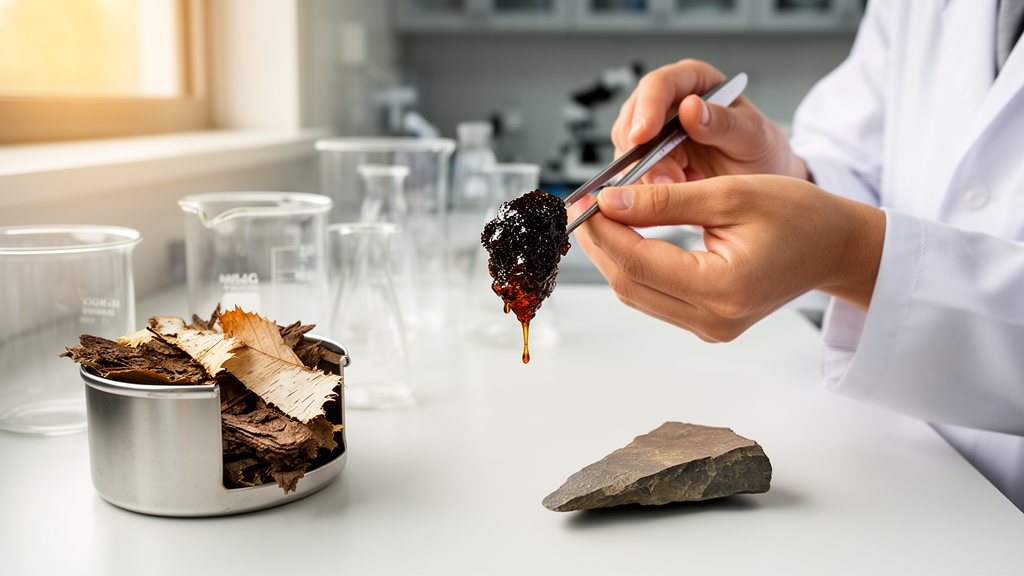
Birch tar holds a special place in the story of human technology. It is the oldest known synthetic material made by our relatives, a sticky black adhesive that Neanderthals in Europe were producing from birch bark as early as 200,000 years ago. The earliest evidence comes from Campitello in Italy, where tar residues still cling to two stone flakes, and further finds at Zandmotor in the Netherlands and Königsaue in Germany confirm that Middle Palaeolithic hominins routinely transformed bark into a workable glue, likely wrapped around the gripping ends of stone tools. Now a new experimental study suggests that the story of this remarkable substance may be broader than anyone assumed: birch tar can also be made from birch leaves, and the resulting adhesive carries a chemical fingerprint distinct enough to be recognized in the archaeological record.
The research, carried out by June Versluis and Patrick Schmidt at Eberhard Karls University of Tübingen and published in Archaeological and Anthropological Sciences, was inspired by an unexpected parallel from southern Africa. There, studies of Middle and Later Stone Age adhesive technology showed that hunter-gatherers produced so-called biomass tars by burning the leaves of a variety of plant genera using a condensation process. That discovery raised an obvious question for European prehistory: if leaves from African plants could yield tar, could the same be done with birch, the iconic raw material of Ice Age Europe? And if so, would leaf-derived birch tar be chemically confounded with the bark-derived tar that archaeologists have identified for decades, or could the two be told apart?
To find out, the team turned to the condensation method, one of the simplest ways of making birch tar and the technique documented in the African leaf-tar tradition. In this aboveground approach, plant material is burned beneath an overhanging cobble; tar from the flames condenses on the cobble’s surface and can be scraped off with a stone tool. Five participants in an experimental archaeology course each produced tar from both birch bark and birch leaves, following the same protocol so that the two raw materials could be compared directly. All material came from Betula pendula trees in the Schönbuch forest in Baden-Württemberg, Germany, harvested in summer. Because fresh leaves do not burn easily, they were air-dried for two weeks before the experiments, while bark, which burns readily even when wet, was collected on the morning of each run.
The experimental setup was carefully standardized. Leaves were bundled into 25-gram portions and wrapped with birch twigs so that the mass of burned material could be estimated, while bark was allowed to roll up naturally and weighed beforehand. Two river-rounded quartzite cobbles served as condensation centres, one dedicated to leaf experiments and one to bark, and each cobble was deliberately reused across runs so tar could accumulate on its surface. After each five-minute burning run, the cobble was scraped for tar and cooled in water to provide the same starting temperature for the next attempt. The protocol produced ten tar samples in total, five from bark and five from leaves, which were then subjected to two complementary analytical techniques: gas chromatography-mass spectrometry (GC-MS) to probe the soluble molecular fraction, and infrared spectroscopy to characterize the insoluble, highly polymerized portion.
The first answer came quickly: birch tar can indeed be made from birch leaves. But the yields told a more nuanced story. Per unit of raw material, bark was far more efficient, producing an average of 0.11 grams of tar per 100 grams of bark compared with just 0.04 grams per 100 grams of leaves, roughly 2.6 times more. Yet when production time was factored in, the picture shifted. Because the thin leaves burned fast and the fire was easy to keep alive, a given amount of leaf tar could be produced in less time than the same amount of bark tar; once scraping and cooling time were included, leaf tar yielded a hypothetical 0.13 grams per hour against 0.10 grams per hour for bark. In other words, bark gives more tar per gram, but leaves give more tar per minute, a trade-off that may have mattered to foragers weighing effort against return.
The chemical analyses revealed that the two tars, while recognizably related, are far from identical. Birch bark is chemically distinctive: roughly 45 percent of its outer layer consists of suberin, a cross-linked polymer, and another 40 percent consists of lipophilic extractives, chiefly the lupane-type triterpenoids betulin and lupeol. Birch leaves, by contrast, are built mostly from the heavy biopolymers lignin and cellulose, coated in waxes and fats. Those differences carried through into the tars. The bark-derived tar contained the classic suite of lupane triterpenoid biomarkers, including betulin, lupeol, and their degradation products such as betulone and lup-20(29)-en-3-one, compounds that form through oxidation and dehydration during tar production. The leaf-derived tar entirely lacked this triterpenoid fraction in identifiable form, though a few small peaks with fragmentation ions characteristic of lupane-skeleton molecules hint that such compounds may be present at very low concentrations.
What the leaf tar did contain was a rich signature of epicuticular leaf waxes. The chromatograms showed long-chain even-carbon alcohols, tentatively identified as docosanol, tetracosanol, and hexacosanol, alongside fatty acids and odd-carbon n-alkanes, a combination characteristic of the waxes that coat plant leaves. Both tars also contained levoglucosan, a marker of cellulose pyrolysis that confirms plant material was burned. In the infrared spectra, the differences were equally telling. Bark tar showed a split carbon-hydrogen bending region resembling that of bitumen asphaltenes, along with absorption bands tied to betulin, lupeol, and their degradation products. Leaf tar showed a diffuse, unsplit version of that region and a distinctive split band near 729 and 719 wavenumbers, a hallmark of crystalline n-alkanes in waxes. Leaf tar also carried calcite bands, interpreted as ash particles incorporated from the burning leaves, a contamination that apparently does not occur when denser bark rolls burn with smaller, oilier flames.
These findings matter because they hand archaeologists a new diagnostic toolkit. Until now, identifications of birch tar in the archaeological record have rested on the assumption that the raw material was bark, and the authors propose that the two tars can be distinguished by their overall molecular signature rather than any single biomarker: bark tar is dominated by triterpenoids in its soluble fraction and shows a split CH bending region in its insoluble phase, while leaf tar is dominated by n-alkanes, fatty acids and alcohols, and carbohydrates, with a diffuse unsplit bending region. Intriguingly, no archaeological birch tar made from leaves has ever been identified, but as the researchers note, that may simply be because no one has specifically looked for it. Future finds of birch tar artefacts can now be tested for these diagnostic differences.
The study also adds a cautionary note about analytical method. One infrared band at 1515 wavenumbers, previously assigned to betulin, appeared in the leaf tar spectra even though GC-MS detected no betulin there, a discrepancy the authors attribute either to a misassignment of the band or to betulin concentrations too low for chromatographic detection. Either way, it underscores that infrared spectroscopy alone is impractical for identifying specific organic molecules in complex mixtures like tar, and that molecular confirmation remains essential. The team also acknowledges limitations in the sensitivity of their chromatographic setup for the later-eluting triterpenoid region, which is why they frame the low-level presence of triterpenoids in leaf tar as a hypothesis rather than a confirmed result.
Beyond the laboratory, the implications ripple outward through human history. Birch tar vanished from the European record after the Middle Palaeolithic and only reappears clearly in the Mesolithic, becoming widespread from the Neolithic onward as a hafting adhesive, a sealant for ceramics, and later a material for metalworking and decoration. Yet remarkably little is known about how it was actually produced in most of these periods, since many proposed analytical criteria for identifying ceramic-based production techniques have been invalidated. By showing that the same condensation method documented in African leaf-tar traditions works with birch leaves, and by defining how leaf tar differs chemically from bark tar, the Tübingen team has expanded the range of raw materials early humans could plausibly have exploited and opened a genuinely new line of evidence. The first synthetic material ever made may have had more recipes than we ever imagined.
Subject of Research: Experimental production and chemical identification of birch tar made from birch leaves versus bark
Article Title: Birch leaves as raw material for tar – production, identification and implications
Article References: Versluis, J., & Schmidt, P. (2026). Birch leaves as raw material for tar – production, identification and implications. Archaeological and Anthropological Sciences, 18(11), Article 218. https://doi.org/10.1007/s12520-026-02571-w
Image Credits: AI Generated
DOI: 10.1007/s12520-026-02571-w
Keywords: birch tar, experimental archaeology, Neanderthals, ancient adhesives, biomass tar, gas chromatography-mass spectrometry, infrared spectroscopy, Middle Palaeolithic, condensation method, triterpenoids, epicuticular waxes, pyrotechnology
Cite Scienmag News
Courtney Benton. (October 19, 2026). Neanderthal Glue Reimagined: Scientists Make Stone Age Adhesive from Birch Leaves. Scienmag. https://scienmag.com/neanderthal-glue-reimagined-scientists-make-stone-age-adhesive-from-birch-leaves/
Courtney Benton. "Neanderthal Glue Reimagined: Scientists Make Stone Age Adhesive from Birch Leaves." Scienmag, 19 October 2026, https://scienmag.com/neanderthal-glue-reimagined-scientists-make-stone-age-adhesive-from-birch-leaves/. Accessed 19 October 2026.
Courtney Benton. "Neanderthal Glue Reimagined: Scientists Make Stone Age Adhesive from Birch Leaves." Scienmag. October 19, 2026. https://scienmag.com/neanderthal-glue-reimagined-scientists-make-stone-age-adhesive-from-birch-leaves/


