


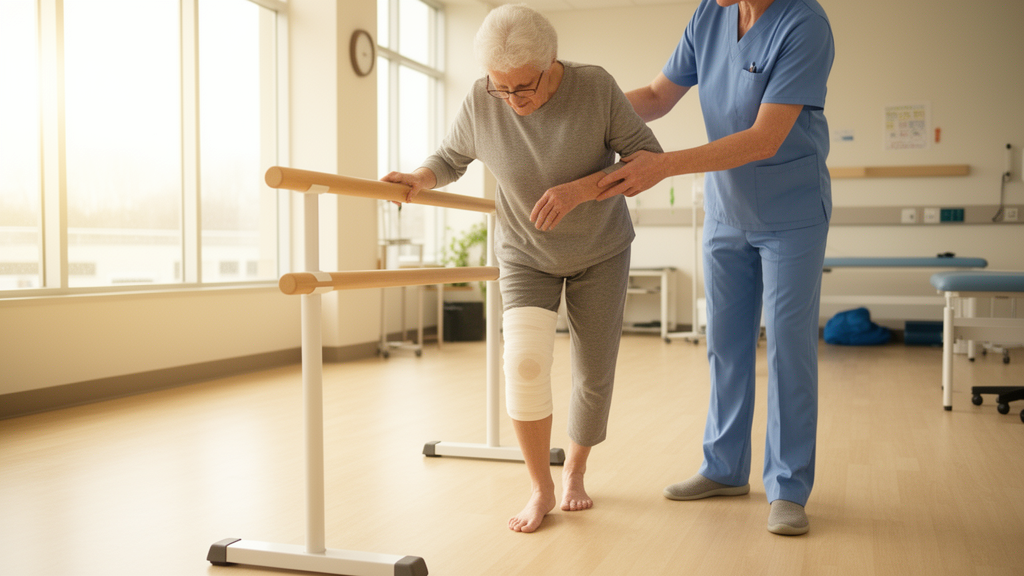
Fear of movement has quietly become one of the most stubborn obstacles to a successful knee replacement. Surgeons can replace the joint in a matter of hours, and modern rehabilitation can restore remarkable strength and mobility, yet a substantial number of patients remain hesitant to bend, bear weight, or trust the new knee long after the tissue has healed. This condition, known clinically as kinesiophobia, is now the focus of a comprehensive evidence-informed narrative review published in Frontiers in Rehabilitation Sciences, which brings together for the first time the scattered research on how fear of movement should be assessed, prevented, and treated across the entire journey of total knee arthroplasty.
The review’s central argument is that kinesiophobia is a potentially modifiable barrier, not a fixed personality trait or an inevitable consequence of surgery. That distinction matters enormously for patients and clinicians alike. If the fear that limits walking, stair climbing, and return to work can be identified early and addressed deliberately, the thinking goes, then a meaningful share of disappointing outcomes after knee replacement might be preventable. Until now, however, the evidence on fear of movement has been dispersed across rehabilitation journals, psychological literature, nursing research, and perioperative studies, and it has frequently been conflated with evidence about knee replacement rehabilitation in general. A trial that improves pain and function after surgery is not necessarily a trial that reduces fear of movement, and the review insists on keeping those two categories of evidence separate.
To build the synthesis, the authors searched PubMed/MEDLINE and the Physiotherapy Evidence Database, known as PEDro, from their inceptions through 15 September 2026. They supplemented these searches with the Cochrane Library, current rehabilitation guidance, and both backward and forward citation tracking, applying bibliographic verification to ensure that the evidence base they describe actually exists as cited. Critically, they did not simply pool findings. Each study was interpreted according to its design, how directly it measured kinesiophobia outcomes rather than general recovery measures, the consistency of its results, and the limitations the original authors reported. This layered approach produces a more honest picture than a simple vote-count of positive trials, because it forces a distinction between interventions that were designed to target fear and interventions that merely happened to measure it.
What does the assembled evidence actually show? Across available studies, kinesiophobia after total knee arthroplasty is consistently associated with higher pain levels, pain catastrophizing, lower self-efficacy, impaired physical performance, and poorer participation in daily and social life. Patients who fear movement tend to avoid using the operated knee, and that avoidance can compound stiffness, weakness, and deconditioning in a self-reinforcing loop. The review is careful, however, to flag a crucial caveat: most of these associations are cross-sectional or observational, and causal relationships remain uncertain. Fear may drive poor outcomes, poor outcomes may breed fear, or both may spring from shared underlying factors such as preoperative anxiety or uncontrolled postoperative pain. Untangling those directions of effect is one of the field’s outstanding scientific problems.
On the intervention side, the picture is cautiously encouraging but incomplete. Direct studies in knee replacement populations have reported reductions in kinesiophobia with multicomponent fear-focused functional exercise, with selected educational and cognitive-behavioral approaches, and with some technology-supported interventions such as digital programs that guide patients through graded activity. The mechanisms are plausible: education can reframe postoperative pain as a normal signal rather than a sign of damage, cognitive-behavioral techniques can interrupt catastrophic interpretations of sensation, and graded functional practice allows patients to accumulate corrective experiences that disconfirm their worst expectations. Yet the review notes that effects on pain and physical function have been inconsistent across trials, and that many studies are small or single-center, limiting confidence that findings generalize to the broad population of knee replacement recipients.
Perhaps the review’s most methodologically pointed conclusion concerns the broader rehabilitation toolkit. Multimodal analgesia, early supported mobilization, progressive strengthening, and telerehabilitation all remain important, evidence-supported components of knee replacement care. But the authors argue that their general effectiveness should not be interpreted as evidence of a specific antikinesiophobia effect unless fear outcomes were actually assessed in the underlying trials. A program that reduces pain and improves range of motion may or may not touch the psychological barrier of fear, and assuming that it does risks misdirecting clinical resources and overstating what standard rehabilitation can deliver for the fearful patient. The message to trialists is clear: if you want to claim an effect on kinesiophobia, you must measure kinesiophobia.
Assessment itself carries subtleties that the review addresses in detail. The Tampa Scale for Kinesiophobia is the field’s dominant instrument, and its various versions can support repeated, multidomain assessment of fear across the surgical pathway. But the authors warn that threshold scores and clinically important change values are not interchangeable across different versions of the scale, different languages, different populations, or different postoperative time points. A cutoff that flags high fear in one translated version or at one week after surgery may misclassify patients in another context. For clinicians, this means that a single number should never drive a treatment decision in isolation; for researchers, it underscores the need to establish context-specific meaningful change thresholds rather than importing values from unrelated studies.
From this synthesis the authors construct the review’s most practical contribution: a clinically oriented screening schedule paired with a stepped-care pathway. Screening is proposed at defined points across the perioperative period so that rising fear can be caught before it hardens into avoidance. The stepped-care model then organizes treatment intensity to match need. The first steps prioritize excluding medical or surgical barriers to recovery, such as unresolved mechanical problems or infection, before attributing limitation to fear. Next comes realistic education about what to expect after surgery, followed by supported movement and fear-focused functional practice in which patients gradually rehearse the specific activities they dread. For those who need more, the pathway adds self-efficacy enhancement strategies, and for a smaller subset, selective psychological or digital adjuncts deliver formal cognitive-behavioral treatment. The architecture mirrors stepped-care models used in mental health, conserving intensive resources for the patients who demonstrably need them.
The authors are explicit that these frameworks are offered for local adaptation and prospective validation, not as finished clinical guidelines. Their evidence-informed character means they are built from the best available but imperfect evidence, and the review calls directly for more rigorous multicenter studies to establish what constitutes clinically meaningful change in kinesiophobia, to determine which patients benefit from targeted interventions, and to define the optimal dose, durability, safety, and cost-effectiveness of those interventions. Until such trials mature, the pathway functions as a structured hypothesis: that systematically screening for fear of movement and escalating care in deliberate steps will convert a modifiable barrier into a manageable one.
The broader significance extends beyond orthopedics. Total knee arthroplasty is among the most common and consequential elective surgeries worldwide, and even modest improvements in the proportion of patients who fully engage with rehabilitation would translate into large absolute gains in mobility and quality of life. By insisting on fear-specific evidence, flagging the causal uncertainty in the literature, and offering a concrete clinical pathway, the review gives rehabilitation teams both a caution and a compass: fear of movement after knee replacement is real, measurable, and likely treatable, but proving that treatment works, and for whom, is the next chapter of the story.
Subject of Research: Kinesiophobia after total knee arthroplasty: assessment, prevention, and stepped-care management
Article Title: Prevention and management of kinesiophobia after total knee arthroplasty: an evidence-informed narrative review and proposed stepped-care pathway
Article References: Liu, L., Sun, H., & Ni, L. (2026). Prevention and management of kinesiophobia after total knee arthroplasty: an evidence-informed narrative review and proposed stepped-care pathway. Frontiers in Rehabilitation Sciences, 7, Article 1962328. https://doi.org/10.3389/fresc.2026.1962328
Image Credits: AI Generated
DOI: 10.3389/fresc.2026.1962328
Keywords: kinesiophobia, total knee arthroplasty, knee replacement, rehabilitation, fear of movement, pain catastrophizing, self-efficacy, Tampa Scale for Kinesiophobia, stepped-care pathway, telerehabilitation, cognitive-behavioral therapy, physical function
Cite Scienmag News
Ophelia Keating. (October 19, 2026). Fear of Movement After Knee Replacement: Review Maps a Stepped Path to Recovery. Scienmag. https://scienmag.com/fear-of-movement-after-knee-replacement-review-maps-a-stepped-path-to-recovery/
Ophelia Keating. "Fear of Movement After Knee Replacement: Review Maps a Stepped Path to Recovery." Scienmag, 19 October 2026, https://scienmag.com/fear-of-movement-after-knee-replacement-review-maps-a-stepped-path-to-recovery/. Accessed 19 October 2026.
Ophelia Keating. "Fear of Movement After Knee Replacement: Review Maps a Stepped Path to Recovery." Scienmag. October 19, 2026. https://scienmag.com/fear-of-movement-after-knee-replacement-review-maps-a-stepped-path-to-recovery/


