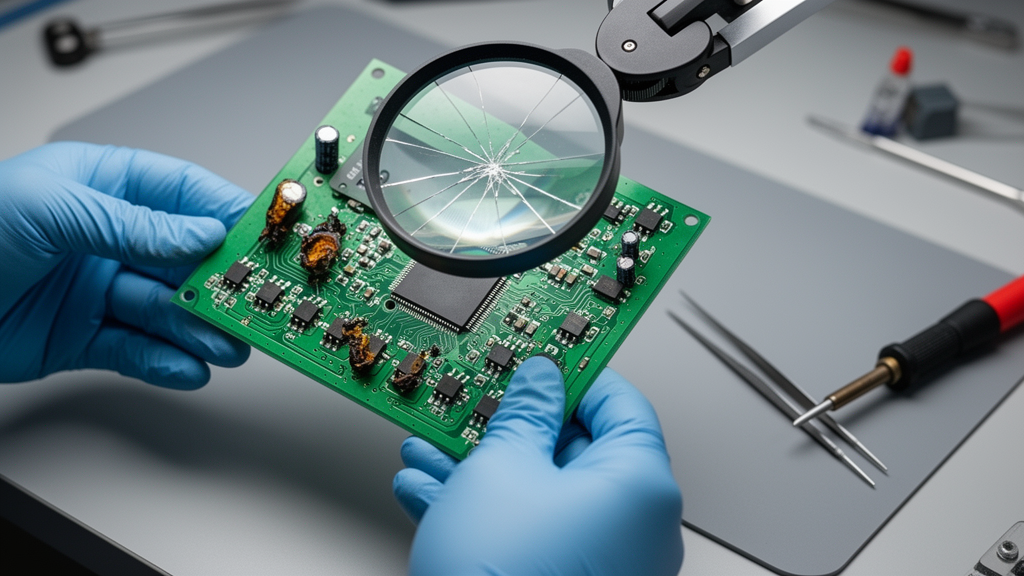
Analog filter circuits sit quietly inside nearly every electronic device that touches the real world. They smooth out signals in communication systems, condition sensor readings in medical equipment, and prepare analog waveforms for conversion into digital data. When one of these circuits fails, the consequences can range from degraded audio to a malfunctioning automotive control unit. Yet diagnosing exactly which component has gone wrong has long been a stubbornly manual, expert-driven process. A team of researchers in India now reports a machine learning framework that can automatically classify faults in two classic analog filters with an overall accuracy of roughly 98.5 percent, and it does so without ever touching a physical circuit board.
The study, published in Discover Artificial Intelligence by V. Govindaraj, C. Ezhilazhagan, K. Lakshmi Prabha, S. Karthikeyan, G. Rajkishore, and V. Sainithiesh, focuses on two workhorse filter topologies: the Sallen–Key filter and the Chebyshev filter. The Sallen–Key is a beloved active design built from resistors, capacitors, and an operational amplifier, prized for its stable frequency response in low-pass applications. The Chebyshev filter trades a small amount of passband ripple for a much sharper cutoff than a Butterworth design, making it the choice of engineers who need a rapid transition between passband and stopband. Both are notoriously sensitive to parameter variations, and that sensitivity is exactly what the researchers turned into a diagnostic advantage.
The core idea is elegantly simple in concept: a broken component changes the way a circuit responds, so the response itself becomes a fingerprint of the fault. The team simulated each filter under normal operating conditions and then under a battery of systematically injected faults. These included drift, where a component value wanders away from its nominal value due to aging or temperature; leakage, an unwanted current path caused by insulation degradation; open circuits; and a family of transistor-level defects inside the operational amplifier, including drain–source open (DSO), drain–source short (DSS), gate–source short (GSS), threshold voltage variation (Vth), and beta variation, a change in the transistor’s current gain.
Generating realistic faulty behavior required careful statistical modeling. Resistor drift faults were produced using a Gaussian distribution with roughly 30 percent deviation from the known value, while capacitor open faults were simulated by dropping the capacitance to 10 percent of nominal. Single-fault scenarios used component tolerances of plus or minus 30 percent, and multiple-fault scenarios used 25 percent, all generated with MATLAB’s randn() function to mimic manufacturing variation while keeping parameters physically plausible. Open faults were modeled with high-resistance paths and short faults with low-resistance paths, a standard technique that captures how these defects actually manifest in silicon and solder.
From every simulation, the researchers extracted three key features from the circuit’s frequency and time responses: the natural frequency (ωn), which describes how fast the filter’s dynamics oscillate; the damping ratio (ζ), which governs how quickly those oscillations settle; and the DC gain (G0), which measures how much the circuit amplifies a steady input. Each sample was labeled with its circuit type, fault status, faulty component, transistor identification where relevant, and fault type. The resulting dataset contained 5,334 samples, evenly split between 2,667 Sallen–Key and 2,667 Chebyshev cases, stored in CSV format and divided 80/20 into training and test sets using stratified sampling to preserve class balance.
The classification engine is a Random Forest, an ensemble method that builds many decision trees on bootstrap samples of the training data and averages their votes. The authors chose it deliberately. A single decision tree tends to overfit its training data; k-nearest neighbor is computationally heavy at prediction time and sensitive to the choice of k; support vector machines perform well but demand careful kernel tuning. Random Forest, by contrast, handles the nonlinear interactions between natural frequency, damping ratio, and gain that characterize analog circuit behavior, tolerates noise and parameter variation, works with high-dimensional data without demanding normalization, and resists overfitting through bagging. In head-to-head comparisons with decision tree, KNN, and SVM classifiers, it offered the best trade-off between accuracy, robustness, and computational efficiency.
The framework’s most distinctive design choice is its two-stage architecture. In the first stage, a Random Forest classifier examines the extracted features and determines which type of circuit it is looking at — Sallen–Key or Chebyshev. In the second stage, circuit-specific Random Forest models take over and classify the fault status, the faulty component, the specific transistor involved, and the fault mode. This hierarchy matters because the two filter types share overlapping response characteristics; separating them first reduces cross-class confusion before the harder fault-level decisions are made. An ablation study comparing the two-stage approach against a conventional single-stage classifier confirmed that the hierarchical method yields better results by trimming that feature overlap.
The numbers are striking. The Sallen–Key filter achieved 98.52 percent overall accuracy, and the Chebyshev filter came in at 98.48 percent, with high precision, recall, and F1-scores across all fault categories. Fault component classification exceeded 98.5 percent, and transistor-level fault identification — the capability that most competing methods lack — also performed strongly. Five-fold cross-validation, in which the data is rotated through five train-test splits, averaged 98.50 percent accuracy with little variation between folds, indicating that the results are not an artifact of one lucky split. The sample prediction outputs show the system correctly recovering the full fault label: circuit type, status, component, transistor ID, and fault type.
The motivation extends beyond academic benchmarking. Early fault detection in analog filters can substantially extend the reliability and lifespan of telecommunications, automotive, and medical systems, while lowering maintenance costs and preventing safety-critical breakdowns. Because the entire framework runs on simulation-generated data, it eliminates the need for board-level hardware testing, requires minimal input, and scales to new circuit types within a single unified pipeline — a sharp contrast with traditional manual testing that is time-consuming, expert-dependent, and poorly suited to the complexity of modern electronics.
The authors are candid about the limits of the work. The framework was validated only for Sallen–Key and Chebyshev filters in simulation, and hardware prototypes along with a broader range of analog and mixed-signal circuits remain future work. Even so, the study adds to a growing body of evidence — from KNN-based natural-response diagnosis to semi-supervised SVMs and deep forest classifiers — that machine learning can outperform conventional fault dictionaries and built-in self-test approaches. If the simulation-to-reality gap proves as manageable as the 98.5 percent figures suggest, the days of an engineer probing a circuit board with an oscilloscope to hunt a single failed capacitor may finally be numbered.
Subject of Research: Automated machine learning-based fault classification in analog filter circuits
Article Title: A random forest framework for automated fault classification in analog filter circuits using simulation-derived features
Article References: Govindaraj, V., Ezhilazhagan, C., Lakshmi Prabha, K., Karthikeyan, S., Rajkishore, G., & Sainithiesh, V. (2026). A random forest framework for automated fault classification in analog filter circuits using simulation-derived features. Discover Artificial Intelligence, 6(1), Article 1192. https://doi.org/10.1007/s44163-026-02259-z
Image Credits: AI Generated
DOI: 10.1007/s44163-026-02259-z
Keywords: analog circuits, fault classification, random forest, machine learning, Sallen–Key filter, Chebyshev filter, feature extraction, fault diagnosis, electronic circuits, MATLAB simulation, transistor faults, Discover Artificial Intelligence
Cite Scienmag News
Blake Davidson. (October 19, 2026). Machine Learning Spots Broken Circuit Parts With 98.5% Accuracy. Scienmag. https://scienmag.com/machine-learning-spots-broken-circuit-parts-with-98-5-accuracy/
Blake Davidson. "Machine Learning Spots Broken Circuit Parts With 98.5% Accuracy." Scienmag, 19 October 2026, https://scienmag.com/machine-learning-spots-broken-circuit-parts-with-98-5-accuracy/. Accessed 19 October 2026.
Blake Davidson. "Machine Learning Spots Broken Circuit Parts With 98.5% Accuracy." Scienmag. October 19, 2026. https://scienmag.com/machine-learning-spots-broken-circuit-parts-with-98-5-accuracy/