


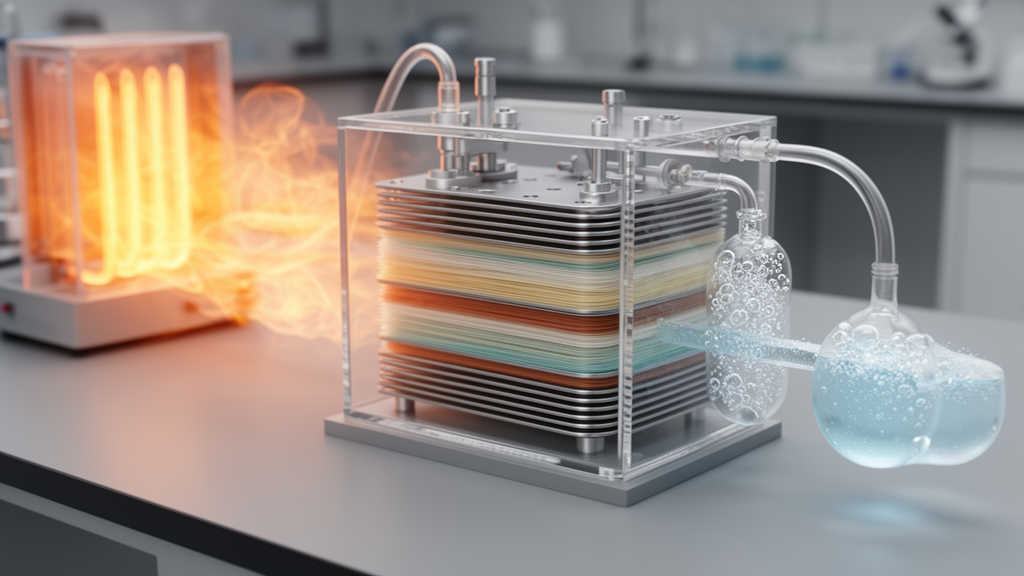
Turning carbon dioxide into useful chemicals with clean electricity has long been one of the most tantalizing promises of the energy transition. Now a team of researchers from ETH Zurich, the University of Toronto and Northwestern University argues that the missing ingredient may be something as mundane as heat. In a study published in Nature Chemical Engineering, the group shows that running CO2 electrolyzers at elevated temperatures rather than at ambient conditions allows their waste heat to be recycled into the rest of the chemical plant, cutting total energy demand by up to 10 percent, climate impacts by 9 percent and overall cost by 11 percent for a complete carbon dioxide to 1-butene process. The finding challenges a deeply embedded assumption in the field: that room-temperature operation is the natural default for electrochemical reactors.
The case study the team chose is deliberately ambitious. Direct air capture supplies carbon dioxide to an electrolyzer that converts it into ethylene, which then flows straight into a dimerization reactor that pairs ethylene molecules into 1-butene, a four-carbon building block widely used in polymer manufacturing and today produced by cracking fossil feedstocks. Targeting a C4 product directly is a clever sidestep of one of the field’s thorniest problems: separating dilute mixtures of carbon monoxide, hydrogen and ethylene from the electrolyzer outlet. By letting the dimerization step do the work and finishing with an industrially mature C1/C4 distillation, the process avoids the hardest separations and recovers byproducts such as hydrogen, carbon monoxide, ethanol, acetate, n-propanol and butane in a single combustion loop that regenerates electrolyzer feedstock.
The energy accounting that emerges from the fully integrated model is sobering. In a base case reflecting what laboratories can achieve today, roughly 50 percent ethylene Faradaic efficiency and a 2.5 volt cell voltage, only 22 percent of the electrical input ends up chemically stored in the 1-butene product. Half the energy dissipates as waste heat inside the electrolyzer, which at ambient temperature is not a resource but a liability, forcing large cooling duties in any industrial-scale installation. The team’s ideal case, 100 percent Faradaic efficiency and 1.4 volts, lifts that energy efficiency to 62 percent, though the authors are careful to note that such a benchmark may sit beyond practical reach for a demanding twelve-electron product. It serves instead as a theoretical ceiling that reveals how much headroom the technology has.
Here is where temperature enters the story. The process needs thermal energy above all for the direct air capture unit, which in the temperature-vacuum swing adsorption configuration requires both electricity and heat. When the electrolyzer runs at ambient temperature, its ohmic losses vanish into cooling water, and once ethylene Faradaic efficiency climbs above roughly 70 percent, the shrinking byproduct streams can no longer supply enough combustion heat, forcing the plant to buy external heat. But when the electrolyzer operates above about 90 degrees Celsius, its waste heat becomes hot enough to drive the capture system directly. At that point the external heating utility disappears entirely, and the electrolyzer stops being a heat sink and becomes a heat source for the rest of the plant.
The consequences ripple through the whole energy balance. Elevating the electrolyzer temperature cuts the total energy demand of the 1-butene process by up to 10 percent in the fully electrified heating scenario, an improvement equivalent to gaining 10 percentage points of Faradaic efficiency. The savings also translate into smaller heat exchangers, because larger temperature differences across the exchangers reduce the required heat transfer area and therefore capital cost. Generalizing the analysis across other electrochemical carbon dioxide products, including carbon monoxide, formic acid, acetate, ethanol and n-propanol, the team finds potential electricity savings of 5 to 27 percent, with the largest gains for small molecules whose carbon capture burden is proportionally heaviest. The logic holds for both direct air capture and point-source capture, and surplus heat can even be exported to neighboring processes, turning elevated-temperature electrolyzers into active thermal utilities within industrial parks.
Perhaps the most counterintuitive result concerns climate impacts. One would expect that pushing Faradaic efficiency higher always lowers the carbon footprint, and that is true when the plant’s heat comes from decarbonized electricity. But under today’s typical utility systems, where steam is still generated by burning natural gas on site, increasing ethylene Faradaic efficiency can actually increase climate impacts, because the more selective the electrolyzer, the fewer byproducts remain to burn, and the more fossil heat the plant must purchase. The study’s authors conclude that decarbonizing the heating system is just as important as decarbonizing the electricity supply, a message that most techno-economic analyses of electrochemical processes, which have traditionally assumed cheap thermal energy, have quietly missed.
The economics follow a similar pattern. The estimated minimum selling price for 1-butene ranges from about 5.60 dollars per kilogram in the base case down to 1.30 dollars in the ideal case with electrified heating, approaching the fossil reference range of roughly 1.09 to 1.87 dollars per kilogram. Even current state-of-the-art technology, the analysis suggests, could cut climate impacts by more than 30 percent relative to fossil production, with the ideal system reaching 75 percent. Raising the electrolyzer temperature shaves a further 11 percent off cost across all Faradaic efficiencies, thanks to combined operating and capital savings. The team also stress-tested the obvious objection: higher temperatures are known to accelerate membrane degradation. Their modeling shows the process could tolerate a fourfold increase in stack replacement frequency and still come out ahead environmentally, and a doubling while remaining economically beneficial.
Why, then, has the field been operating at room temperature all along? The authors point to experimental convenience: ambient-temperature setups are simpler and carry a lower entry barrier than temperature-controlled systems. Yet commercial proton exchange membrane water electrolysis routinely runs at 80 degrees Celsius, establishing that elevated-temperature operation is industrially feasible. Recent work has already demonstrated carbon dioxide electrolysis at elevated temperatures and confirmed waste heat recovery potential through device-scale simulations. What remains to be solved is a set of materials questions: how membranes degrade, how crossover behaves and how catalysts hold up when the cell runs hot. Bridging that gap, the authors argue, is the single most valuable experimental direction the field could pursue next.
The study closes with a four-point research agenda that reads like a to-do list for the entire carbon dioxide electroreduction community: run experiments at elevated temperature to understand how heat reshapes efficiency and selectivity; scale up electrolyzers to gather real cost and environmental data on large equipment; design integrated energy and synthesis systems that couple cooling, waste heat recovery and carbon capture, including their start-up dynamics and flexibility; and take separation seriously, especially the liquid byproduct streams that are routinely neglected in the literature but can quietly carry away substantial carbon and energy. If the community follows through, the humble thermostat setting may prove to be one of the cheapest levers available for making electrified chemistry competitive with the fossil incumbency it hopes to replace.
Subject of Research: Elevated-temperature CO2 electrolysis and process heat integration for sustainable chemical production
Article Title: Elevating CO2 electrolyzer temperature accelerates the viability of chemical electrification
Article References: Spiekermann, L., Lee, M. G., Wicks, J., Peng, B., Xie, K., Bosetti, L., Winter, B., Seiler, J., Sargent, E. H., & Bardow, A. (2026). Elevating CO2 electrolyzer temperature accelerates the viability of chemical electrification. Nature Chemical Engineering, 3(10), 597-610. https://doi.org/10.1038/s44286-026-00444-6
Image Credits: AI Generated
DOI: 10.1038/s44286-026-00444-6
Keywords: CO2 electrolysis, electrolyzer temperature, waste heat recovery, heat integration, 1-butene, ethylene dimerization, direct air capture, techno-economic analysis, life cycle assessment, chemical electrification, Faradaic efficiency, process systems engineering
Cite Scienmag News
Denise Maddox. (October 19, 2026). Warmer CO2 Electrolyzers Turn Waste Heat Into a Chemical Industry Win. Scienmag. https://scienmag.com/warmer-co2-electrolyzers-turn-waste-heat-into-a-chemical-industry-win/
Denise Maddox. "Warmer CO2 Electrolyzers Turn Waste Heat Into a Chemical Industry Win." Scienmag, 19 October 2026, https://scienmag.com/warmer-co2-electrolyzers-turn-waste-heat-into-a-chemical-industry-win/. Accessed 19 October 2026.
Denise Maddox. "Warmer CO2 Electrolyzers Turn Waste Heat Into a Chemical Industry Win." Scienmag. October 19, 2026. https://scienmag.com/warmer-co2-electrolyzers-turn-waste-heat-into-a-chemical-industry-win/


